
1.4 Methods of Training and Checking
The training organisation uses an operating method to deliver the philosophy of 1.2 Philosophies of Learning under the constraints of the 1.3 Five Principles of Flight Training. The method is the Systematic Approach to Training (SAT): a structured, iterative approach to designing, delivering, and evaluating training that treats every training programme as a problem to be solved and every solution as an artefact to be measured. Four sub-sections develop the SAT in detail: 1.4.1 sets out the SAT cycle; 1.4.2 anchors practical-systems training in the principle of "learning by doing"; 1.4.3 specifies the standard ("training to proficiency"); 1.4.4 prescribes the Training Needs Analysis procedure that produces the SAT cycle's inputs.
The task of training must be considered as a whole, with an instruction system defined to achieve training objectives. The primary interest is what people must "learn" to perform their role safely, efficiently, and effectively. All applicable regulatory requirements must also be satisfied.
The training organisation thus uses a Systematic Approach to Training whereby the tasks employees are required to perform are defined by knowledge objectives which are in turn determined through task analysis. The knowledge objectives define the outcomes that the training is designed to achieve.
1.4.1 Systematic Approach to Training
A systematic approach is a logical approach to problem-solving. It involves:
- Defining the problem to be solved in the clearest possible terms.
- Considering every available method by which the problem could be solved.
- Selecting and implementing the preferred method.
- Monitoring effectiveness of the method adopted and incorporating modifications as required.
The four steps express the SAT in its most generic form. Applied to flight training, the SAT addresses four basic questions:
- What should the student learn?
- How should the training be conducted?
- Where and when should the training be undertaken?
- How do we know when the student has learned?
In applying a Systematic Approach to Training, training is undertaken on a planned basis in a logical series of steps. The steps cover such aspects as the development of knowledge objectives and plans, formulation of an assessment scheme, implementation of planned training, validation, and evaluation.
The training cycle
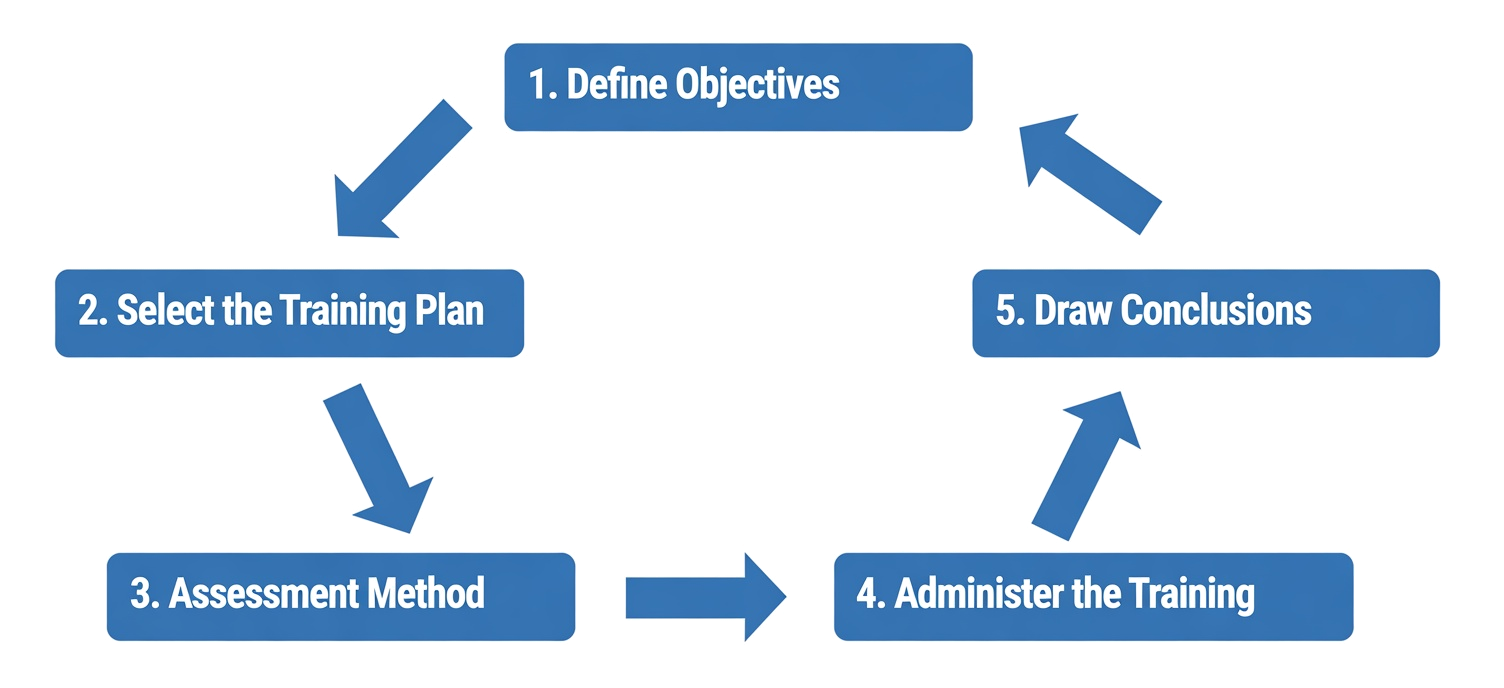
The five-step training cycle below is the operational form of the SAT. The arrows make the cyclical nature explicit: evaluation (Step 5) feeds back into the next round of objective-setting (Step 1), so each cycle through the loop incorporates the lessons of the previous one.
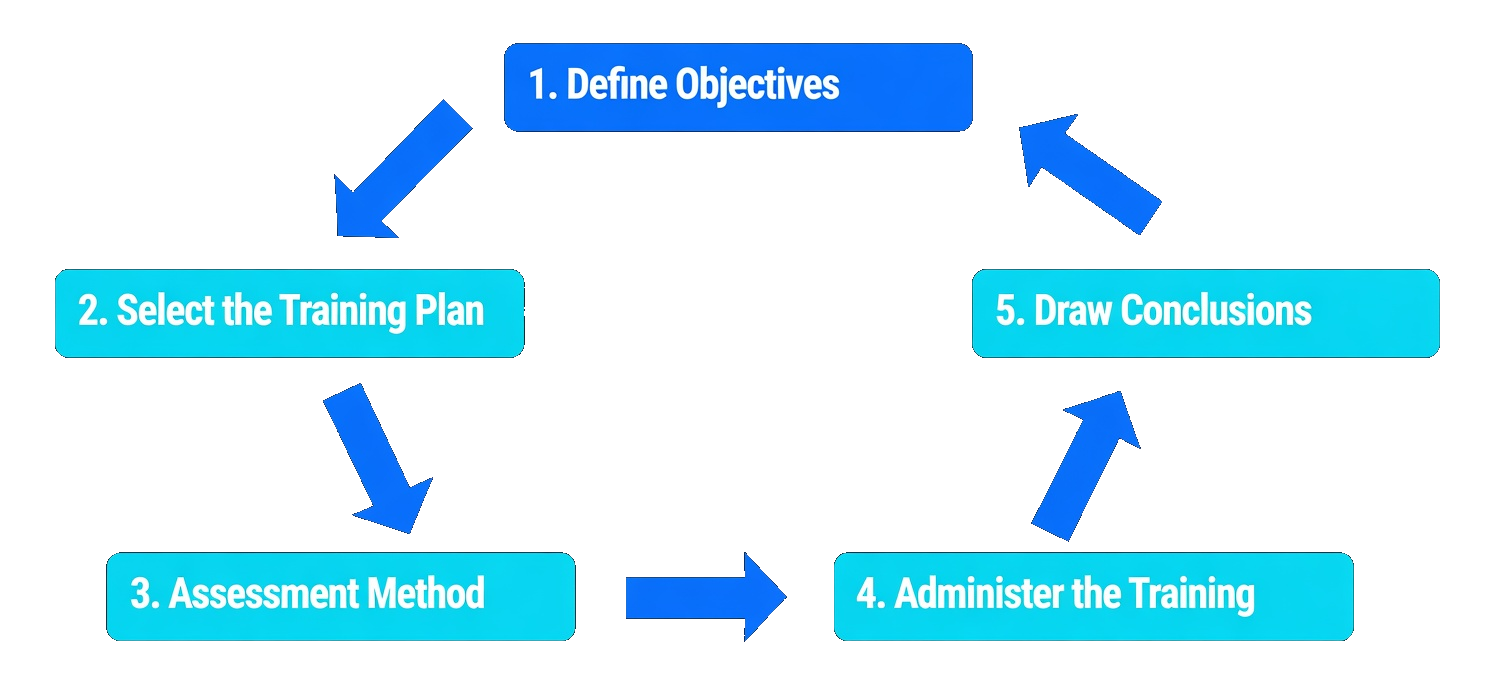
The same cyclical instructional-design pattern is more widely known in training literature as ADDIE: Analyse, Design, Develop, Implement, Evaluate. The five phases map closely onto the SAT five-step cycle the course manual prescribes (Analyse / Design ↔ Define Objectives + Select the Training Plan; Develop ↔ Assessment Method preparation; Implement ↔ Administer the Training; Evaluate ↔ Draw Conclusions), and the cyclicity is the same: Evaluate feeds back into the next Analyse round.


ADDIE instructional design model: Analysis, Design, Development, Implementation, Evaluation. The arrows show the iterative, cyclic flow that mirrors the SAT cycle reproduced above; the SAT and ADDIE express the same instructional-design discipline in slightly different vocabulary.
The five steps are:
- Define Objectives. What should the trainee be able to do at the end? Stated in 1.5 Knowledge Objectives terms (KNOW, BE FAMILIAR WITH, BE ABLE TO, BE PROFICIENT) so that completion can be assessed unambiguously.
- Select the Training Plan. Which methods, media, sequence of lessons, and training devices will most efficiently and effectively move trainees toward the objectives?
- Assessment Method. How will the organisation measure whether the objectives have been met? Defined before the training starts so that the training is designed against the assessment, not retrofitted to it.
- Administer the Training. Run the planned programme through the selected methods and devices.
- Draw Conclusions. Evaluate trainee outcomes and system effectiveness; feed conclusions back into the next round of objective-setting.
The performance-based reframe
Correctly applied, the SAT can also be thought of as a "performance-based approach to training", in that it sets out to achieve the following objectives:
- Precisely relate training and education to operator and regulatory requirements.
- Select training content to ensure that the critical elements are included, and that students learn in the time allocated for training.
- Select the most appropriate instructional methods and media.
- Set standards of performance that the trainees must meet.
The verbatim above is the course manual's italicised emphasis at the close of the SAT cycle. CRM principles are not added on top of the SAT; they are part of the criterion the SAT chooses methods and means against. A method that produces the right behavioural outcome but bypasses CRM principles (a single-pilot drill that displaces the multi-crew coordination the line operation actually requires, for example) does not satisfy the criterion.
1.4.2 Learning by Doing
Practical Systems Training is progressively introduced with the implementation of the Standard Operating Procedures (SOP). Crew concept and task-sharing are developed using a Synthetic Training Device (STD) or other training devices. The functionality of these devices reflects as closely as practicable the environment and configuration of the local fleet of aircraft.
The principle behind the section heading is older than the SAT: trainees acquire procedural and motor skills more reliably by doing them than by being told about them. The operational consequence is the device strategy: the training organisation uses synthetic training devices whose functionality reflects the line aircraft as closely as practicable, so that the doing the trainee does in training is the same doing the trainee will do on the line. The Learning by Doing statement is the seed of the more developed treatment in 9.1 Introduction and is the prerequisite for the A4.2.2 Guidance for Instructors treatment in A4.2.1 Guidance for Examiners.
The two-part construction (SOP-based progression plus device-based practice) is what makes the "doing" non-arbitrary: the trainee is not just doing things, the trainee is doing the approved procedures on a device that approximates the local fleet. Crew concept and task-sharing (the PF / PM discipline that governs every multi-crew flight deck) are developed in this device-based environment because the device is the only place outside the line where the discipline can be exercised in realistic context.
1.4.3 Training to Proficiency
At the end of the training programme, each crew member must be capable of carrying out their tasks safely and efficiently, in accordance with the training objectives. Therefore, a trainee cannot move up from one phase to the next until they have acquired the skills necessary to complete the specified objectives.
Following each training programme an assessment or examination is performed and recorded to confirm that each crew member has satisfied the requirements of the training objectives (i.e., they have achieved the required knowledge and skills to perform their role).
The Training to Proficiency rule "a trainee cannot move up from one phase to the next until they have acquired the skills necessary to complete the specified objectives" is the course manual's statement of the same gating principle the ICAO 9995 conduct of EBT standards-body source enforces: any area of competence assessed not to meet the required standard must be retrained until it does, and a pilot whose competency cannot be raised to the minimum standard is removed from line flying duty until additional training and assessment confirm it. The two sources agree on the principle; only the wording differs.
1.4.4 Training Needs Analysis
The suggested components of a Training Needs Analysis for the training department's purposes are:
- Select task to be analysed.
- Identify the training needs of all involved.
- Derive training objectives from the training needs.
- Evaluate the objectives.
- Sequence the objectives.
- Use content of the Learning Task Analysis for assessment, notes, and lesson plans, etc.
The six components are the procedure that produces the inputs to Steps 1, 2, and 3 of the [[#1.4.1 Systematic Approach to Training|SAT cycle]]. They are also what the SAT closing line ("the consequent refinement of the training given is achieved through the Training Needs Analysis Programme") points to: the TNA is not a one-time exercise at the start of a training programme, it is the continuous activity that closes the SAT cycle and re-opens it for the next iteration.
The link between TNA and the cycle is bidirectional: the TNA produces the training objectives the cycle starts from (Step 1), and the cycle's evaluation (Step 5) produces the data the next TNA consumes. An organisation that runs the TNA once and then runs SAT cycles against the original analysis indefinitely has broken the loop: the TNA stops reflecting the operation as the operation evolves (new aircraft generation, new route network, new safety findings, new regulatory requirements), and the SAT cycle's outputs gradually drift from the operation's actual training needs.
Drawn from EBT: the data argument
The TNA is, in EBT terms, the operationalisation of the "evidence-based" commitment in 1.2 Philosophies of Learning obligation 3. The A4.1.1 Evidence-Based Training makes the data argument explicit: the need for EBT and the design of its training concept were both established by "a comprehensive analysis of safety data sources and training results", which demonstrated important differences in training needs between different manoeuvres and different aircraft generations. EBT "addresses [the impossibility of foreseeing all potential threats and safety events] by moving from pure scenario-based training, to prioritising the development and assessment of core competencies."
The TNA the component list above describes is the local instance of that data-driven analysis: where EBT works from industry-wide safety and training data, the local TNA works from the approved programme's own task inventory, fleet, route network, and event history to identify lesson-level training needs the SAT cycle then engineers solutions for.
Connections
- 1.1 Introduction. Frames the training-philosophy arc this section sits in.
- 1.2 Philosophies of Learning. The obligations the SAT cycle is the method for delivering.
- 1.3 Five Principles of Flight Training. The constraints (especially Principle 3 practical needs and regulatory requirements, and Principle 5 efficient and effective) the SAT cycle satisfies.
- 1.5 Knowledge Objectives. The unit Step 1 (Define Objectives) of the SAT cycle terminates in.
- 1.6 Training References. The regulatory floor the "regulatory requirements" half of the SAT inputs has to clear.
- 2.1 Introduction. The cognitive mechanics that explain why Learning by Doing produces durable change.
- 9.1 Introduction. The full treatment of the device strategy Learning by Doing introduces.
- 11.1 Purpose of Evaluation. The full treatment of the assessment side of Step 3 and the evaluation side of Step 5.
- A4.1.1 Evidence-Based Training. Supplies the data argument this section integrates.
- ICAO 9995 Chapter 7 Conduct of EBT. The standards-body source that confirms the proficiency-based gating principle.
- Competency-based training and assessment. The methodology the SAT cycle delivers under.
- EBT. The recurrent-training instance that uses the SAT cycle continuously against operator and industry safety data.
- CRM. The principles the SAT-cycle closing italics name as essential to the SAT method.
- Synthetic Training Device. The device class Learning by Doing anchors on.