
A4.B.7 Johari Window
The model
The Johari window is a 2 × 2 grid that sorts what is known about a person along two axes: what the person knows about themselves, and what others know about them. The four quadrants the grid produces are the operational basis for the feedback discipline an EBT instructor uses on themselves.
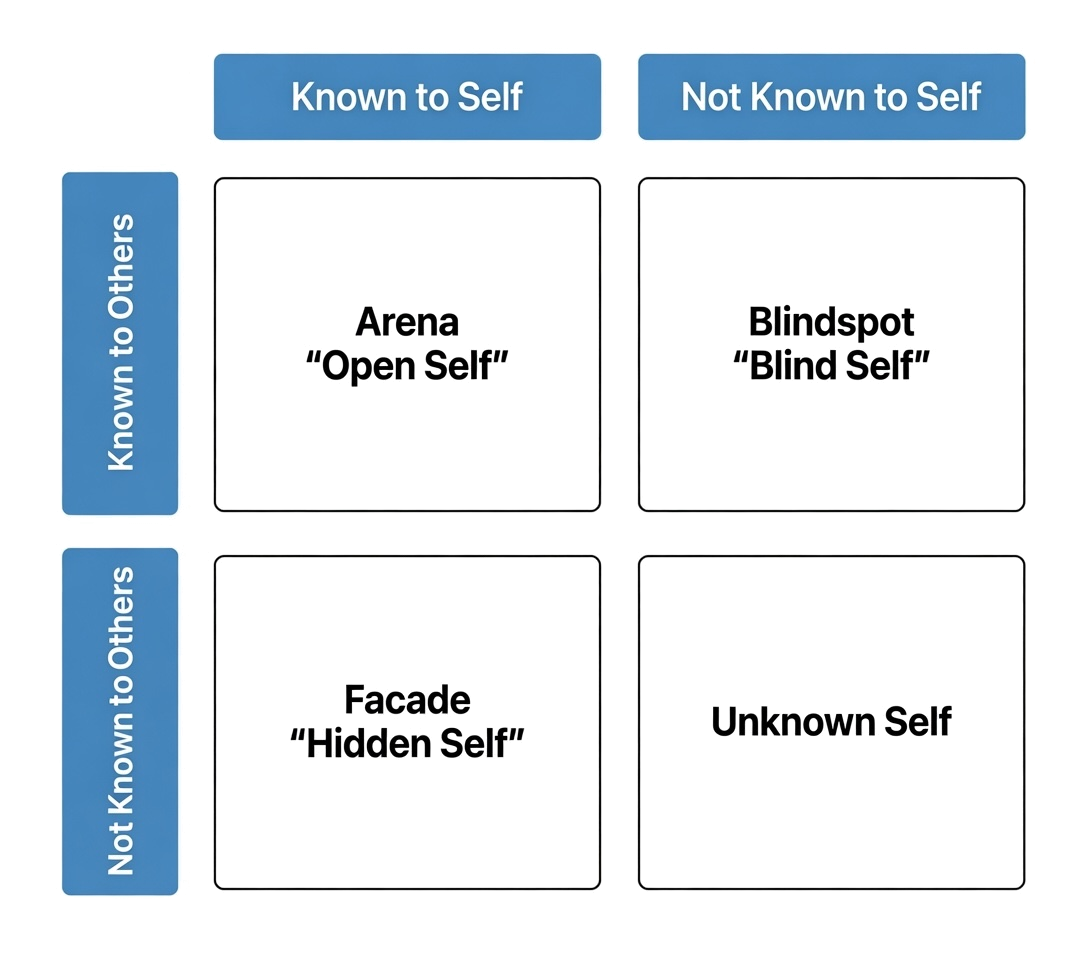
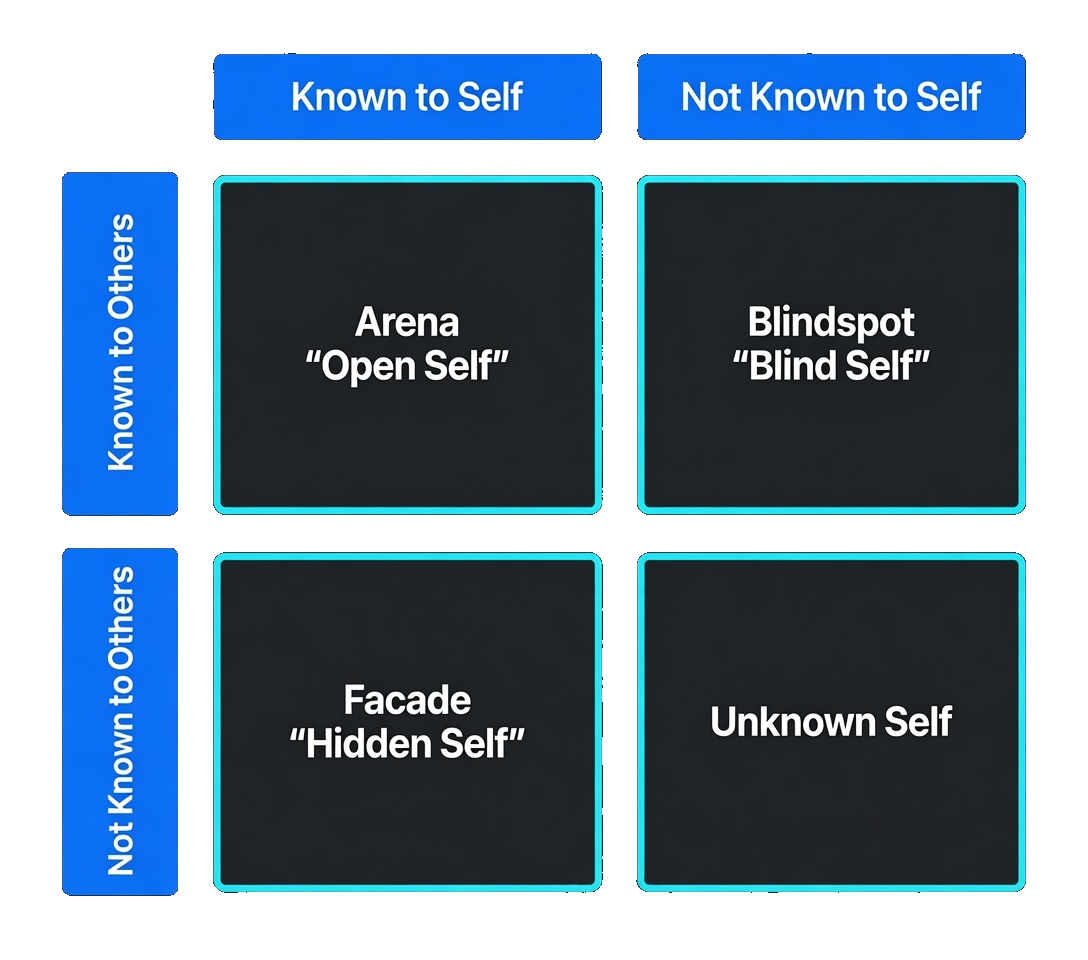
The Johari window: four quadrants formed by two axes (what I know vs do not know about myself; what others know vs do not know). Public area, blind spot, hidden area, and unknown.
Public area
What the instructor knows about themselves and that others also know. The shared baseline of self-knowledge.
Blind spot
What others know about the instructor that the instructor does not know about themselves. This is the diagnostic quadrant: it contains the data the instructor most needs and is least equipped to discover unaided.
This reference is operational about the blind spot:
- Blind spot.
- What they think about me.
- I want to minimize my blind spot.
- I want all the information about me.
- Ask for criticism.
Hidden area
What the instructor knows about themselves and chooses not to share with others. Self-disclosure shrinks this quadrant; assertive behaviour (see A4.B.4 Behaviour) is what makes appropriate self-disclosure operational.
Unknown
What neither the instructor nor others know about the instructor. This reference labels this with two operational tags:
- Unknown.
- Unfulfilled potential.
The Unknown quadrant is what changes when the instructor takes on a new challenge, develops a new skill, or operates in a new context. It is the growth space.
How an instructor uses the model on themselves
How the model maps to the instructor's relationship with the trainee
The same window applies to the trainee. The instructor's job in the debrief is to operate on all four quadrants:
- Public area: confirm what the crew already know about their performance, both positive and improvable.
- Blind spot: surface the things the instructor observed that the crew did not (the captain's tone in the third call; the first officer's hesitation on the checklist).
- Hidden area: create the conditions of trust under which the crew chooses to disclose what they were thinking when the indicator occurred.
- Unknown: through the facilitated discussion, surface insights neither the crew nor the instructor had at the start of the debrief.
Connections
- A4.B.6 Listening. The discipline that turns the blind-spot-data offer into actually-received data; LISTEN is what makes the gift reach the recipient.
- A4.B.8 Giving Criticism. The structured form of blind-spot-reduction that makes the gift receivable.
- A4.B.4 Behaviour. The assertive register that makes self-disclosure (Hidden Area shrinkage) operational.
- 7.3 General Debrief Techniques. The debrief framework whose facilitated-discussion stage operates on all four Johari quadrants.
- A1.4 Facilitation Techniques. The full active-listening and questioning toolkit that surfaces blind-spot content.
- Johari window. Synthesised concept that consolidates the Johari model across Appendix 4 and ICAO material.