
3.11 Additional Questioning Techniques
3.11.1 Teaching Question Design
In 3.7 Types of Question, it was established that teaching questions generate greatest interest and mental activity. Teaching questions can be used in the lesson introduction and lesson consolidation; however, they are used predominantly in the lesson development to establish key points. Whilst teaching questions are a powerful technique and pose the greatest challenge to students, they require careful design before the lesson for their incorporation into the lesson plan. With all lesson plans the starting point are the lesson objectives.
Once the lesson objectives are determined, the key points for each objective can be obtained. These key points may be names of components, principles, concepts, objects, procedures, etc. Once the key points are known, the instructor starts a process of separation. First, the key points that will be established by questioning are separated from those that will be told by the instructor. The latter are generally those which are either extremely easy or extremely difficult. Key points that are to be established by questioning are then divided into those that are already known by the students and those key points that require no reasoning. Recall or testing questions can now be written in accordance with the principles established earlier.
With each key point to be established by teaching questions, the instructor asks two simple questions of himself:
- What problem does this key point overcome?
- What would happen if we did not have the key point?
The design of teaching questions, once key points have been determined, is a reverse process of working from the key point to the problem and then to the establishing of the background information. It is up to the instructor to decide as to how basic the key point must be for the student to determine.
3.11.2 Socratic versus Facilitative Questioning
The conventional communication pattern of questioning is described as "Socratic" (Socratic questioning seeks to get the other person to answer their own questions by making them think and drawing out the answer from them), which implies that only the instructor is required to evaluate student responses.
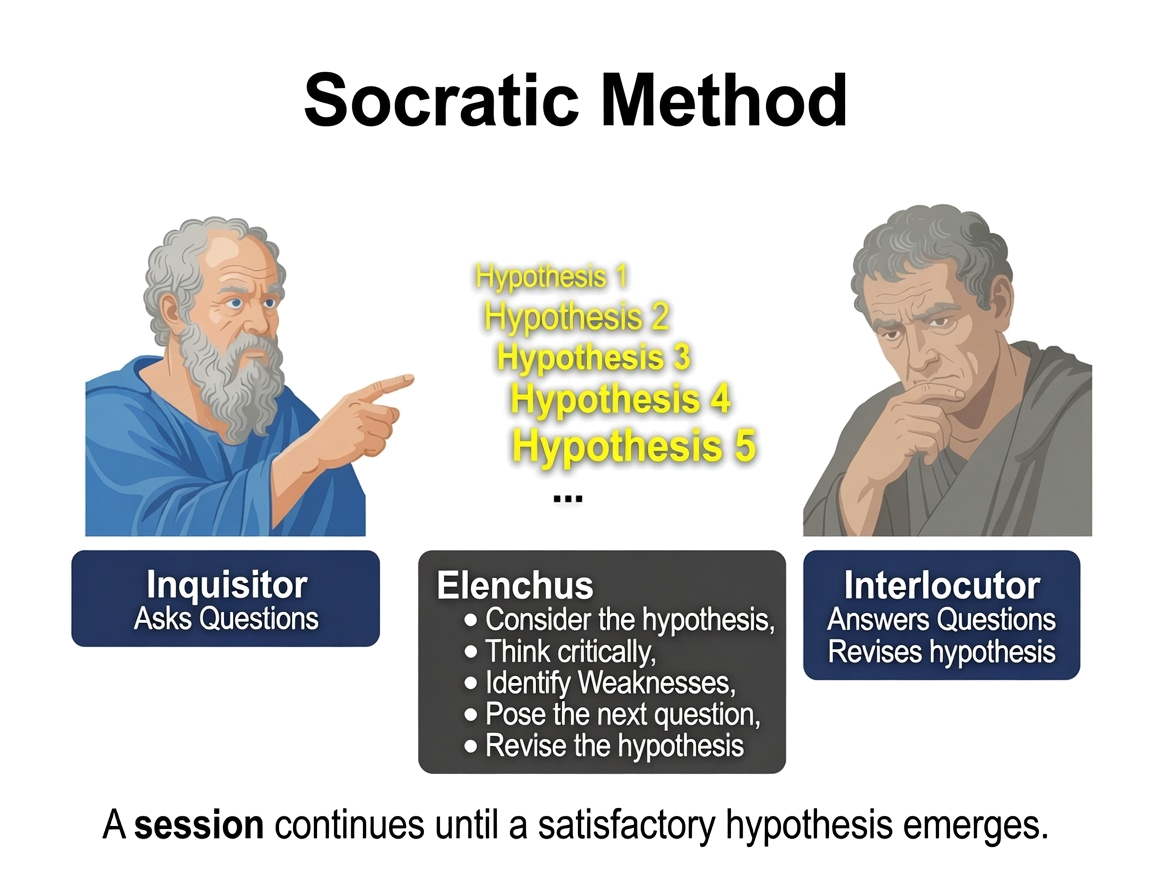
The Socratic method: a teacher poses questions whose answers the student already implicitly holds; the questioning sequence makes the implicit explicit. The instructor remains the evaluator of each response.
3.11.3 Facilitative - Student Clarification
If a "Facilitative" pattern is employed, ALL trainees know that they may be required to comment upon a response to a question. Communication is lateral as well as directed back to the instructor. Trainees have to be more analytical and are called upon to participate more often.
3.11.4 Interrogatives
Interrogatives are important to your questioning and they should feature early in the question. Interrogatives are best remembered as follows:
Place the interrogative at the start of the question (per 3.8 How to Use Questions on Delayed / Missing Interrogatives) and the student is alerted that a question is being asked from the first word. Place it later (or omit it) and the student is unaware until the interrogative arrives or until a name is nominated.
3.11.5 Checking Progress
In order to check that students are progressing, some instructors use questions such as:
- "Has anyone not got that?" or "Anyone not understand?" or "Is everybody OK on that?"
The progressive summary is the operational antidote: instead of "any questions?", ask specific questions on the key points just covered. If the answers come back accurate and prompt, the green light is justified. If they come back faltering, repeat the section.
3.11.6 Questioning Summary
Questioning is the most important technique of theory instruction for stimulating interest, mental activity and directing student thought. Questioning prevents the student from being a passive spectator in the classroom. To be effective, questions need to be designed prior to the lesson and then incorporated into the instructor's lesson plan. Good questions do not arise from spur of the moment thinking. During the lesson questions need to be asked according to the correct procedure, to maintain lesson pace, to ensure that all students are participating, and to ensure that all students understand what is required by the instructor.
Drawn from Appendix 4: facilitation versus instruction
Socratic and Facilitative patterns are introduced above as two question modes, but the broader instruction-versus-facilitation distinction the EBT Instructors and Examiners Handbook treats in A4.C Facilitation Guide is not developed here. Two principles from App C deserve foreshadowing:
- Instruction is the most efficient technique to use to transfer knowledge and many skills (it would be laborious and unnecessary to teach a straightforward and precise subject such as an electrical system using facilitation). Facilitation is the technique that fits well with how adults learn best: when they understand the reason for learning, are actively involved, can connect learning with existing mental models, and engage in reflection and self-analysis.
- One useful test of which technique an instructor is using: who is doing most of the talking. When facilitating, trainees need to be clear in their own minds and able to self-assess what they are doing and the benefits of changing; that is hard to do whilst trying to listen to an instructor passing multiple messages.
The Socratic-versus-Facilitative distinction (Socratic versus Facilitative Questioning above and Facilitative - Student Clarification) is the question-mode face of this larger instruction-versus-facilitation distinction. Both apply: choose the pattern that fits the content and the trainee.
Drawn from Appendix 2: questioning as an assessable instructor competency
The Pilot Instructor / Examiner Competency Framework Unit 4 Conduct Training codifies the questioning chain (from 3.5 Questioning through this section) as required, assessable instructor behaviour. Three behaviours map directly onto this section:
- Element 4B (Demonstrates effective presentation skills), behaviour (f): "Demonstrates effective questioning skills."
- Element 4C (Demonstrates effective instruction and facilitation), behaviour (c): "Asks appropriate questions to encourage learning or to confirm understanding."
- Element 4C, behaviour (e): "Promotes trainee participation by questioning, redirecting, balancing participation, etc."
Behaviour 4C(e) (redirecting and balancing participation) is the Facilitative pattern in competency-framework form. The framework treats it as required, not optional. An instructor who runs Socratic only, with no redirecting and no lateral balancing of participation, does not meet 4C(e); the assessor records the gap as a competency deficiency, not as a stylistic choice. The full reproduction is at A2.5 Unit 4 Conduct Training.
Connections
- 3.7 Types of Question. The Teaching question type whose design procedure is set out under Teaching Question Design above.
- 3.2 Establishing Set and Closure. The Closure section that the progressive summary operationalises in question form.
- 3.5 Questioning. The opening section of the chain that closes here.
- 3.8 How to Use Questions. The Delayed / Missing Interrogatives fault that the interrogative-first rule is the antidote to.
- 3.12 Student Attention. The wider attention-producing repertoire that includes the pauses the putting-the-question sequence depends on.
- 3.14 Which Method of Questioning to Use. The closing section that puts the techniques into selection logic.
- A1.2 Instruction vs Facilitation. The full upstream treatment of the instruction-versus-facilitation distinction.
- A2.5 Unit 4 Conduct Training. The competency framework that codifies the questioning chain as assessable instructor behaviour.
- A4.C Facilitation Guide. The EBT-handbook treatment of facilitation versus instruction in the recurrent training context.