
2.5 Needs
In any given situation the items in each of the lists in 2.4 Motivation (Maslow's hierarchy and Kenney's reward factors) would not be mutually exclusive; they would vary in relative importance as trainees seek to make the greatest gains while avoiding their dislikes. Basic needs are satisfied first; then secondary needs and rewards are pursued with various levels of effort as determined by each individual's appreciation of their relative importance.
The E-factor model
The individual decision is described by Handy, where E-Factors are: effort, energy, excitement, expenditure, and similar. The source represents the model as a simple convergence diagram (NEEDS, E-Factors, and Results all flowing into a single decision arrow): the figure is reproduced in 1.1 Introduction.
In its simplest form the model states:
- That each individual has a set of "needs" and of "desired results."
- That each individual decides how much "E" to invest by doing a "calculation" of the desired end result.
The bottom line of motivation calculus is results: the satisfaction of need and the attainment of reward. Each one of us has to identify our desired outcome or take part in the specification of it to feel there is an acceptable and attainable objective. It is not enough for it to be imposed on us; for when that happens we do not own the decision.
The calculus components
At the heart of the relationship between needs and results is the calculus of the E-Factor by which we calculate, either unconsciously or consciously (instinctive or calculating), how much E to expend on achieving results.
Each individual will see the relationship differently because there are separate elements to the calculus:
- The "strength" or "salience" of the need (salience is the most important of).
- The "expectancy" that E will lead to a particular result.
- The "instrumentality" of that result in reducing the need (instrumentality is the means to an end).
For the instructor, understanding the mechanism in its simplest form can lead to insight into the trainee's motives and might suggest training strategies that will be more effective. The instructor should establish clear and specific objectives for the trainee. Without objectives neither the trainee nor the instructor can measure progress or evaluate achievements.
This expectancy-instrumentality framing is a working version of Vroom's expectancy theory of motivation, which decomposes motivational force into the same three components (expectancy, instrumentality, valence). The model's contribution to flight-training instruction is that motivation gaps are diagnosable: the instructor who notices low engagement can isolate which of the three components is broken, rather than treating "motivation" as one undifferentiated thing.
Factors that may affect motivation
Unfortunately there is no single magical formula for motivating students. Factors that may affect motivation include:
- Interest in the subject matter.
- Perception of its usefulness.
- Desire to achieve.
- Self-confidence.
- Approval or challenge.
These five are the levers the instructor can pull within the session itself. Subject-matter interest is partly intrinsic to the trainee and partly a function of how the instructor frames the content. Perceived usefulness is built by the instructor making the link between the session and the trainee's operational reality. Desire to achieve is amplified by clear standards and visible progress. Self-confidence is built by a sequence of attainable challenges with feedback. Approval is delivered through honest positive feedback when warranted; challenge is delivered by stretching the trainee just past their current capability without crushing them.
Encouraging independent and self-motivation
To encourage independent and self-motivation, instructors can:
- Give frequent, early, positive feedback.
- Ensure opportunities for success with tasks that are neither too easy nor too difficult.
- Help students find personal value and meaning in the material.
- Create an open and positive atmosphere.
- Help students feel that they are valued members of a course or class.
- Encourage co-operation in groups rather than competition as individuals.
The teaching challenge is to shape personal motivations to serve the learning situation.
The "tasks neither too easy nor too difficult" criterion is the working version of what educational psychology calls the "zone of proximal development": the band of difficulty just above the trainee's current independent capability and within reach with instructor support. Tasks below this band produce boredom and disengagement; tasks above it produce overwhelm and disengagement; tasks within it produce engagement and growth. The instructor's calibration of session difficulty against the trainee's current capability is one of the central skills of flight-training instruction.
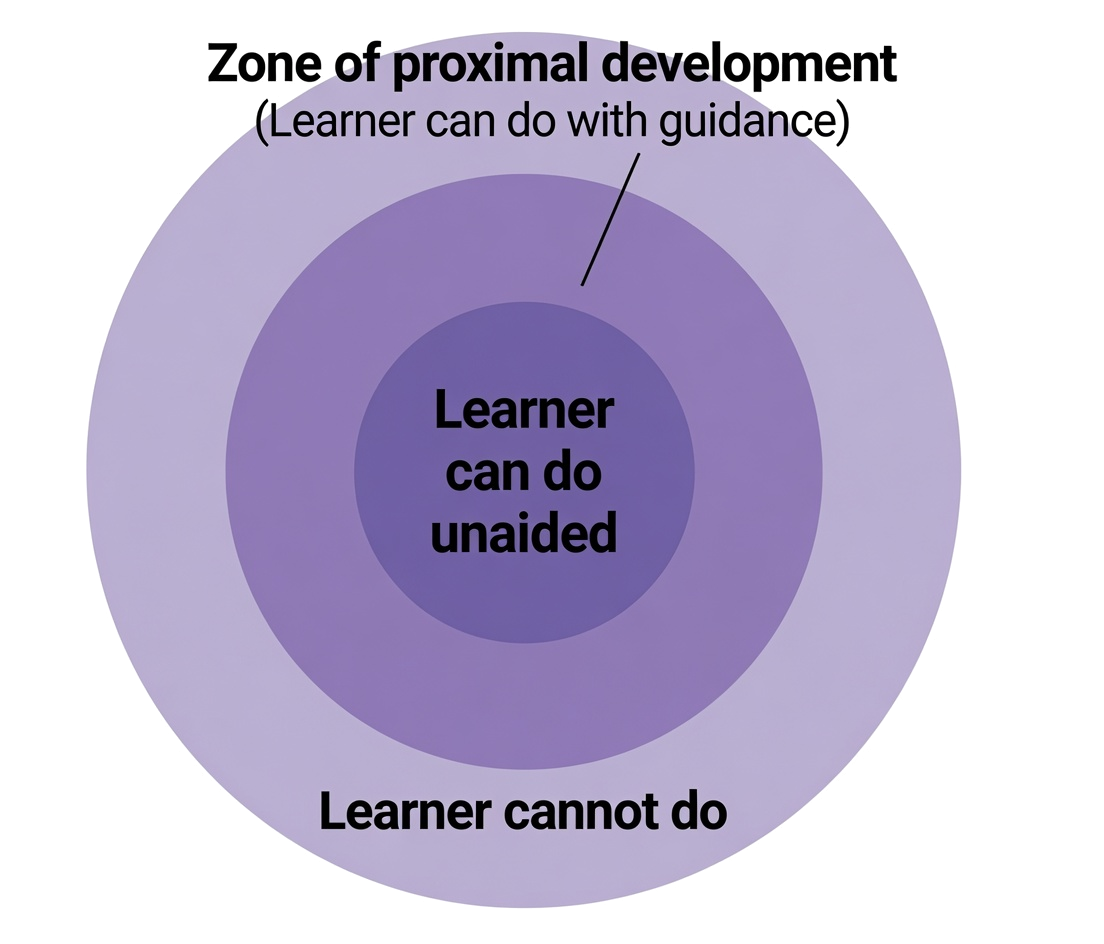
Vygotsky's zone of proximal development: the band of tasks the learner cannot yet do alone but can do with guidance. Inside the inner ring are tasks already mastered; outside the outer ring are tasks beyond reach even with help. The middle band is where instruction earns its place.
How Motivation and Needs fit together
2.4 Motivation supplied the force; Needs supplies the direction and the calculation by which the force is allocated. The combined picture is:
| Question | Where it is answered |
|---|---|
| What kind of force drives the trainee? | 2.4 Motivation (Maslow's hierarchy, Kenney's rewards) |
| Which direction does the force point? | Needs (the trainee's specific needs and desired results) |
| How much force does the trainee allocate to this session? | Needs (the E-factor calculus across salience, expectancy, instrumentality) |
| What can the instructor do to shape the calculation? | Needs (the factors-affecting-motivation list and the encouragement list) |
Together, 2.4 Motivation and Needs give the instructor the diagnostic vocabulary to read a trainee's engagement (or lack of it) and the practical levers to shape it. 2.6 Perception and Understanding moves from why the trainee engages to how the trainee perceives and processes the content once engaged.
Connections
- 2.4 Motivation. The previous section, which set up the motivation force this section directs.
- 2.6 Perception and Understanding. The next section, on how the trainee makes sense of what they are receiving once they engage.
- 2.2 The Learning Process. The ten incentives to learning listed there overlap heavily with the encouragement list here; together they define the conditions for engaged learning.
- 6.1 Introduction. The session preparation phase where the instructor sets the conditions that produce a high E-factor calculation by the trainee.