
2.2 The Learning Process
Learning may loosely be described as the process by which the database of long-term memory and motor programmes is laid down. The clear distinction between learning and training matters: learning is an internal process accomplished by the student, whereas training is the control of the process. The best instructor in the world cannot teach a student anything unless the student is a willing and active participant. Motivation is all-important in learning, and pilots tend to respond positively when they perceive that a training situation will improve their professional competence and understanding. Equally, they may reject training that they see as threatening. The perceived threat is often irrationally based, but no less real to the individual. A good instructor maintains the trainee's motivation by accentuating the positive and eliminating the negative.
Information is transferred to long-term memory through a number of memorisation strategies, of which the most obvious are repetition and rehearsal. Repeating a phone number to oneself retains it in working memory; as the number of repetitions increases, the information is transferred to long-term memory, and the probability of correct recall is proportional to the number of repetitions.
Of greatest importance is the way material is prepared and organised for storage in long-term memory. This might be compared with placing books in a library: the coding and organising of the books has a major influence on the ease of finding them again. Preparation for storage involves time, through such activities as summarising and emphasising significant and distinctive items.
2.2.1 Rates of learning
The learning process has been shown to take the form of a negatively accelerated curve of skill level against time. Learning proceeds rapidly at first when a new task is introduced, then more slowly as a degree of proficiency is obtained. Finally there is a plateau in learning while skills are consolidated. In practice, learning curves rarely follow the ideal pattern: there may be a series of intermediate plateaux as the elements of a complicated skill are consolidated.
For maximum effect, Seymour (1968) recommends breaking learning down into small incremental tasks, the aggregation of which builds up into a repertoire of skills. The example of skiing is often quoted: early practice on a ski slope prepares beginners for the cues that enable them to control their balance when they get to the piste. The same principle applies in flight training; complex manoeuvres are decomposed into elements that the trainee masters separately and then combines.
The concept of the learning curve is an additional aid by which both the instructor and the trainees can improve the measurement of what has been learned. It is important for trainers to realise that learning does not take place as a straight line on a graph with time on one axis and achievement on the other. Early success can quickly be followed by apparent failure: "I thought I was really beginning to understand this but it doesn't make any sense now." If the trainee encounters a series of plateaux, the trainer might be able to reschedule the training programme to help them overcome the barriers.
Workload and performance: the inverted-U
The relationship between workload and performance takes the form of an inverted "U" curve. At low workload levels, arousal is low and the "sampling rate" of the environment is also low. Thus at low workload levels (underload), errors may arise from a lack of attention.
As demands increase, performance standards also increase until an optimum level of workload and performance is achieved (the mid-point of the curve). Any increase in workload after this point leads to degradation in performance. At extremely high levels of workload (overload), important information may be missed due to the narrowing or focusing of attention onto one aspect of the task.
The inverted-U is the classical Yerkes-Dodson finding from experimental psychology and applies to any cognitively-demanding task: simple tasks tolerate higher arousal before performance degrades, while complex tasks (like flying an instrument approach in turbulence) peak earlier and degrade faster. The instructor's job during a session is to keep the trainee in the central band of the curve: enough demand to maintain attention, not so much that selective attention narrows and important cues are missed.
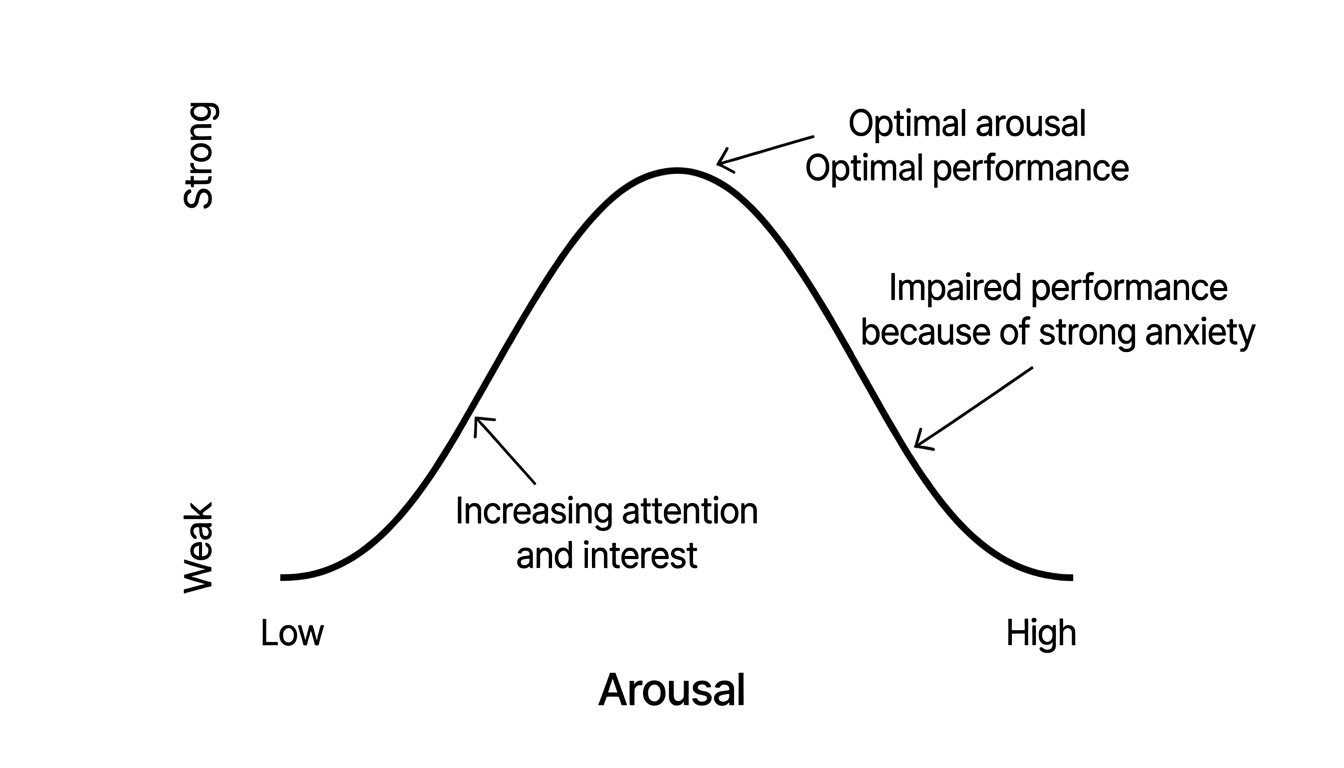
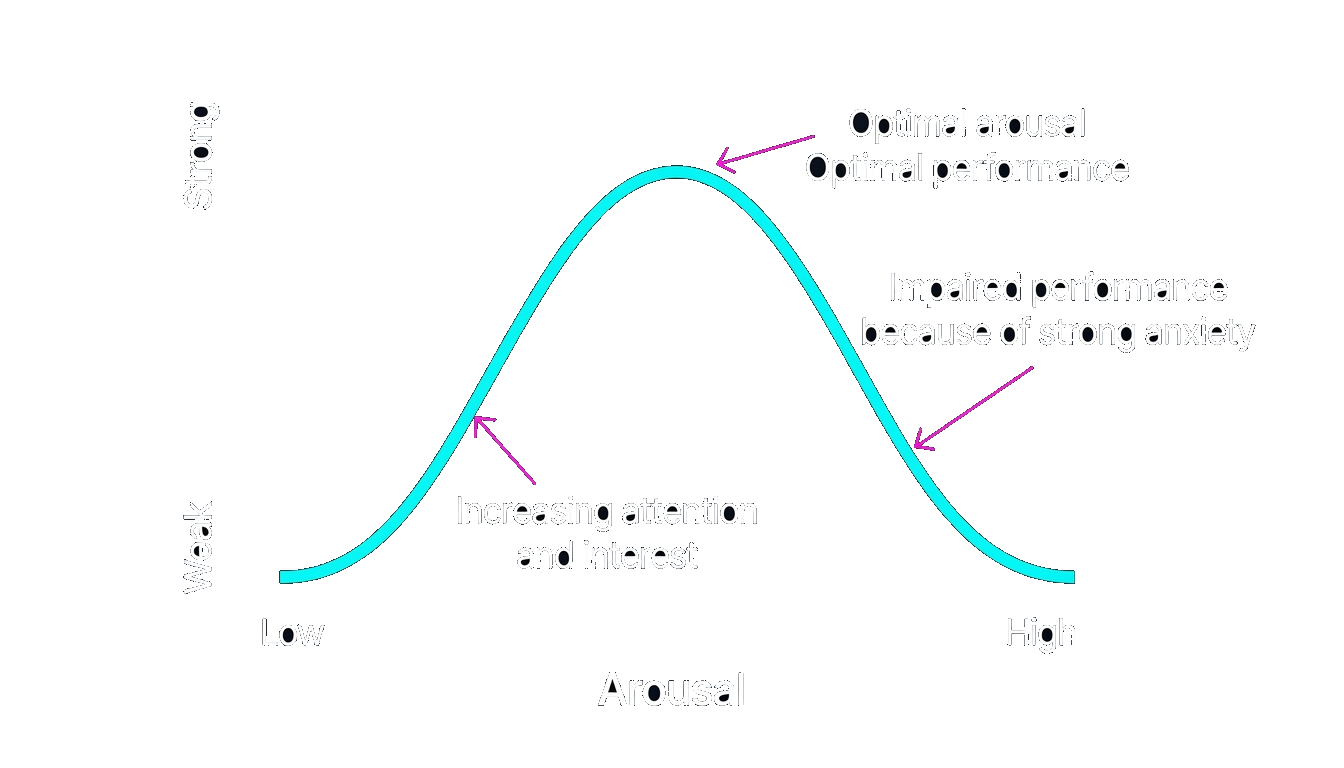
The Yerkes-Dodson inverted-U: performance rises with arousal up to an optimum (optimal arousal / optimal performance) and then degrades under strong anxiety. Rising arousal first increases attention and interest; past the peak, performance falls.
2.2.2 Habits and transfer
Habits may be defined as conscious or unconscious repetitive behaviour patterns.
Habits are frequently learned through repetition and stored in long-term memory. They are usually presented as a motor skill and can vary from an irritating or annoying habit such as repetitive scratching to a repetitive solution to similar posed problems.
In aviation it is possible for students to pick up a "bad habit" (which is simply another term for an incorrect skill or response) through assumption or misunderstood learning followed by repeated practice of the uncorrected behaviour.
Transfer of training
The effect of learning one task on the learning of another, and the extent to which past learning or experience can be applied to new situations, affects the transfer of training:
- Positive transfer is when past training facilitates learning of a new task.
- Negative transfer is when past training hinders learning of a new task.
- Neutral transfer applies when past training does neither, or because the new task is unrelated to previous experience.
Maximum positive transfer takes place when the new task is closely related to the past learning or experience. Negative transfer takes place when the new task has some similarity but is different to past learning: the stimuli may appear the same, but different responses are required to those assumed.
There are two theories applicable to the transfer of training:
- The Identical Elements Theory postulates that positive transfer occurs if task A and task B contain identical elements.
- The Transfer through Principles Theory postulates that basic principles once learned can be applied to a variety of problems, resulting in positive transfer.
The two theories sit at opposite ends of the transfer-of-training literature. The Identical Elements view (Thorndike) explains why a pilot trained on one type-rated aircraft can fly a similar aircraft of the same generation more easily than a structurally different aircraft: the elements (instrument layout, control feel, FMS logic) are identical. The Transfer through Principles view (Judd and others) explains why pilots can transfer training between very different aircraft when the underlying principles (energy management, configuration sequencing, threat-and-error scanning) are the same. In flight training both apply: type-specific training depends on identical-element transfer, while the cross-fleet competencies and the broader TEM discipline depend on principle-based transfer.
2.2.3 Obstacles to learning
Four obstacles recur across the source's treatment: attitudes, ego, environment, and physiology.
Attitudes
It is vital that trainers set the right atmosphere for a learning event to take place. Students may view their instructors with awe, deference, or even trepidation; if the trainer sends the wrong signals the resulting distraction will disrupt the learning process. A trainer's posture is important as the resulting body language can be interpreted by the student as "uninterested" or "threatening." For example, leaning forward over a desk and maintaining fixed eye contact (particularly through spectacles) can appear intimidating, while continually turning away and avoiding eye contact may signal a lack of interest or even dislike. Consequently, trainers must show interest in the student and be approachable.
Ego
A good trainer will subjugate his/her own ego to the needs of the student. It is necessary to focus on the task or issue rather than the trainer's own perceptions or needs such as status, recognition, etc.
Students may have problems with their own ego state and be over- or under-confident, either of which is an obstacle to learning. The instructor has to make allowances and encourage as necessary. The setting of achievable goals can help with the under-confident; adult communication can help with the over-confident.
Environment
The environment must be conducive to learning. Uncomfortable room temperature, bad light, background noise, poor room layout, inadequate training tools, insufficient breaks between periods, and constant distractions will all affect the learning process adversely. Few of these are within the simulator instructor's control inside the FSTD building, but the briefing-room environment usually is, and the instructor should treat the briefing room as part of the training environment, not as a passive container for it.
Physiology
Age may affect the efficiency of short-term or working memory, making it a longer learning process for some older students. This does not mean that older people cannot achieve the same level of learning as those younger; as a trainer, the necessary allowances can be made by structuring content delivery in more manageable blocks and giving the students adequate time to fully assimilate them.
People with some limitation of high or low tone hearing may not pick up all audio signals, and where this problem is detected they should be encouraged to ask for repeats of anything not fully understood.
2.2.4 Incentives to learning
Learning will be assisted when:
- The trainee has a reason to learn new behaviour.
- The new behaviour makes sense.
- The new behaviour does not conflict with previous behaviour or views unless these have been "unlearned".
- The new behaviour can be used in many different circumstances.
- The new behaviour is "rewarded" in some way.
- The learner is actively involved in the learning.
- The training provides opportunities for practice of new behaviour.
- The behaviour to be learned is dealt with in manageable chunks.
- Help is available (coaching, guidance) to enable the learner/trainee to develop the new behaviour.
- The training recognises differences in speed, depth, and quality of learning.
These ten incentives are the operational checklist for any session design. A session that does not provide a reason, does not make sense, conflicts with prior learning, has no transfer, no reward, no active involvement, no practice, no chunking, no help, and no individualisation will fail. A session that provides nine of them and not the tenth will succeed unevenly: the missing condition predicts the failure mode.
A4.B.5 Learning Theory condenses similar material into three checklists. They are reproduced below because they extend the source's ten-point incentive list with operator-tested observations on what specifically helps and hinders adult learning in a flight-training context.
The "what helps" list maps closely to the source's ten incentives; the "what does not help" list is the same content read in the negative. Together the two lists form a practical pre-flight checklist that the instructor can run mentally before any session: are the helping conditions present, and are the hindering conditions absent?
2.2.5 Four ways of learning
Many factors have to be taken into account when planning a learning event (a training session, a unit of instruction, any piece of training aimed at developing learners' knowledge, skills, and attitudes). The trainer should consider questions such as:
- Is the objective to develop knowledge or skill?
- Is the objective to develop attitudes?
- What is the entry behaviour of learners (what do they already know)?
- What are they capable of doing?
- Are they willing to learn?
- Is the entry behaviour likely to vary within the learning group?
- What is the learning style of the learners?
- Are they accustomed to being told?
- Do they prefer to work things out for themselves?
- What feedback to the learners (knowledge of results) will be possible with the learning event?
- Will this be appropriate to the objective?
Underlying these questions are the ways in which people learn. The learning-process material identifies four:
- Trial and error: by trying for oneself.
- Being told: by receiving instruction, either orally or in writing.
- Imitation: by copying the actions of another person, usually an instructor or a skilled person.
- Thinking: by organising one's thoughts about a topic or problem to arrive at an explanation or solution.
Each is treated below.
1. Trial and error
This is probably the simplest and most primitive form of learning. Learners try to do something and learning takes place when they review the success or failure of their attempt. Trial-and-error learning is essentially a practical activity and is therefore particularly suitable for learning skills.
Learners often like to learn from trial and error ("having a go"). This is especially true when the learner feels confident and able to make the correct response to what will usually be practical, work-related stimuli. Generally, the reason younger people like to try for themselves is that learning activities are often introducing something new, challenging, and of practical work-related significance. Older people like to learn by trial and error because they are able to build upon their existing repertoire of skills and use their experience as the basis for learning.
One of the most important features of a learning event is knowledge of results. When learners try to do something, their attempt has to be reinforced, either by praising them and confirming that the attempt was correct (positive reinforcement) or in some way admonishing them for making an incorrect attempt (negative reinforcement). This means that:
a. Trial-and-error learning situations should be so designed that learners have a good chance of making successful attempts, leading to positive reinforcement. b. Learning events leading to probable failure should usually be avoided. Errors lead to a lowering of confidence and a reluctance to attempt further trial-and-error learning activities. c. An exception to (b) above is when a failure attempt is used as the basis for further learning, allowing learners to reflect upon what went wrong (see "Thinking"). d. Learners should feel a sense of security: confident that should their attempt result in failure, nothing other than friendly advice will result.
Opportunities for practising trial-and-error learning should be created around structured practical, realistic, learning events. When properly planned, learning by trial and error can make valuable contribution to training activities and is particularly useful for practical, on-job training.
The reinforcement framing here is the operant-conditioning lineage from Skinner: positive reinforcement (adding something pleasant) and negative reinforcement (removing something unpleasant) increase the probability of a behaviour recurring; punishment (adding something unpleasant) and extinction (removing reinforcement) decrease it. The flight-training instructor uses the full set, but the source is right that the safest design has the trainee succeed most of the time, with structured failure used only where the failure itself is the lesson (a stalled approach, a deliberate FMS gotcha) and the safety margin is kept by the instructor.
2. Being told
The basis of this way of learning is that learners receive some information from the trainer. The instruction can be in words, symbols, or figures. The entire content of what has to be learned is presented to the learners in a final form. The task of learning does not require the learners to make any independent discovery.
When learners are told something they are being presented with a fleeting moment in which to understand and remember the information. How fleeting the moment, and how much they learn, depend upon:
- The amount of information to be remembered. Learners can only be told and expected to remember a simple amount.
- The complexity of the information. It is usually better to present complex information visually as well as orally.
Being told something is not always an easy activity for either the learner or the trainer. First, there is the willingness of the learner to listen and learn. Younger people find this easier to do than do adults, who may resent this somewhat dictatorial approach to learning. The relationship between the trainer and the learner is another factor: "being told" implies that the learner does not know and the trainer does.
Being told is a useful way to impart a clear-cut body of knowledge with a minimum amount of ambiguity.
The "being told" mode is the showing-and-telling end of the facilitation-versus-instruction continuum that runs through post instructional debrief and the cluster's facilitation appendix. Being told is the most efficient way to transfer a clear-cut body of knowledge in minimum time, but it is also the most fragile: the trainee who has only been told retains the information less durably than the trainee who has discovered it. The instructor's choice between modes is a trade-off between time efficiency (being told wins) and durability (discovery wins).
3. Imitation
Learning by imitation means learners observing somebody performing a task and imitating the performance.
Essentially, learning by imitation is based upon what learners see being done, not on what they are told should be done.
A "model" which learners can imitate should have positive influence on their behaviour because it should be a demonstration of the correct way to do something.
Imitation is the social-learning leg of the four ways. The trainee who watches the instructor execute a complex manoeuvre and then attempts the same is using observational learning to compress the time it would take to discover the technique by trial and error. The technique of "demonstrate, then trainee follows through with hand on top of instructor's, then trainee flies with instructor monitoring" is structured imitation followed by structured trial and error.
4. Thinking
Learning can occur when learners are encouraged to think about an experience and reflect on it in learning terms. Using questions such as "why do you think that happened?", "what would you do if you were to repeat it?", the trainer is able to create a learning event within which complex situations can be thought about and discussed. Learning can take place when the learners have to evaluate the options, draw conclusions, consider consequences, and generally "think through" the situation.
In practical, work-related situations, particularly ones facing managers, technicians, and supervisors, there is rarely a simple solution. The learning event created for such situations must reflect and take account of the complexity of the situation.
Thinking is a valuable and rewarding learning experience. It provides an excellent basis for learning about complex situations. The role of the trainer is one of establishing the conditions for learning to take place and then acting as the coach and counsellor.
The thinking mode is the discovery / facilitation end of the continuum and is the dominant mode in the C-A-L debrief. The instructor sets the conditions (the question, the scenario, the silence after the question) and the trainee does the thinking. The durability of the resulting learning is high because the trainee has done the cognitive work themselves. The cost is that the technique is slower than telling and demands more from the instructor (see 7.2 Role of an Instructor on facilitation as the higher-workload mode).
Figure: Kolb's experiential learning cycle
The four ways of learning above sit alongside Kolb's experiential learning cycle, which models learning as a four-stage loop: concrete experience, reflective observation, abstract conceptualisation, and active experimentation. The Honey-Mumford learning-style taxonomy (10.3 Learning Styles) is built on this cycle, and the EBT debrief moves through the same four stages: the trainee experiences a scenario, reflects on what happened, abstracts the principle (often through facilitated questioning), and then experiments with the new principle in the next run or on the line.
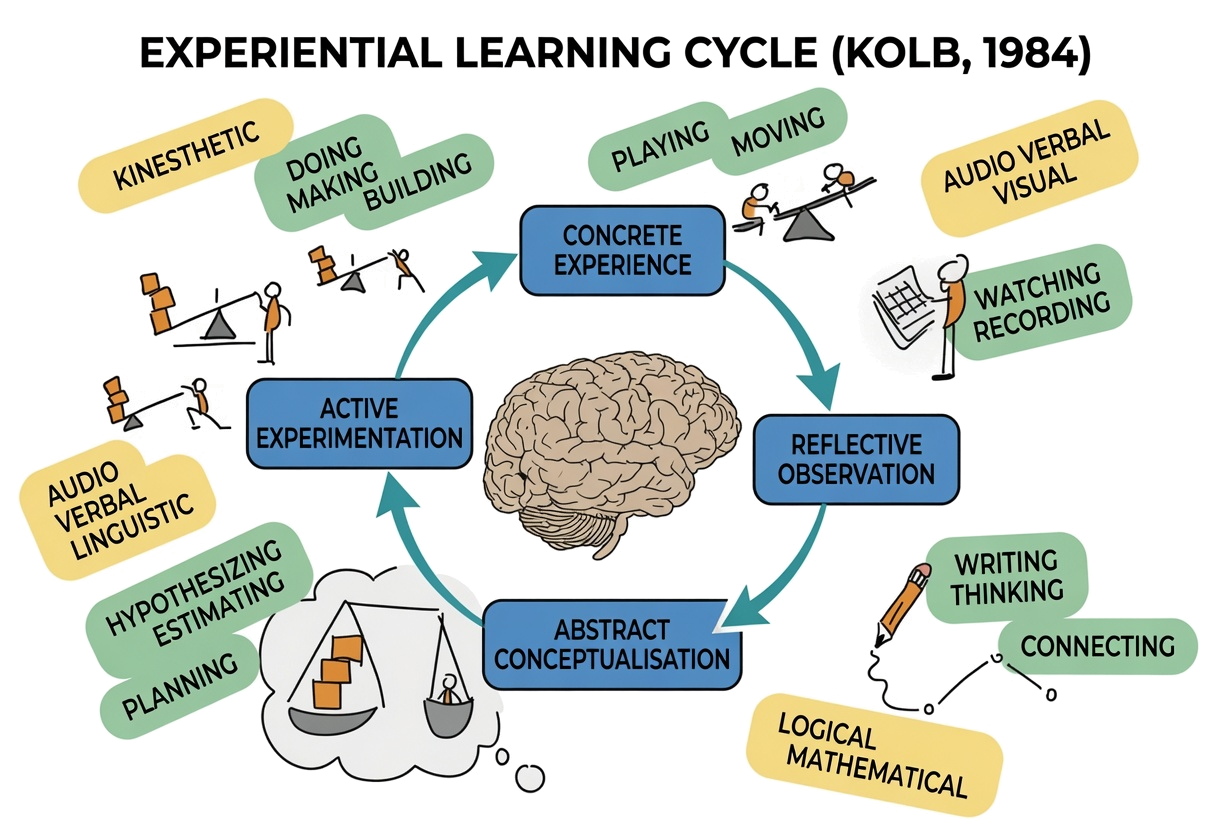
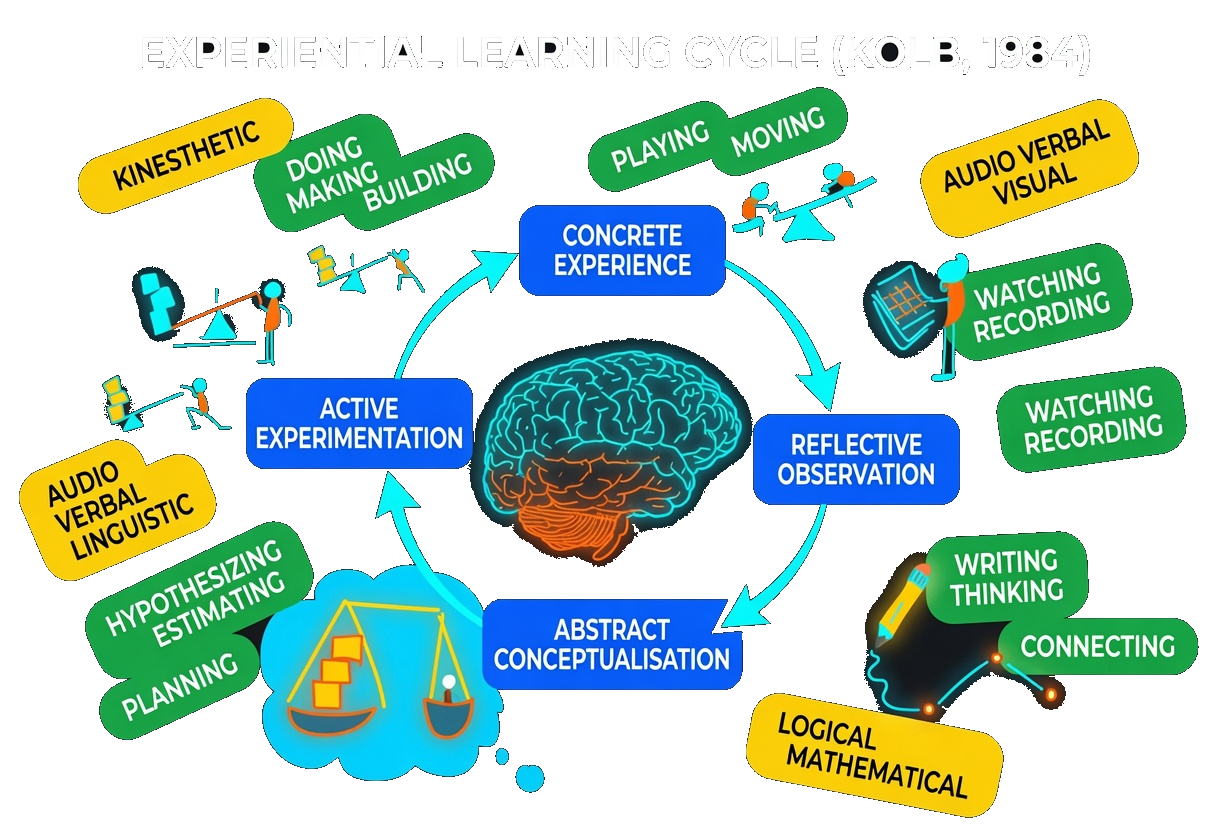
Kolb's experiential learning cycle: the four stages (concrete experience → reflective observation → abstract conceptualisation → active experimentation) form a loop the trainee traverses repeatedly.
Figure: Dale's cone of learning (modified)
The four ways of learning above also map onto Dale's cone of experience, which orders learning experiences from the most abstract (verbal symbols) at the apex through the more concrete (demonstrations, direct purposeful experience) at the base. The "imitation" and "trial and error" modes sit at the concrete end of Dale's cone; "being told" and "thinking" sit at the more abstract end.
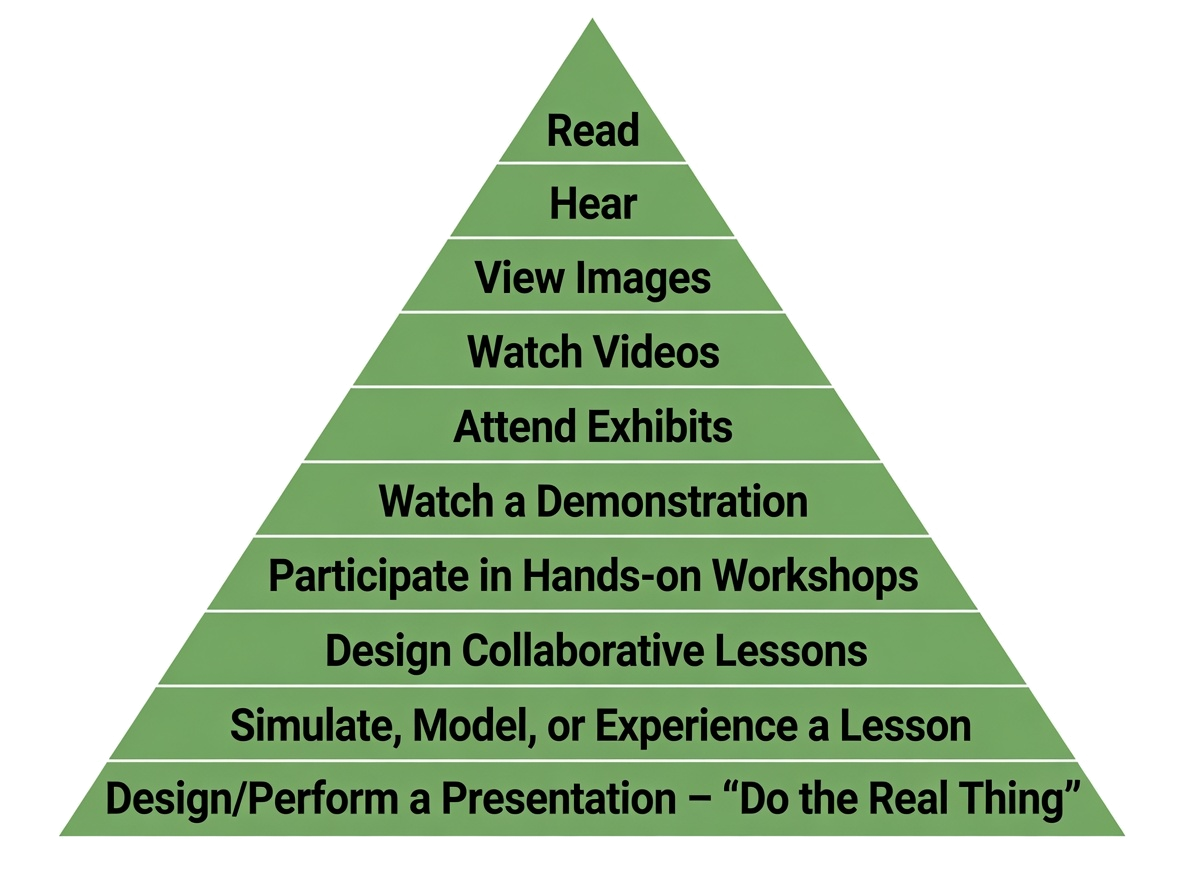
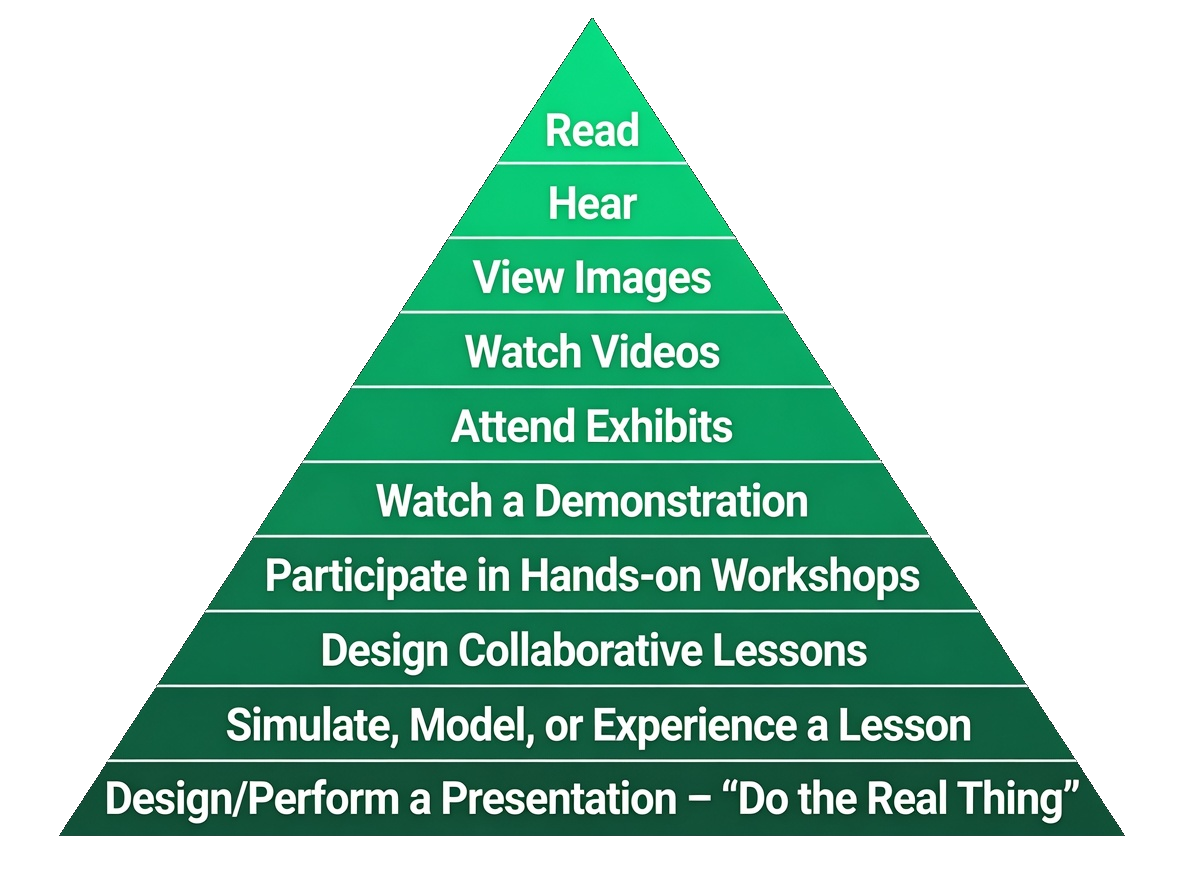
Dale's cone of experience (modified version): learning experiences ordered from the abstract (verbal and visual symbols at the apex) to the concrete (direct purposeful experience at the base).
Connections
- 2.1 Introduction. Sets the learning-theory frame this section develops.
- 2.3 Behaviour. The categories of behaviour that the learning process produces.
- 2.4 Motivation. The motivation force that drives engagement with the learning process.
- 2.6 Perception and Understanding. The categories of knowledge and skill that learning targets.
- 2.7 Human Information Processing and Memory. The cognitive architecture that constrains how the learning process works.
- Facilitation. The instructional technique that operationalises the "thinking" way of learning.
- Threat and error management. The competency-management discipline that the principle-based transfer of training serves.