
1.5 Knowledge Objectives
The unit in which the 1.4 Methods of Training and Checking expresses its outputs is the knowledge objective. Knowledge objectives define the tasks employees are required to perform; they are determined through the 1.4 Methods of Training and Checking. Knowledge objectives are found in the Instructors Guide and Lesson Plans for each course.
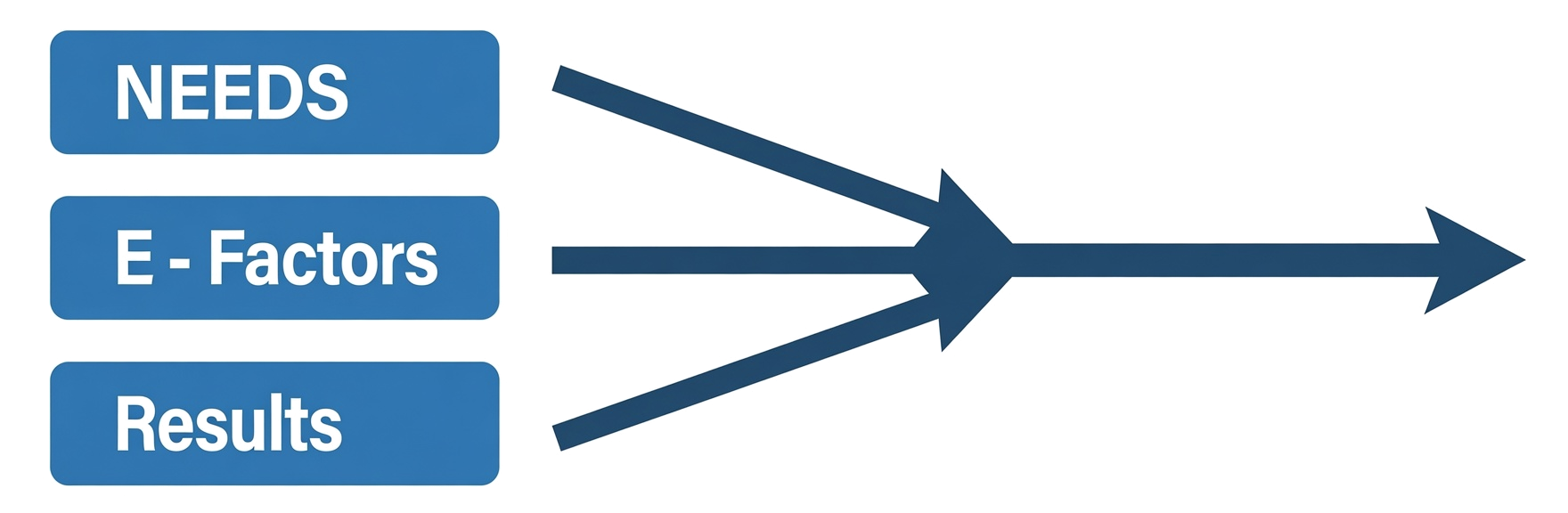
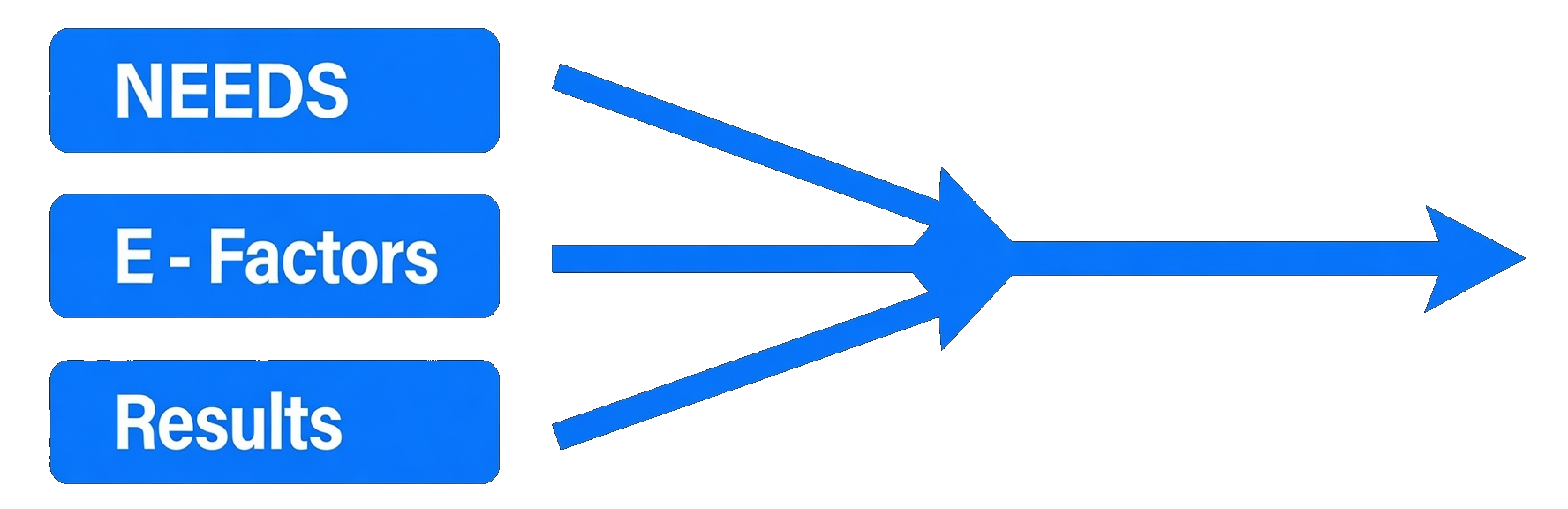
The figure above is the NEEDS / E-Factors / Results stub. It captures the three-element pipeline 1.4 Methods of Training and Checking describes: identified training NEEDS (the output of the 1.4 Methods of Training and Checking) drive the E-factors of the training programme (engineered through the 1.4 Methods of Training and Checking cycle) which produce measurable RESULTS (assessed against the knowledge objectives this section defines). The knowledge objective is the unit the Results column is measured in; without a defined objective, Results have nothing to be assessed against.
1.5.1 Definition of an Objective
The definition is short and load-bearing. Three properties follow from it:
- A statement. The objective is written down and shared; tacit objectives in the instructor's head are not knowledge objectives in this sense.
- What a graduate must be able to achieve. The objective is expressed in terms of trainee capability at the end of the course, not in terms of what the instructor will teach. The unit is the trainee's end-state.
- Must. The objective is mandatory. A course that does not test against the objective has not measured what it claims to measure.
The definition is the course manual's statement of the same outcome-based principle the competency-based training and assessment methodology in ICAO-9868 enforces: training is designed backwards from the demonstrable end-state the trainee must reach.
1.5.2 The Need for Knowledge Objectives
The training organisation requires knowledge objectives for six reasons:
- Students see what they have to achieve.
- Provides instructor direction.
- Ensures that learning remains task related.
- Allows for a standardised course design.
- Allows for assessment prior to instruction.
- Evaluation is less subjective.
Reasons 1 and 2 are the trainee-facing and instructor-facing benefits. Reason 3 binds the syllabus to operational tasks and blocks instructor-preferred drift. Reason 4 is the cross-instructor comparability benefit. Reason 5 is what allows the SAT cycle's Step 3 (Assessment Method) to precede Step 4 (Administer the Training). Reason 6 is the assessment-fairness benefit: a written objective anchors evaluation in observable behaviour rather than instructor inference.
1.5.3 Knowledge Objective Terminology
The levels of knowledge objective specify the depth at which the objective is to be achieved; the lesson plan and the syllabus dictate which level applies to each item. A fifth level (BE PROFICIENT) is often named in operations manuals (OM-D or equivalent) and is reproduced as the operational target of the Chapter 7 debrief in 7.3 General Debrief Techniques; it completes the progression though it is not enumerated in the Knowledge Objective Terminology itself.
KNOW
Means that the student is to become highly knowledgeable and acquire a complete understanding of (master) this knowledge such that it can be readily recalled and applied in the performance of his job.
The pilot will:
- Know the maximum take-off weight.
- Know the meaning of the symbols on the airspeed tape.
- Know how to initialise the FMS.
- Know the meaning of a pulsing parameter.
- Know the memory items associated with a decompression.
- Know how to cancel a nuisance warning.
- Know how to select an assigned altitude.
- Know how to engage the autopilot.
- Know the function of the bus tie pushbutton.
- Know the meaning of a red fault indication.
KNOW is reserved for items the pilot must master and recall on demand; the examples are items where mis-recall on the line would create a flight-safety problem (memory items, fault interpretations, system-state knowledge driving time-critical decisions).
BE FAMILIAR WITH
Means that the student is to become generally knowledgeable and gain a practical understanding of this knowledge such that it will be useful in the performance of his job. However, quick recall of the details of this knowledge is not considered essential. Familiarity with a knowledge area implies that if the pilot is reintroduced or re-exposed to certain elements of the subject matter, he will likely recall the necessary details and be able to apply the knowledge in the performance of his duties. It further implies that the pilot has enough knowledge to readily access the necessary details from the resources available to him. In addition, familiarisation of the subject matter will assist the pilot in completing tasks supported by checklists and ECAM procedures.
The pilot will:
- Be familiar with the location of the aircraft antennae.
- Be familiar with the indications and ECAM procedures associated with a blue hydraulic pump failure.
- Be familiar with the schematic diagram of the electrical system.
- Be familiar with the approximate flight range of the aircraft.
- Be familiar with the consequences of a dual FMGC/FMGEC failure.
- Be familiar with the functions of the flight augmentation computer.
- Be familiar with the functions of the bleed monitoring computers (BMC).
- Be familiar with the manual starting procedures.
- Be familiar with the functions of the speed brakes.
- Be familiar with the location and operation of the emergency lights.
BE FAMILIAR WITH sits below KNOW. The pilot does not have to recall the details on demand but must have enough background to apply the knowledge with reference to the resources available (checklists, ECAM procedures, QRH, FCOM). The level is appropriate for items that line procedures already scaffold and inappropriate for items the line operation requires the pilot to produce from memory.
BE ABLE TO
Means that the student is to gain a cognitive skill that applies to the performance of a required task. This term is closely related to the term "know".
The pilot will:
- Be able to identify the electrical panel.
- Be able to calculate the maximum runway take-off weight.
- Be able to interpret the wind display information on the navigation display.
- Be able to interpret the indications of the yellow speed trend arrow on the airspeed indicator.
- Be able to interpret the information at the top right corner of the navigation display in Rose NAV mode.
- Be able to visually distinguish between a managed mode and a selected mode.
- Be able to identify the brake wear accumulators on each wheel.
- Be able to identify the outflow valve.
- Be able to identify the fuel water drain valves and properly check their condition during the pre-flight inspection.
BE ABLE TO is the cognitive-skill level: the pilot must perform a defined cognitive operation (identify, calculate, interpret, distinguish) on demand, given the relevant inputs. The source notes BE ABLE TO is closely related to KNOW; the distinction is that KNOW emphasises mastered knowledge that can be recalled, while BE ABLE TO emphasises the application of that knowledge to a defined cognitive task.
1.5.4 Glossary of Performance Verbs
The glossary below anchors every knowledge objective in an observable performance verb. The verbs are organised by cognitive level: Knowledge, Comprehension, Application, and Analysis (the lower four of the six cognitive levels in Bloom's revised taxonomy (Anderson and Krathwohl 2001), reproduced because they cover the operational range of pilot training tasks).
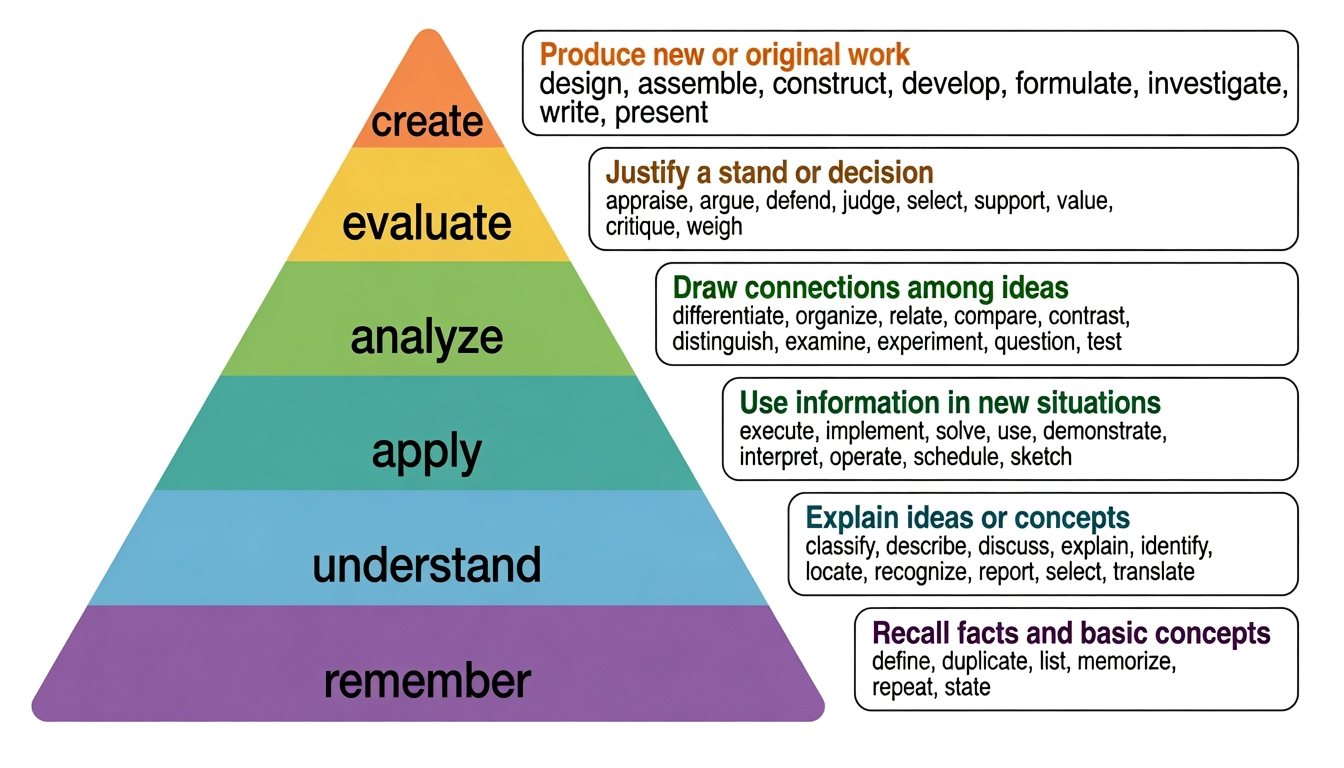
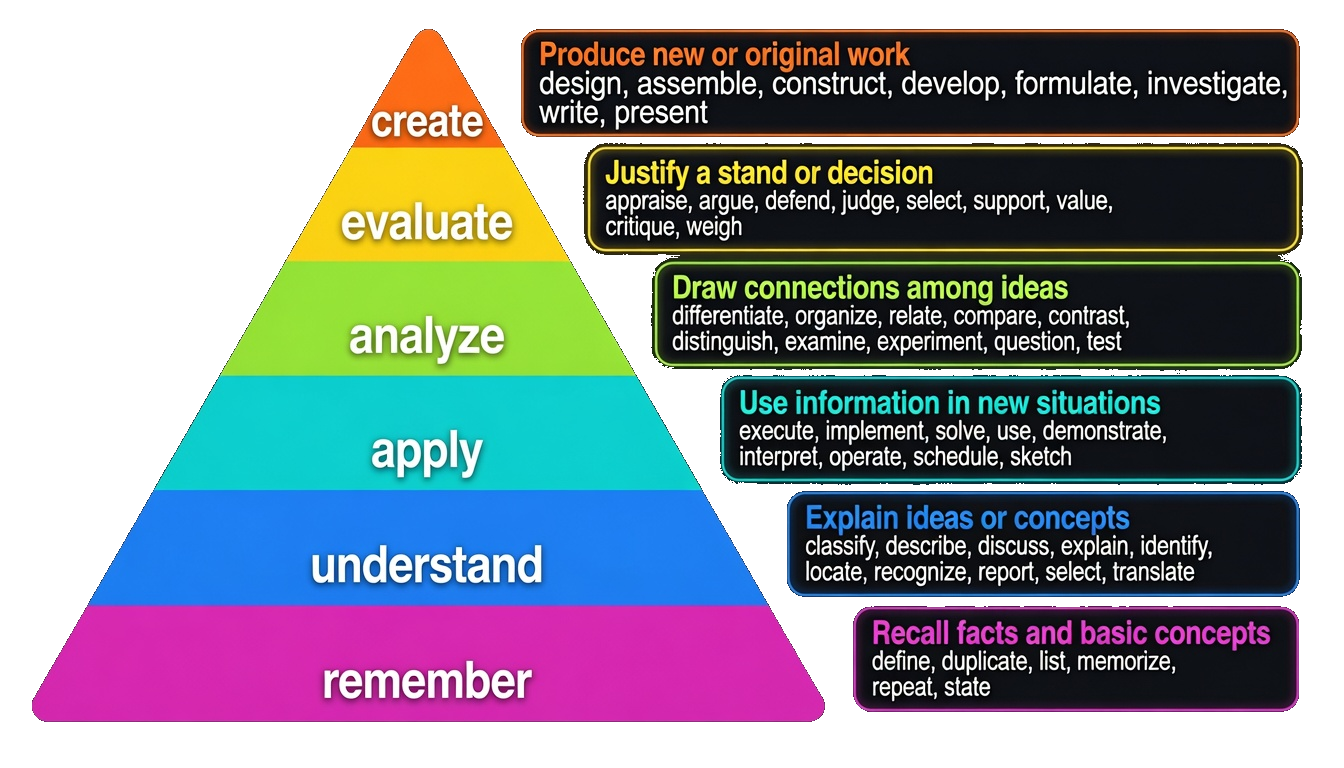
Bloom's revised taxonomy (Anderson and Krathwohl 2001): the six-level cognitive hierarchy from Remember at the base through Understand, Apply, Analyse, Evaluate, to Create at the apex. The glossary below anchors performance verbs in the lower four levels.
Knowledge: remembering previously learned material
This may involve the recall of a wide range of material from specific facts to complete theories, but all that is required is the bringing to mind of the appropriate information.
| Verb | Definition |
|---|---|
| Brief | To give all the pertinent facts to. |
| Define | To state the exact meaning or give the limits. |
| Describe | To give a description or state the characteristics. |
| Detail | To give particulars of, describe item by item. |
| Identify | To establish the individuality of an item. |
| Inform | To give a detailed account of a subject. |
| Label | To attach a label to. |
| List | To enter in a list. |
| Match | To join two or more things so they correspond. |
| Name | To be able to name. |
| Outline | To draw or describe the essential parts only. |
| Present | To exhibit or make known. |
| Recall | To recollect previously learned material. |
| Reproduce | To produce again, to produce copies or representations of. |
| Select | To pick or choose. |
| State | To express in words or numbers. |
Comprehension: the ability to grasp the meaning of material
This may be shown by translating material from one form to another (words or numbers), by interpreting material (explaining, summarising), and estimating future trends (predicting the consequences or effects).
| Verb | Definition |
|---|---|
| Convert | To change into others of a different kind or interchange terms (e.g. mathematics). |
| Distinguish | To make the difference recognisable. |
| Estimate | To fix the value of, quantity of. |
| Explain | To make known in detail. |
| Generalise | To draw broad conclusions from particular instances. |
| Give Examples | To show by illustration or type. |
| Read | To study by reading. |
| Simplify | To make easier to do or understand. |
| Trace | To follow the course, development or history of. |
| Value | To attach importance to, is seen worthy and desirable. |
| View | To observe (demonstration etc.). |
Application: the ability to use learned material in new and concrete situations
This may include the application of such things as rules, methods, concepts, principles, laws, and theories.
| Verb | Definition |
|---|---|
| Act | To perform the part of. |
| Add | To join one thing to another. |
| Apply | To put into practical operation. |
| Assist | To aid or help. |
| Calculate | To ascertain by mathematics. |
| Carry-out | To put into practice. |
| Complete | To finish, make whole or perfect. |
| Comply | To act in accordance with (command, instruction etc.). |
| Conduct | To manage or direct. |
| Construct | To fit together according to given instructions. |
| Delete | To remove. |
| Demonstrate | To illustrate or show by performance. |
| Draft | To compose in writing. |
| Draw | To illustrate in diagrammatic form. |
| Dress | To clothe or to finish the surface of. |
| Enforce | To put into action. |
| Enter | To set down in writing or to input data. |
| Expose | To subject (film etc.) to light, to reveal. |
| Find | To discover by search. |
| Handle | To manage or put thing or person through stated purpose. |
| Implement | To put into effect. |
| Index | To show a position on a scale. |
| Insert | To place between existing items. |
| Make | To construct from parts or other substance. |
| Maintain | To keep up to date, or in good order (e.g. machinery). |
| Manipulate | To handle or demonstrate skilled use of hands. |
| Modify | To improve or change the performance so increasing the operational efficiency. |
| Observe | To adhere to. |
| Operate | To cause to function, to put into operation. |
| Participate | To share in the activity being undertaken. |
| Pass | To determine a predetermined standard. |
| Pay | To give what is due. |
| Perform | To carry into effect. |
| Plot | To graph/mark on a diagram or chart. |
| Predict | To forecast. |
| Prepare | To make ready or construct. |
| Process | To develop and print photographic negatives, series of actions in manufacture etc. |
| Produce | To show for examination or inspection. |
| Raise | To create or start (e.g. to raise a form etc.). |
| Rectify | To make right, correct, amend or reform. |
| Rehearse | To practice as a preparation. |
| Save | To preserve. |
| Select | To choose the item or tool most appropriate to the task. |
| Service | To carry out maintenance of equipment etc. |
| Set Up | To prepare equipment or items for a task. |
| Show | To allow or cause to be seen / offer for inspection. |
| Sketch | To draw giving general outline or brief account. |
| Solve | To find the answer to a problem. |
| Sort | To separate into types or groups. |
| Speak | To make oral address, deliver a speech. |
| Submit | To present for consideration or decision. |
| Undertake | To make oneself responsible for. |
| Update | To bring up to date. |
| Use | To put into operation. |
| View | To survey with the eyes, form mental impression or judgment of. |
| Write | To compose for printed production. |
Analysis: to break down material into its component parts so that its organisational structure may be understood
This may include the identification of the parts, analysis of the relationships between parts, and recognition of the organisational principles involved, or the ability to break a malfunction into its fundamental parts in order to troubleshoot.
| Verb | Definition |
|---|---|
| Analyse | To ascertain the elements of. |
| Breakdown | To reduce to constituent or basic units. |
| Compute | To ascertain by calculation (number or amount). |
| Deduce | To draw as a logical conclusion. |
| Derive | To gather, deduce (knowledge, truth, ideas). |
| Diagnose | To determine the type of fault. |
| Differentiate | To establish the difference. |
| Examine | To scrutinise closely. |
| Express | To put into words, represent by symbols in terms of another (e.g. maths). |
| Illustrate | To make clear by example or drawing. |
| Infer | To deduce or conclude as the result of analysis. |
| Interpolate | To estimate from known values etc. (e.g. mathematics). |
| Relate | To show the relationship between the constituent parts. |
| Separate | To sort. |
Connections
- 1.1 Introduction. Frames the training-philosophy arc this section sits in.
- 1.2 Philosophies of Learning. The "documented learning objectives" design principle this section supplies the unit for.
- 1.4 Methods of Training and Checking. The Systematic Approach to Training that uses knowledge objectives as the output of Step 1 (Define Objectives) and the input to Step 3 (Assessment Method).
- 1.6 Training References. The regulatory hierarchy that constrains how freely a training organisation may set knowledge-objective levels.
- 2.1 Introduction. The cognitive mechanics that explain why the four-level taxonomy works as it does.
- 7.3 General Debrief Techniques. The five-level proficiency target (operations manuals, OM-D or equivalent) the debrief drives the trainee toward; KNOW, BE FAMILIAR WITH, BE ABLE TO from the Knowledge Objective Terminology plus BE PROFICIENT and UNDERSTAND from those manuals.
- 11.1 Purpose of Evaluation. The full treatment of the assessment side that knowledge objectives anchor.
- Competency-based training and assessment. The methodology the outcome-based, observable-behaviour anchoring implements at the lesson level.