
10.2 The Trainee
10.2.1 Introduction
If the student is frustrated, the learning process is interfered with. The instructor has a responsibility to minimise these frustrations, and to do this the instructor must learn to consciously observe and recognise behaviour patterns. The trainee is hardly likely to tell the instructor that they feel inadequate, yet failure to recognise the symptoms of frustration will certainly lead to low levels of learning.
The framing carries the trainee section's central operational claim: trainee frustration is not a side effect to be tolerated but a primary input the instructor manages. The behavioural observation skill is not optional; it is part of the instructor's craft.
10.2.2 Defence Mechanisms
The following things are likely to be worrying the trainee, to a greater or lesser extent:
- Fear of Failure.
- Feeling of inadequacy (personally, socially, and intellectually).
- Separation from family, friends.
- Unfamiliar surroundings.
- Unfamiliar classmates.
- The air of competition.
- The aura of instruction ("back to school").
The effect of all of these things will be to put the trainee on the defensive in any one of the following ways:
| Domain | Manifestation |
|---|---|
| Socially | Brashness / aggressiveness; "life and soul of the party" |
| Intellectually | Lack of studiousness; "couldn't care less" |
| Work-wise | Poor acceptance of new ideas; determined, clinging to old ways |
These subterfuges are termed defence mechanisms, and their purpose is to consciously or unconsciously hide from others the fact that the trainee in some way feels inadequate.
Once the trainees have been in the learning environment for some time, they will (if the instructor has done the job properly) feel more "at home", and will normally learn without interruption. However, at times during instruction, the trainee may again raise these defence mechanisms. This will probably occur at a difficult or disheartening phase of the course, and may manifest itself in any of the following four ways:
Rationalise
They will substitute a plausible reason for the real one. For example, when a student fails a test, they are more likely to blame the quality of the test paper than the inadequacy of their own learning preparation.
Escapism
They will resort to escapism when the going gets difficult. This can be mental (daydreaming) or physical (malingering).
Aggressiveness
They will display aggressiveness or frustration: either openly, or by sudden movements.
Resignation
They will give up in resignation. At the extreme point of frustration, the trainee will lose all interest in the subject.
The four-step protocol for minimising trainee frustration
Trainee material sets out the instructor's responsibilities under four headings.
1. Know the basic background of the trainees before they come on course (if possible)
Pre-course knowledge of the trainee's experience profile, prior aircraft, time in role, and relevant history reduces the chance the instructor walks into the first session with mismatched expectations. The trainee on transition from F/O to command (the Case Two profile in 9.10 Factors that can Affect Simulator Training) is not the trainee with minimum exposure to airline jet operation (Case One). The instructor cannot calibrate to either profile without knowing which profile is in front of them.
2. By presentation of material
- Sequentially arranged, so as not to leave anyone "in the dark".
- Interestingly presented to arouse motivation and feelings of relevance.
- Employing a variety of teaching methods (treated in detail in 3.1 Introduction).
- Lecture, discussion groups, instruction sheets, and other formats appropriate to the content.
3. By personal manner
- Being approachable, so trainees know they can present you with their learning problems.
- Being knowledgeable in your profession, so the trainee feels confident in the worth of your training.
- Knowing the trainees by name, as individuals.
- Giving positive recognition where it is due for tasks well done, and not just mentioning negative tasks.
- Admitting personal mistakes: no one can be right all of the time.
- Taking trainees into your confidence at least to the extent of letting them know what is expected of them, and keeping them informed of their progress.
4. By the arrangement of the learning environment
- Cooling and ventilation.
- Lighting levels.
- Classroom layout.
- Decreasing outside noise levels.
10.2.3 Trainees Differ
Learning is a complex activity and unique to an individual. The trainer has the task of creating a learning event and of making the opportunity as effective as possible by making full use of the four ways of learning.
Trainee material cites Bigge (1982) on the nature of learning:
Other definitions of learning usually stress the same point: that learning is the change in behaviour or disposition causally related to some preceding events. As trainers we set up training events in the hope that they will cause change in behaviour, but it is extremely difficult to prove the causal nature of the link between the event and the change.
The reasons for the difficulty lie in the complex nature of human beings. We can talk; we have an awareness of the past, the present and the future; we have a highly developed imaginative capacity; we share a common culture with our fellows; and we can perceive of ourselves as both subject and object (we can do something and be aware of ourselves doing it).
Trainee material quotes Drucker on the same difficulty:
Mankind shares with animals some primary drives (the need for food, drink, warmth, rest, oxygen, and sex). Some psychologists regard these needs as the determinants of our ability to learn. Others regard our ability to transcend these drives, and deal with perception of ideas, as being of greater importance. Man can extend the world of reality into a world of symbolism: we can operate in the imagination or solve problems that only exist in the abstract.
To develop a theory of learning that is appropriate for your training purposes, you need to take a view of mankind's basic make-up and those features that influence the way we behave. It might make life as a trainer much more comfortable to have a single "Theory of Learning", but the present state of psychology has such a wide range of viewpoints that there is no complete internal consistency from which a single theory could be developed.
10.2.4 Adults in Training
Whether you accept it easily or not, the reality is that the trainees you are going to be dealing with in the airline are adults. As such, there are certain characteristics you should consider when planning your lessons.
Characteristics of the adult learner
- Adults bring a wide variety of life experiences.
- People will come from different cultural backgrounds.
- Different language experiences.
- The learners are volunteers.
- People have a variety of outside pressures.
- Some people may have lost a lot of personal confidence and feel quite apprehensive while others find participating much easier.
- People vary in their physical abilities, especially hearing, sight and concentration.
How this may help your planning
- Start the training event with discussion which gives opportunities for the group to share what they know and their expectations of the programme.
- People will have their own values and ways of working which can add to the interest and depth of the course.
- Vary your presentation to avoid overload of formal talk or reading and give opportunities for course members to question and explore ideas.
- Your course members are keen to co-operate.
- Some are fully committed to your course but some may not be able to give so much time.
- Be relaxed yourself and establish a friendly atmosphere so that people feel free to ask questions and become involved.
- Speak clearly, write plainly, bring people close to each other for discussion, and frequently check that you are being understood.
10.2.5 Cultural Differences
Culture provides people with a design for living and for interpreting their environment. Culture has been defined as "the shared values, traditions, norms, customs, arts, history, folklore, and institutions of a group of people." Culture shapes how people see their world, which in turn affects the way they think and how they behave. A person's cultural affiliation often determines the person's values and attitudes about work issues and responses to messages (communication). Teachers who provide training to diverse groups must understand the culture of the group members that they are teaching, and must design and manage culturally competent training to address those groups.
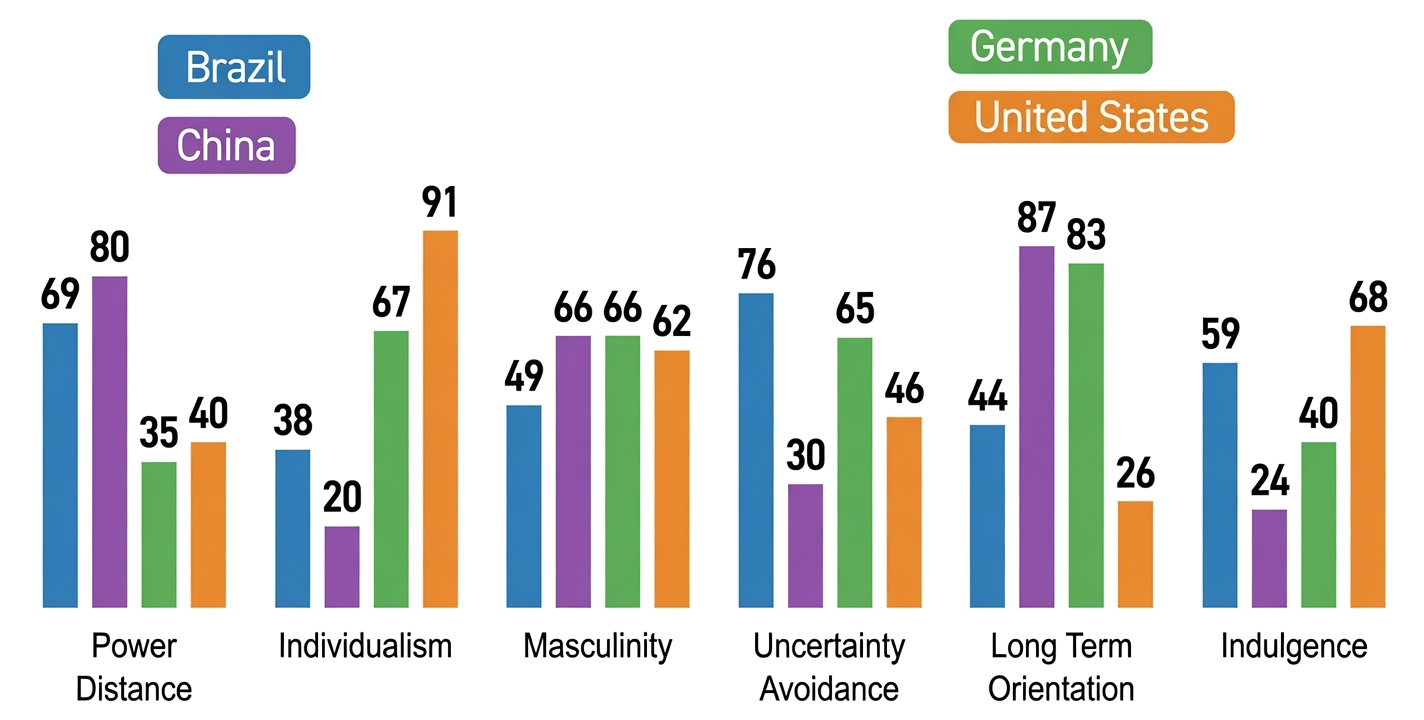
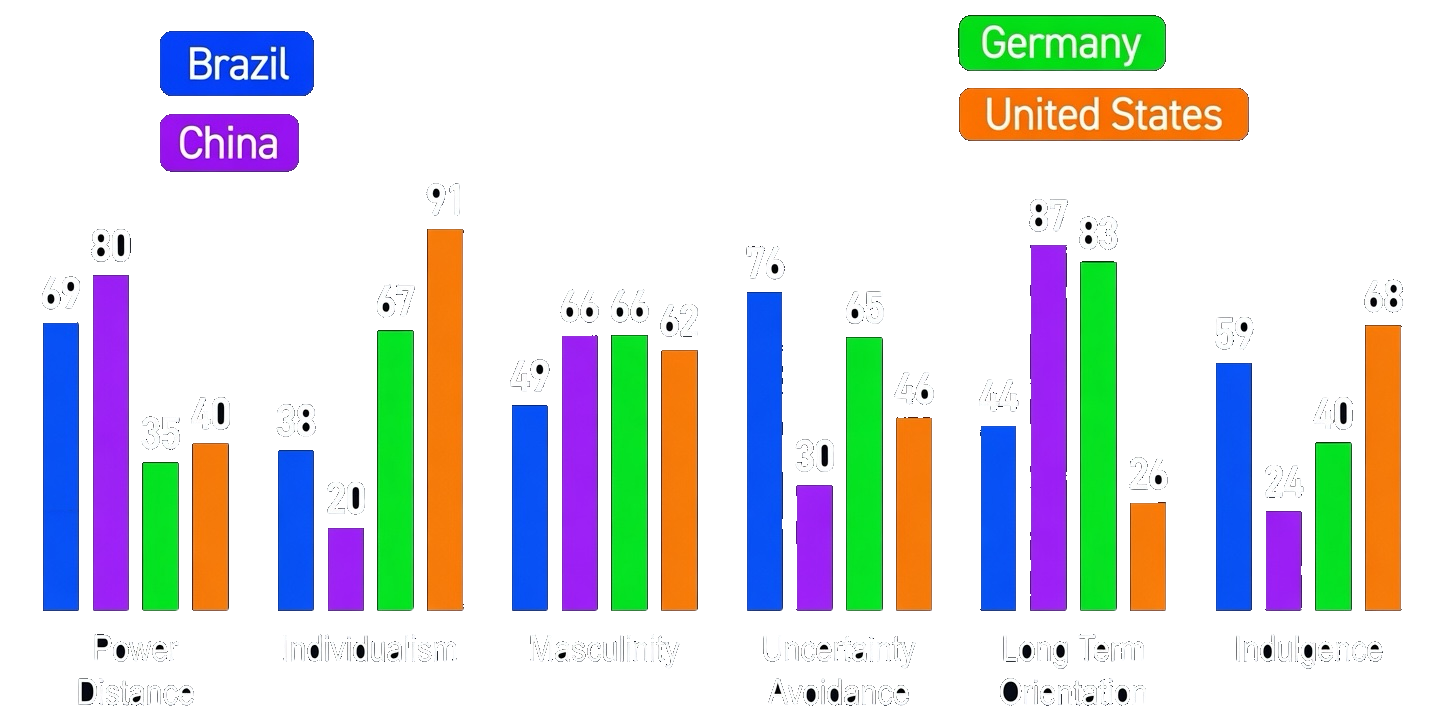
Hofstede's six cultural-dimensions framework, comparing four countries (USA, China, Germany, Brazil) across power distance, individualism vs collectivism, masculinity vs femininity, uncertainty avoidance, long-term vs short-term orientation, and indulgence vs restraint. The framework is one structured way to read the cultural-context variable cultural-differences material is asking the instructor to attend to.
Figure: Tuckman's stages of group development
When trainees are run through training as a class or as a fixed crew over multiple sessions, the group itself develops through predictable stages that affect what the instructor can ask of it. Tuckman's model (1965, extended 1977) names five: forming, storming, norming, performing, and adjourning. A class in the forming stage is polite and tentative; the instructor cannot expect peer challenge or honest disclosure yet. A class in storming is working out hierarchy and norms; conflict surfaces and the instructor's job is to channel it constructively rather than suppress it. A class in norming has established working agreements; productive group work becomes possible. A class in performing is operating as a coherent unit; the instructor can step further back into facilitation. Adjourning closes the group: ending the course in a way that preserves what was learned.
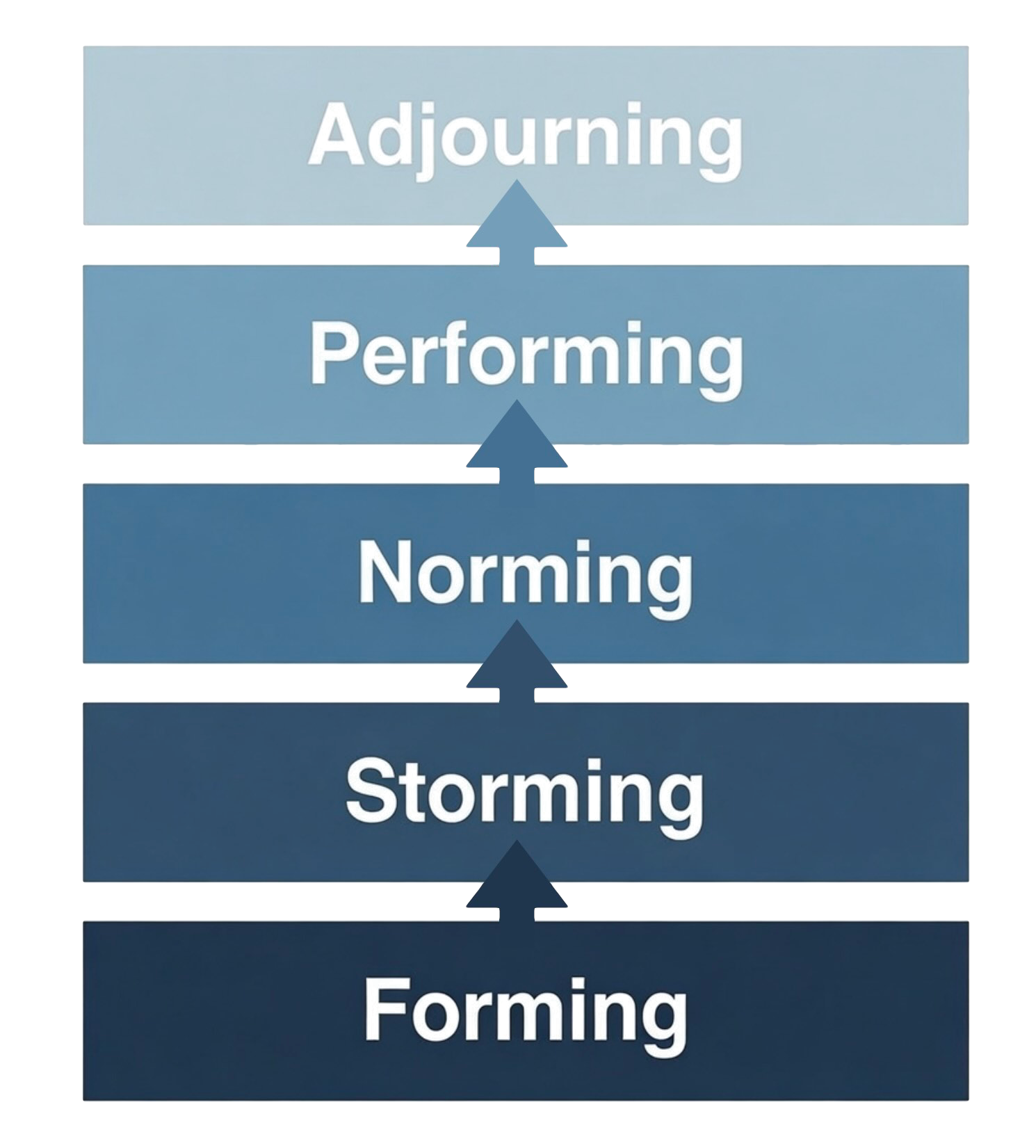
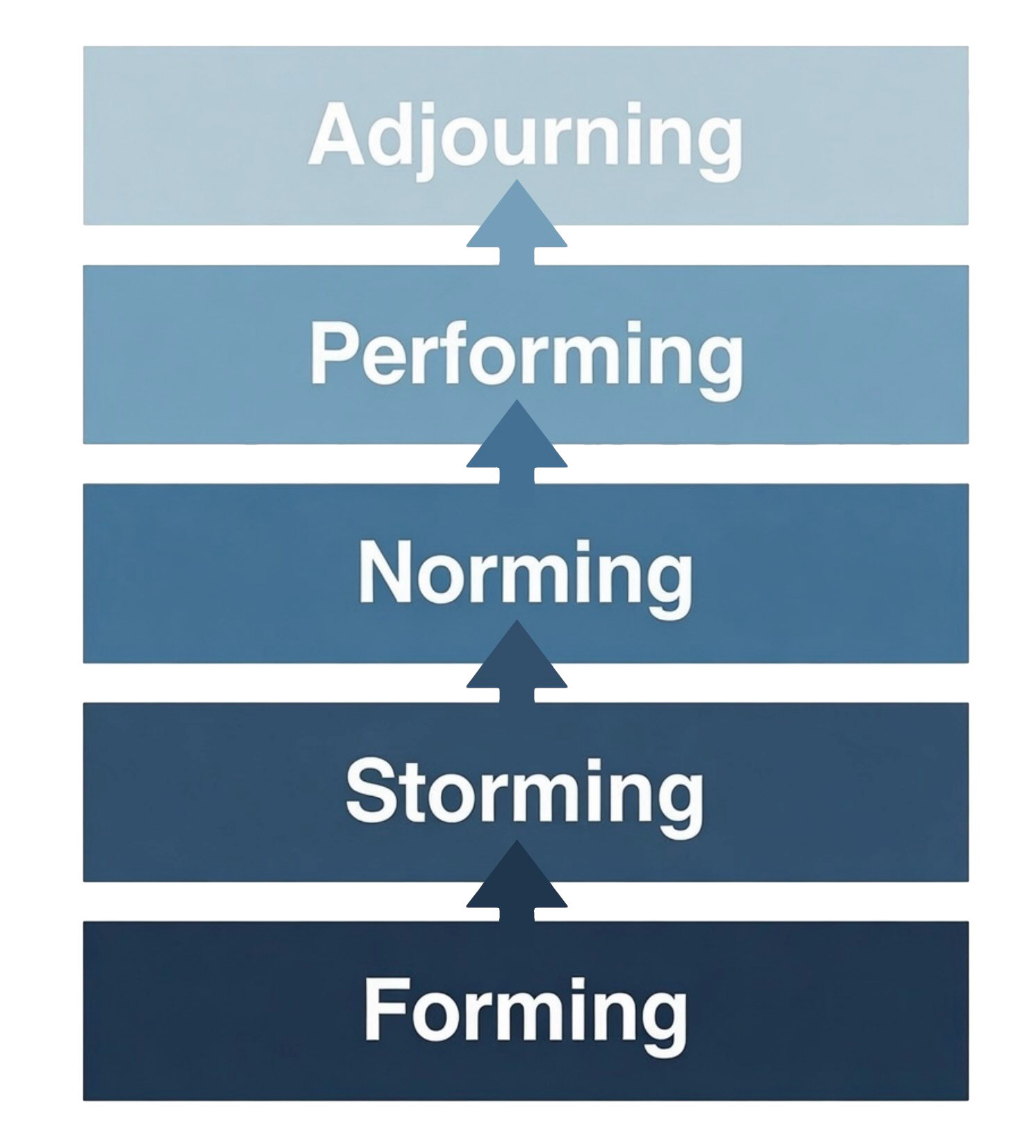
Tuckman's five stages of group development: forming, storming, norming, performing, and the later-added adjourning. Performance starts low in forming, dips through storming, rises through norming, peaks in performing, and ends with adjourning.
The same model applies to a fixed flight-deck crew over a recurrent training cycle and to a multi-day course cohort: the instructor who treats a forming-stage class as if it were performing will be disappointed; the instructor who treats a performing-stage class as if it were forming will under-use it.
Connections
- 10.1 Human Behaviour. Framing section, which the trainee section develops on the trainee side. The Maslow material there is what makes the defence-mechanism analysis pedagogically operational.
- 10.3 Learning Styles. The Honey-Mumford four-type taxonomy is one specific way trainees differ that the instructor calibrates to.
- 10.4 The Instructor. The companion section on the instructor side, including the assertive-vs-aggressive-vs-submissive distinction from the EBT instructor handbook that classifies the aggressiveness defence-mechanism pattern more precisely.
- 2.3 Behaviour. The earlier treatment of behaviour as observable evidence of learning.
- 2.4 Motivation. The earlier treatment of motivation, which the defence-mechanism analysis depends on.
- 2.5 Needs. The earlier treatment of needs invoked above.
- 3.1 Introduction. The variety-of-teaching-methods requirement in the four-step protocol points here.
- 6.4 Briefing Structure. The personal-manner items in the four-step protocol (knowing trainees by name, taking them into confidence) are operationalised in the briefing.