
5.1 Introduction
What the model is for
The Risk Management Model provides a basis for describing and visualising:
- the Risk Potential; and
- the Resources available to manage workload and minimize the possibility of undetected threats and errors.
The model therefore provides a tool that enables pilots to assess factors that can increase risk during line operations, to communicate (share) their assessment of the potential or current risk level, and to identify possible corrective actions.
The three verbs in the source's framing (assess, communicate, identify) are the operational core of the model. Assessment without communication is private and useless to the rest of the crew; communication without identification of corrective action is venting; identification without prior assessment is guessing. The model exists to scaffold all three in sequence.
The triple repetition is deliberate. The single load-bearing failure mode the RMM is built to defeat is the case where a crew member has assessed risk correctly and identified a corrective action correctly, but did not share the assessment with the rest of the crew in time for the corrective action to take effect. The pattern recurs in the accident record under labels such as poor group decision-making, ineffective communication, inadequate leadership, and poor flight deck management (the same cluster the EBT programme was set up to address: see A4.B.1 EBT Introduction for the 70-80% accident-attribution figure that motivates this emphasis). The RMM's restatement of the rule three times is a teaching device: it removes the option of remembering "and the others." The only rule is communicate.
The source closes with a pointer to approved CRM materials for further information. That pointer leads to the broader CRM body of methodology; the RMM is the training-room scaffold that makes CRM operational for risk work specifically.
How to read the model
The two-axis framing (Risk Potential vs. Resources) is small enough to draw on a whiteboard and stable enough to use through an entire briefing or debrief. The instructor uses it to keep the conversation honest in two directions:
- On the risk-potential side. The crew enumerates the threats and errors operating at this point in the flight (weather, terrain, traffic, fatigue, system malfunction, time pressure, unfamiliar airport, recent crew-pairing change, etc.). The RMM does not impose a taxonomy at this level; the TEM frame is the standard taxonomy and the one EBT crews will already have been trained on. The RMM's contribution is to force the crew to name the threats rather than carry them implicitly.
- On the resources side. The crew enumerates what is available to manage that risk: crew experience and qualifications, automation and instrumentation, time, fuel, ATC support, dispatch and operations support, weather alternatives, written procedures (FCOM, QRH, OEB), and external help (cabin crew, company, other crews on frequency). Naming the resources serves two functions: it surfaces under-used capacity (the second crew member's experience that no-one was drawing on) and it surfaces resource gaps that the crew has to plan around (no diversion within fuel range, no second engine on the relevant phase, etc.).
The crew's risk level is the running judgment that compares those two sides. When potential rises (developing weather, unexpected MEL, time pressure) without a corresponding rise in resources, the risk level has risen and a corrective action is owed. The corrective action is whatever moves the equation back toward balance: brief earlier, divert, slow down, request priority handling, hand control, escalate to the captain, request company support. The RMM does not prescribe the action; it forces the question.
The connection to the EBT Performance-Influences model
The RMM is a compact teaching frame; it is not a full human-factors model. In the EBT recurrent-training context, the same problem (why does crew performance vary, and what does the instructor look at to diagnose it?) is addressed through a layered Performance-Influences (Human Factors) model, reproduced and explained in A4.B.1 EBT Introduction. The two models are compatible (they describe the same operational reality at different resolutions) and an instructor working across both training contexts (initial / recurrent / line training and EBT modules) needs to be able to move between them.
The Performance-Influences model decomposes performance into four faces (Direct, Potential, Managing-organisation, Managing-individual) plus a composite. The factor lists for each face are reproduced and credited in A4.B.1 EBT Introduction; the orienting summary here is enough to map them onto the RMM.
The RMM compresses all four faces into a two-column scaffold. The "Risk Potential" column maps to the Potential factors face (the conditions raising the risk: weather, fatigue, time pressure, unfamiliar field). The "Resources" column maps to the Managing factors faces (organisational and individual: SOPs and tools on one side, TEM and communication on the other). Communication, the single Golden Rule, is the conduit between the Direct factors face (what one crew member sees, decides, and acts on) and the rest of the crew, so the situation can be assessed and corrected as a crew rather than as parallel individuals.
How the RMM is used in assessment
The RMM appears explicitly in the course manual's facilitation rubric (see A3.5 Category 4 Focus on Crew Analysis and Evaluation). Category 4's first marker, "Encourages crew to analyse the situation that confronted them using the Risk Management Model," scores the instructor on whether they used the RMM as the analytic frame in the debrief. The five-level marker descriptors at that location read (across the Poor / Marginal / Adequate / Good / Very Good columns) as:
- Poor (1): Does not encourage crew to analyse along CRM dimensions the situation that confronted them, what they did to manage the situation, or why they did it.
- Marginal (2): Only minimally encourages crew to analyse along CRM dimensions the situation that confronted them and / or what they did to manage it. Does not push crew to discuss why they did what they did.
- Adequate (3): On average encourages crew to analyse along CRM dimensions the situation that confronted them and what they did to manage the situation. Encourages but does not push crew to discuss why they did what they did.
- Good (4): Frequently encourages and pushes crew to analyse along CRM dimensions the situation that confronted them, what they did to manage the situation, and why they did it.
- Very Good (5): Continually encourages and pushes crew to analyse along CRM dimensions the situation that confronted them, what they did to manage the situation, and why they did it.
The remaining three markers in A3.5 Category 4 Focus on Crew Analysis and Evaluation measure the instructor's pursuit of crew self-evaluation, the crew's exploration of CRM dimensions in LOFT and line-operations terms, and the depth at which issues, factors, and outcomes are analysed. All four markers operate against the same underlying frame: the crew owns the analysis, the instructor scaffolds it, and the RMM is one of the named scaffolds the course manual's facilitation discipline expects the instructor to be fluent in.
Where the model came from, and where it sits in the cluster
The Risk Management Model is deliberately compact: a single page of text, three Golden Rules, and a pointer to approved CRM materials for depth. The brevity is appropriate because the model is a teaching aid (something an instructor draws on a board for a crew, or refers to mid-debrief), not a standalone analytic framework. Deeper treatment sits in the resources it points to: approved CRM materials for communication and team performance, and the A4.B.1 EBT Introduction for the layered Performance-Influences treatment.
Figure: Reason's Swiss cheese model
Behind the RMM and the broader EBT human-factors approach sits James Reason's Swiss cheese model of accident causation. The model represents an organisation's defences against an undesired outcome as a stack of layered slices (training, SOPs, supervision, automation, crew action, etc.); each slice has holes (latent or active failures); an accident occurs only when a trajectory finds an aligned hole through every slice.
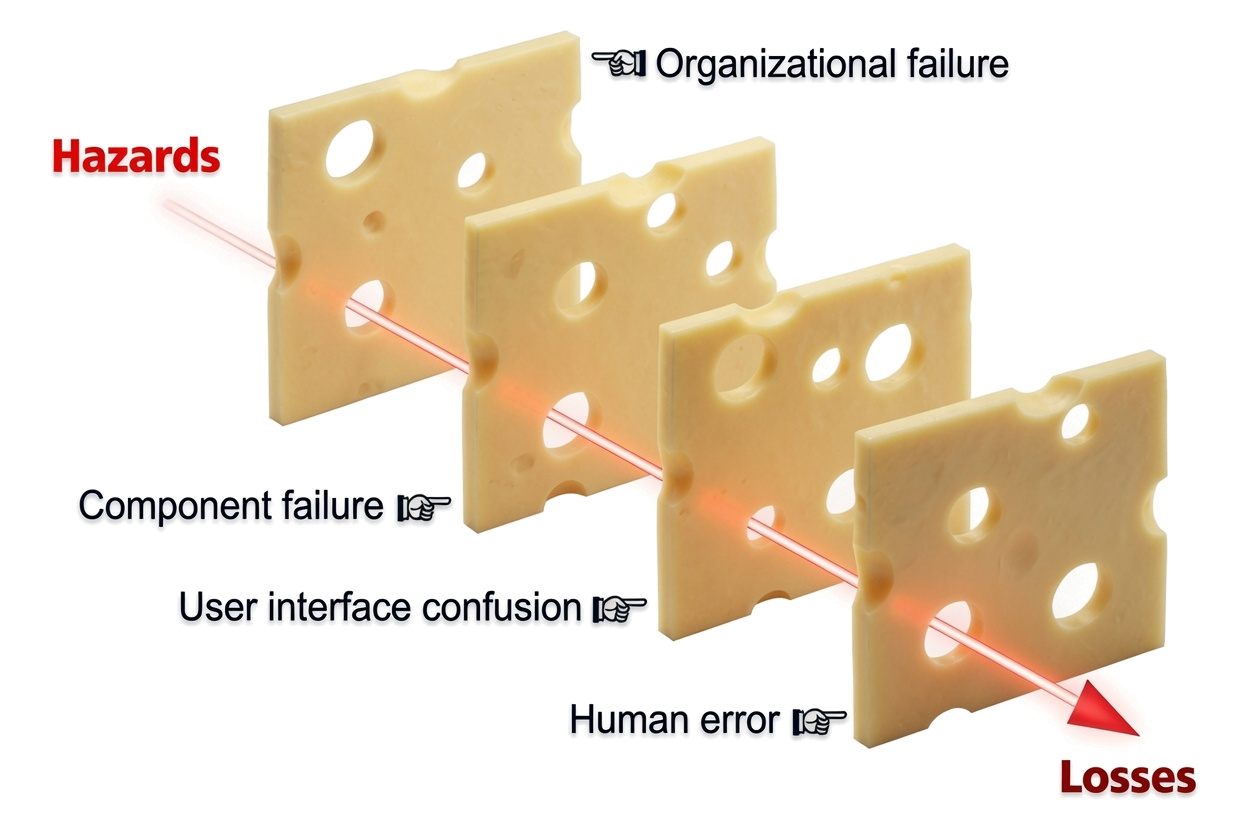
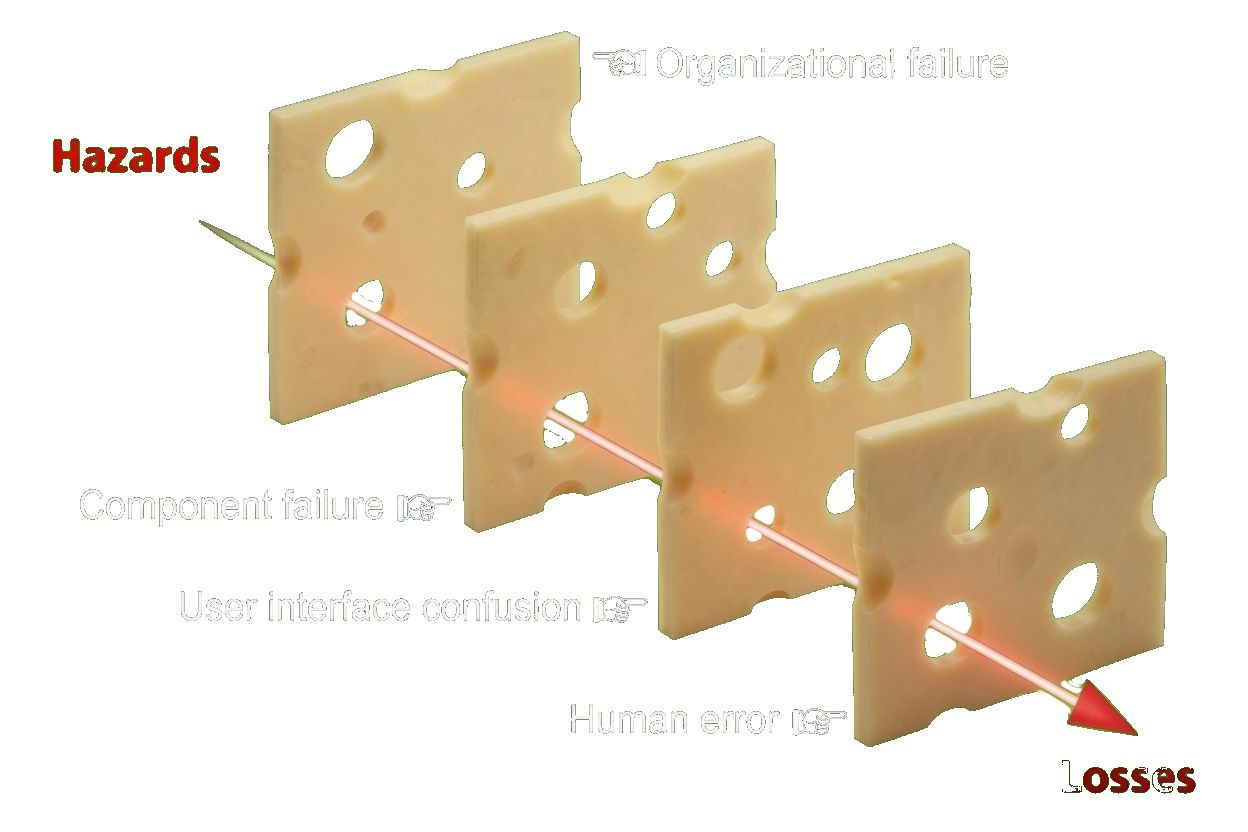
Reason's Swiss cheese model of accident causation: each defence layer (organisation, supervision, preconditions, unsafe acts) carries holes that may align under specific conditions to produce an accident trajectory. The crew's risk-management work is one of those layers.
The RMM's communication-centred framing is one defensive layer in the Swiss cheese stack: a crew that assesses, communicates, and identifies corrective action in time has closed the hole their layer would otherwise have left open. The full layered analysis (organisational decisions → supervision → preconditions → unsafe acts) is what the A4.B.3 Human Factors Model decomposes for the EBT instructor.
Figure: Bow-tie risk analysis
A second classical risk-analysis visual that complements the RMM is the bow-tie diagram. The bow-tie places a top event (the undesired event being analysed) at the centre; on the left, the threats and causes that could lead to the top event, with preventive controls (barriers) inserted between them; on the right, the consequences that would follow if the top event occurred, with mitigative controls inserted between top event and consequence.
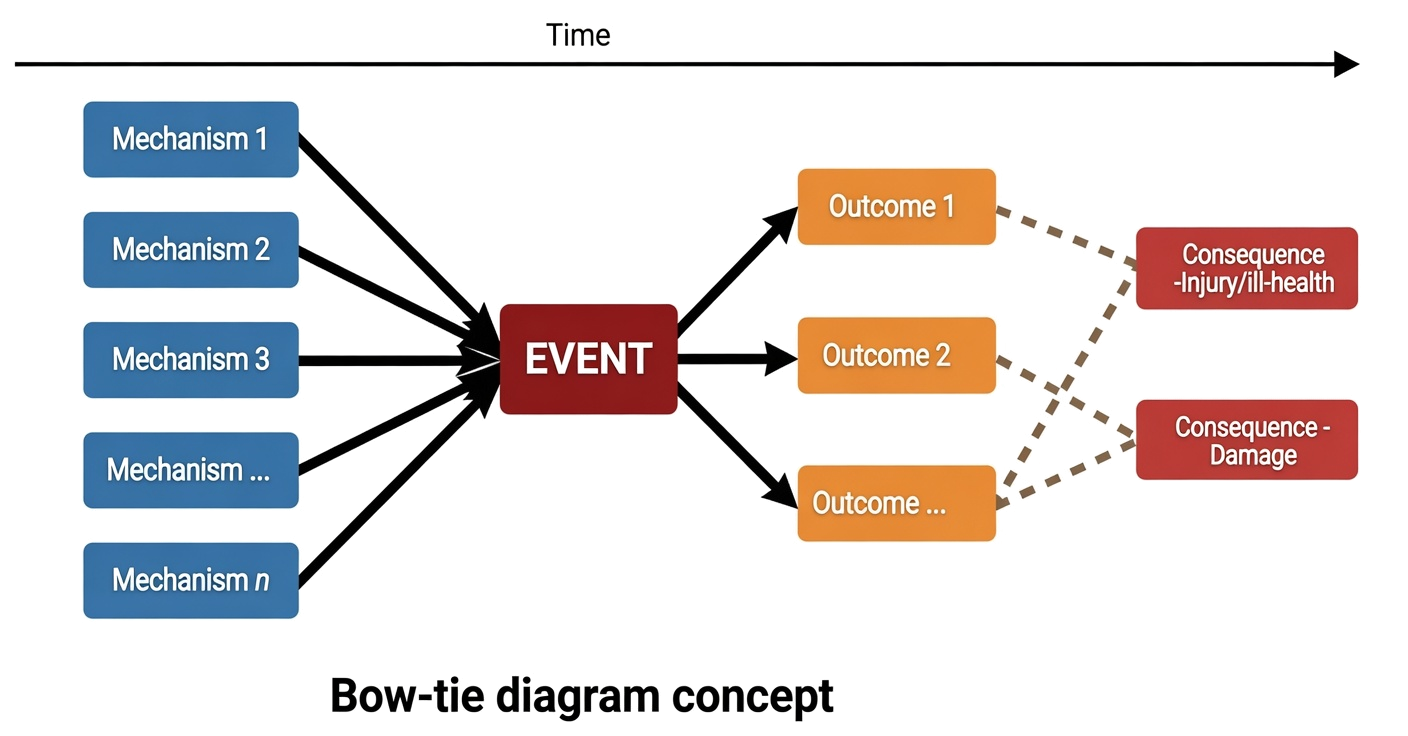
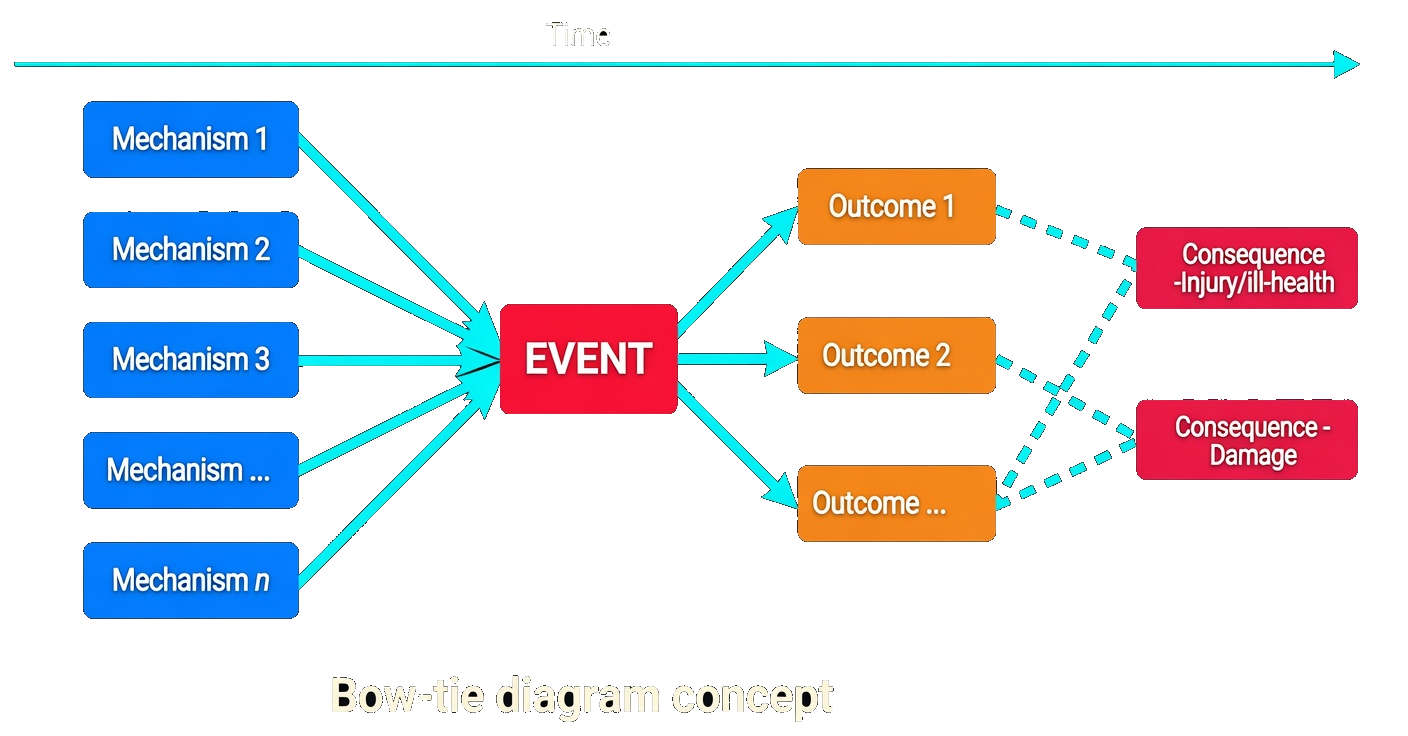
Bow-tie risk analysis: causes and threats on the left, top event in the centre, consequences on the right. Preventive barriers stop the top event; mitigative barriers reduce the harm if it occurs.
The bow-tie is the analytic frame behind the RMM's two-axis scaffold: the risk potential the RMM names is the left-hand side of a bow-tie (threats, causes, and the preventive barriers the crew can deploy); the resources the RMM names are the barrier set (preventive on the left, mitigative on the right). The crew's communication discipline is the conduit through which the barriers actually get placed: a barrier nobody mentions does not exist.
Cross-references
- 4.5 Controlled Note Taking. The last training-aids technique covered before risk management material pivots from in-classroom craft to a model the crew uses in line operations.
- 6.1 Introduction. Pre instructional briefing material, where models like the RMM are introduced to the crew before the session.
- A4.B.1 EBT Introduction. The layered Performance-Influences (Human Factors) model that the RMM compresses, with the five faces (Direct, Potential, Managing-organisation, Managing-individual, composite) reproduced in full.
- A3.5 Category 4 Focus on Crew Analysis and Evaluation. The facilitation rubric explicitly cites the RMM as the analytic frame instructors are expected to lead crew analysis with.
- 1.1 Introduction. Houses the NEEDS / E-Factors / Results stub diagram, the conceptual ancestor the RMM operationalises in the risk domain.
- 7.5 LOFT Debriefing - Introduction. The setting in which the RMM most often serves as the debrief-organising frame.
- CRM. The broader body of crew-performance methodology the source's closing pointer (approved CRM materials) refers into.
- Threat and error management. The taxonomy the RMM's Risk Potential side operates under in EBT-aware crews.
- Core competencies. The grading axes the rubric in A3.5 Category 4 Focus on Crew Analysis and Evaluation references when it asks the instructor to lead analysis "along CRM dimensions."
- EBT. The methodology under which the Performance-Influences model in A4.B.1 EBT Introduction succeeds the RMM as the analytic frame for diagnosis.