
A4.B.3 Human Factors Model
Purpose: a thinking aid for root-cause analysis
This is intended to remind the EBT instructor about the simple model provided during training. It can always be applied in your thought processes when you see performance which warrants improvement. It is a theoretical model, but after the completion of a simulator session, it can be useful to think about which direct factor or factors you observed in both exemplary performance and performance that requires improvement.
The model decomposes the determinants of in-the-moment performance into three concentric layers:
- Direct factors: the four cognitive and motor acts that immediately produce performance (decision, dexterity, attention, awareness).
- Potential factors: the conditions that contaminate or enable those direct factors (design, environmental, fatigue, illness, visual illusions, memory, time, organisational, commercial, automation, security, political, system failures, psychological, physiological, language, procedures, alert systems, emergencies, relationships, documentation, cultural, stress).
- Managing factors: the things the organisation and the individual do to influence the conditions, split into a management-by-organisation face and a management-by-individual face.
The three layers wrap concentrically around the central performance node. The four direct factors form the inner ring and the four arrows that pierce it (Decision, Dexterity, Attention, Awareness); the potential factors form the next ring out as the contextual conditions; the managing factors form the outermost ring as the levers by which performance is shaped over time.
The composite model
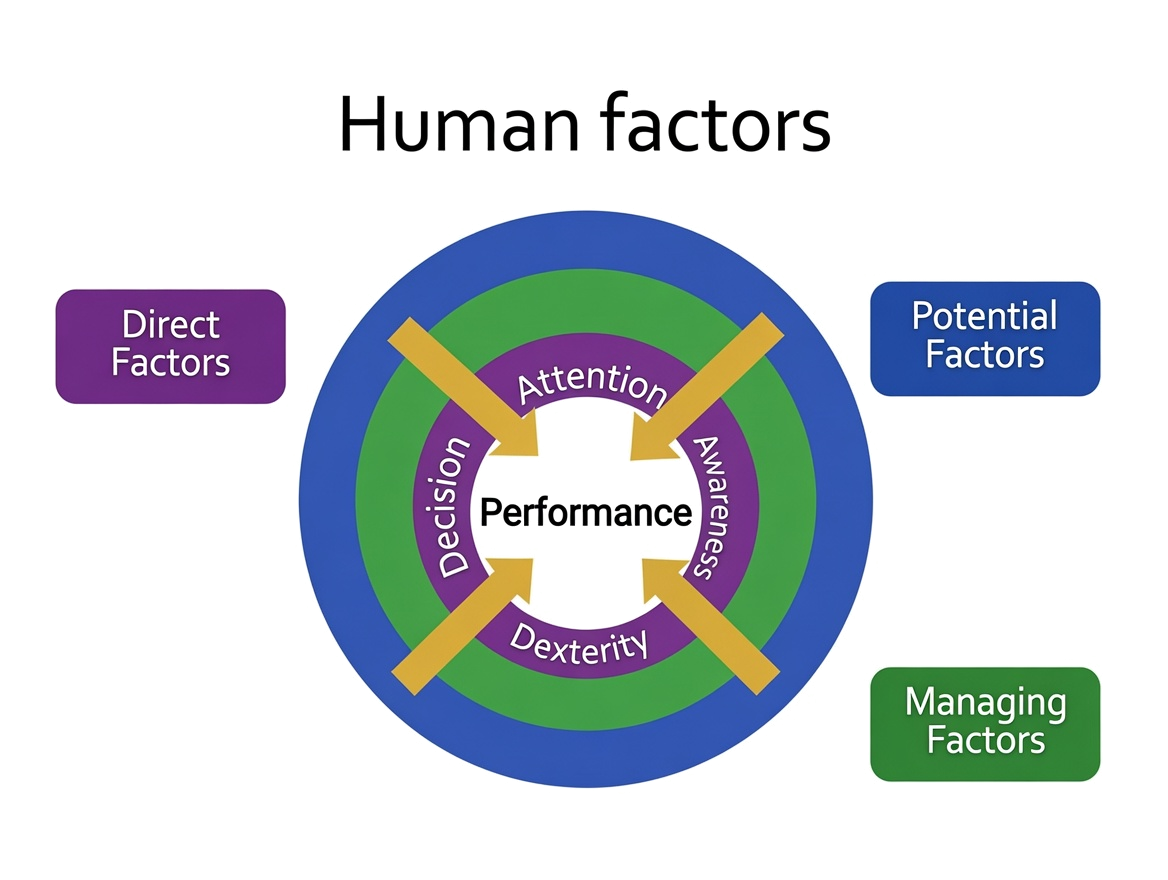
The composite figure is the model in one frame. The performance node sits at the centre with the four direct-factor arrows piercing it (Decision, Dexterity, Attention, Awareness). The blue Direct Factors callout sits at upper left; the blue Potential Factors callout at upper right; the green Managing Factors callout at lower right. Each of the next four sub-sections expands one face of the composite.
Face 1: Direct factors
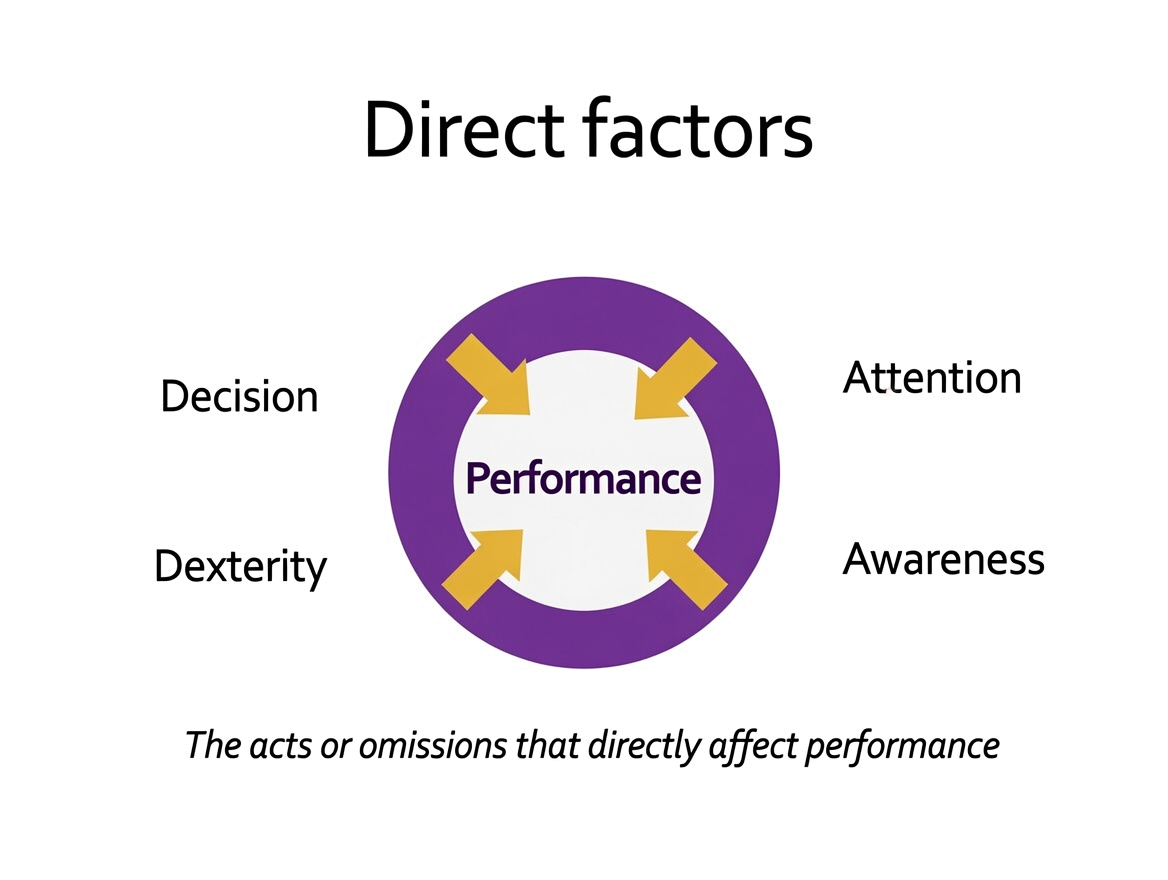
Direct factors are the four acts or omissions that directly affect performance. They are what the crew member does in the moment: decides to do this rather than that; manipulates the controls with this level of dexterity; allocates attention to this rather than that; maintains this level of situational awareness. When an instructor observes a performance shortfall, the direct factor is the proximate cause; the analytical work is to trace it back to the potential and managing factors that produced it.
Face 2: Potential factors
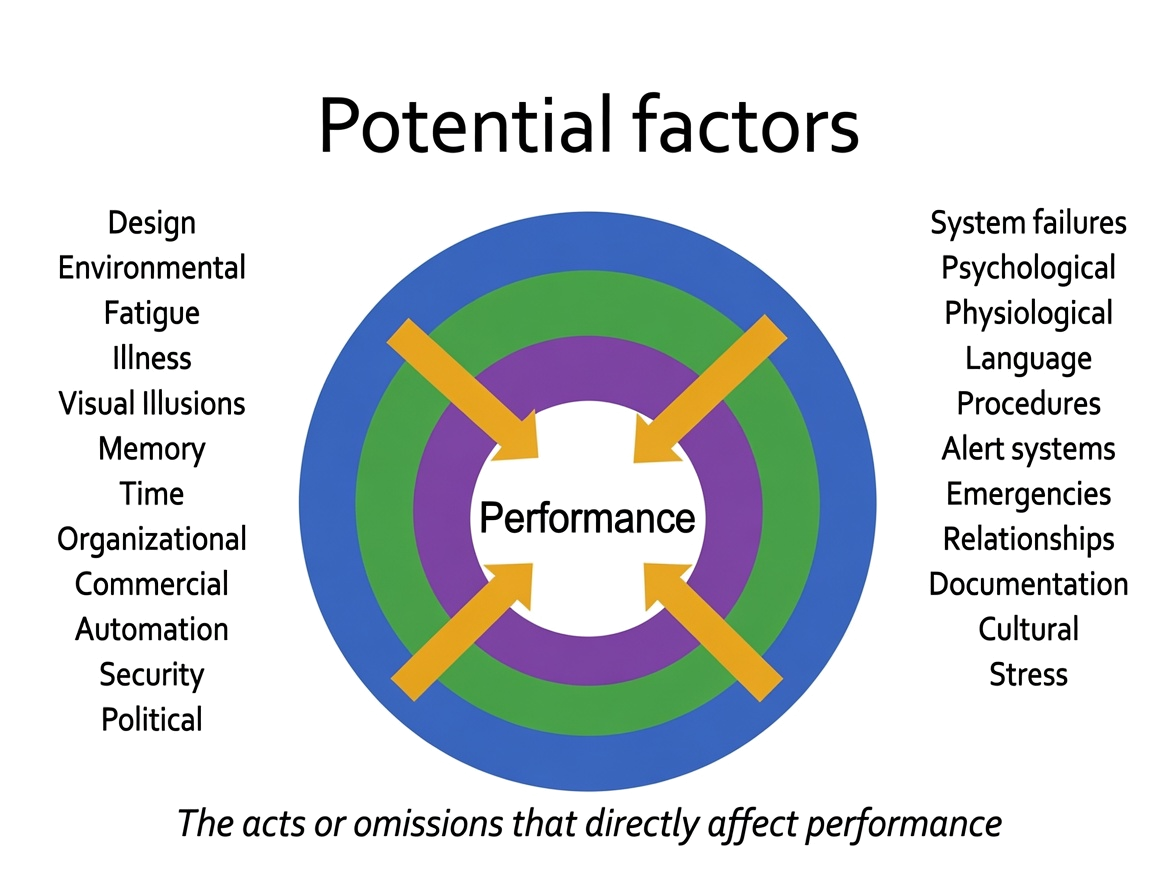
Potential factors are the inventory of conditions present in any given operating context. Some are stable (design, documentation, organisational structure); some are episodic (fatigue, illness, an active system failure, a stress spike). When a direct-factor shortfall (for example, an attention lapse) is observed, the potential-factor list is the menu of candidate causes the instructor probes against. The figure groups them on either side of the performance node but does not impose a sub-classification; the operational reading is that any of these conditions can be present at any time and the crew's compensation for them is what the subsequent analysis surfaces.
Face 3: Managing factors (organisation)
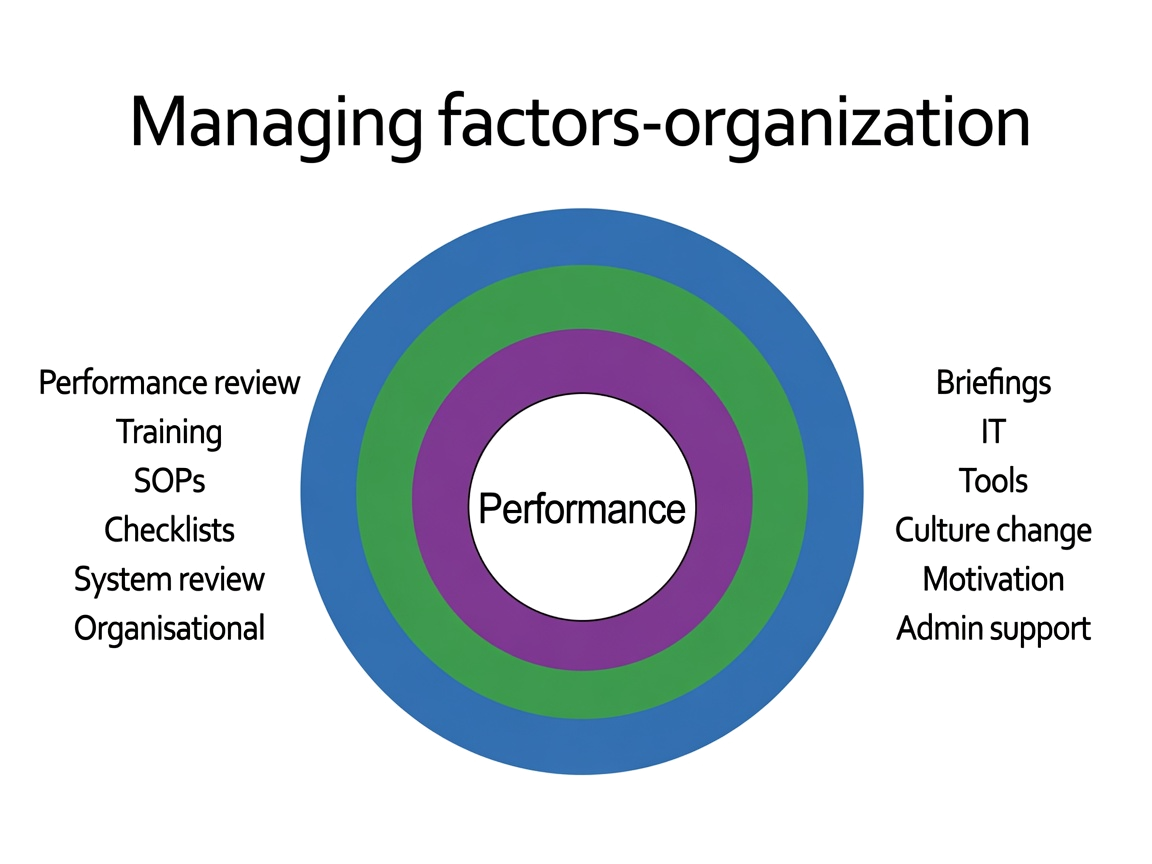
Managing factors at the organisation face are the levers an operator pulls to shape the conditions under which crew performance is produced. They sit upstream of any individual flight: the SOP the crew follows, the checklist they use, the briefing format that shaped their pre-flight preparation, the training programme that built their competencies, the IT systems they rely on, the culture-change programme that has or has not landed. When a performance shortfall traces back through a potential factor (for example, an under-specified procedure) the organisation face is the place the instructor and the organisation look for the durable fix.
Face 4: Managing factors (individual)
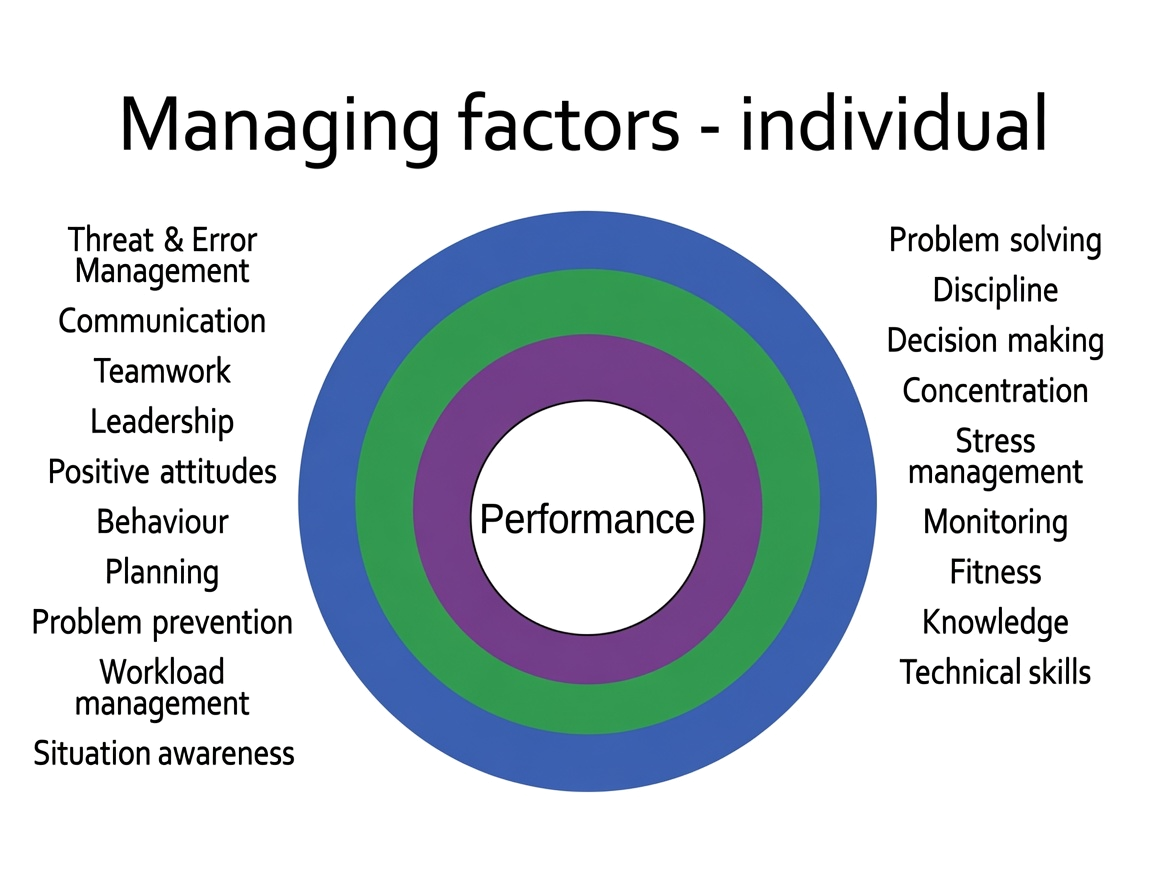
Managing factors at the individual face are what the crew member can themselves bring to bear on the conditions in which they operate. The list is recognisable as the operationalisation of the EBT core competencies (TEM, Communication, Leadership and Teamwork, Workload Management, Situation Awareness, Problem Solving and Decision Making, Application of Procedures, Application of Knowledge, Manual Aircraft Control, Automation) plus the personal-discipline elements (Discipline, Fitness, Stress Management, Concentration). When a performance shortfall traces back through a potential factor that the organisation cannot fix at the SOP or training level (a one-off illness; a personal stressor), the individual face is where the durable fix sits.
Reading the model in practice
Connections
- A4.B.2 Overview. The data-driven case for EBT this thinking aid is the per-session companion to.
- A4.B.4 Behaviour. The next section, which catalogues the four behaviour types (Direct aggression, Indirect aggression, Submissive, Assertive) the instructor's own performance is expressed through.
- Core competencies. The framework whose individual face is operationalised in the Managing-Individual list.
- Behavioural indicators. The observable evidence the model traces back to root cause.
- Threat and error management. The first item on the Managing-Individual face; the crew's primary lever on potential-factor contamination.
- 7.3 General Debrief Techniques. The debrief discipline the model feeds into; the why-question this thinking aid asks is the question the facilitator works the crew through.
- Root cause analysis. The discipline the model is a vehicle for; tracing direct → potential → managing is the operationalisation.
- CRM. The historical precedent for human-factors thinking in pilot training; the Performance-Influences model is the EBT-specific evolution.