
10.1 Human Behaviour
10.1.1 The relationship between the instructor and the learner
The instructor / learner relationship has a profound impact on how the student learns. The instructor is the symbol of authority, and is expected to exercise certain controls. The learner recognises and submits to authority as a valid means of control. The instructor's challenge is to know what controls are best for what circumstances. The instructor should create an enabling environment: one that enables students to help themselves.
The instructor directs and controls the behaviour of the students and guides them toward a goal. This is a process of directing the learner's actions and modifying their behaviour. The controls the instructor exercises (how much, how far, to what degree) should be based on more than random selection or trial and error.
10.1.2 Stress
Stress in flight training comes in two varieties: physical and emotional.
- Physical stresses are those applied to the pilot by aero medical factors.
- Emotional stresses are those that touch the affective element of the pilot.
Physical stress also has an effect on the affective element. If the pilot is stressed physically beyond the body's ability to cope, attitudes, emotions, values, and feelings may be affected.
Emotional stress produces anxiety. The normal cognitive response to tolerable anxiety is a heightened awareness and alertness. The pilot who is preparing to initiate a difficult or dangerous manoeuvre is in a higher state of awareness than the pilot practising straight and level flight. This higher state of awareness makes the pilot more susceptible to learning and aids retention. As the senses become more attuned to sensations, the intensity of perceptions is magnified. The more intense the perceptions, the longer the learning will last. When the affective element perceives the stress as tolerable, it allows the mind or cognition to extend this higher state.
The corollary is operationally important: stress that is not tolerable does not extend cognition; it shuts it down. The instructor's job is to read the trainee's stress level and either absorb load (by simplifying the scenario, slowing the pace, or freezing the simulator per 9.10 Factors that can Affect Simulator Training) or stand back and let the productive stress run.
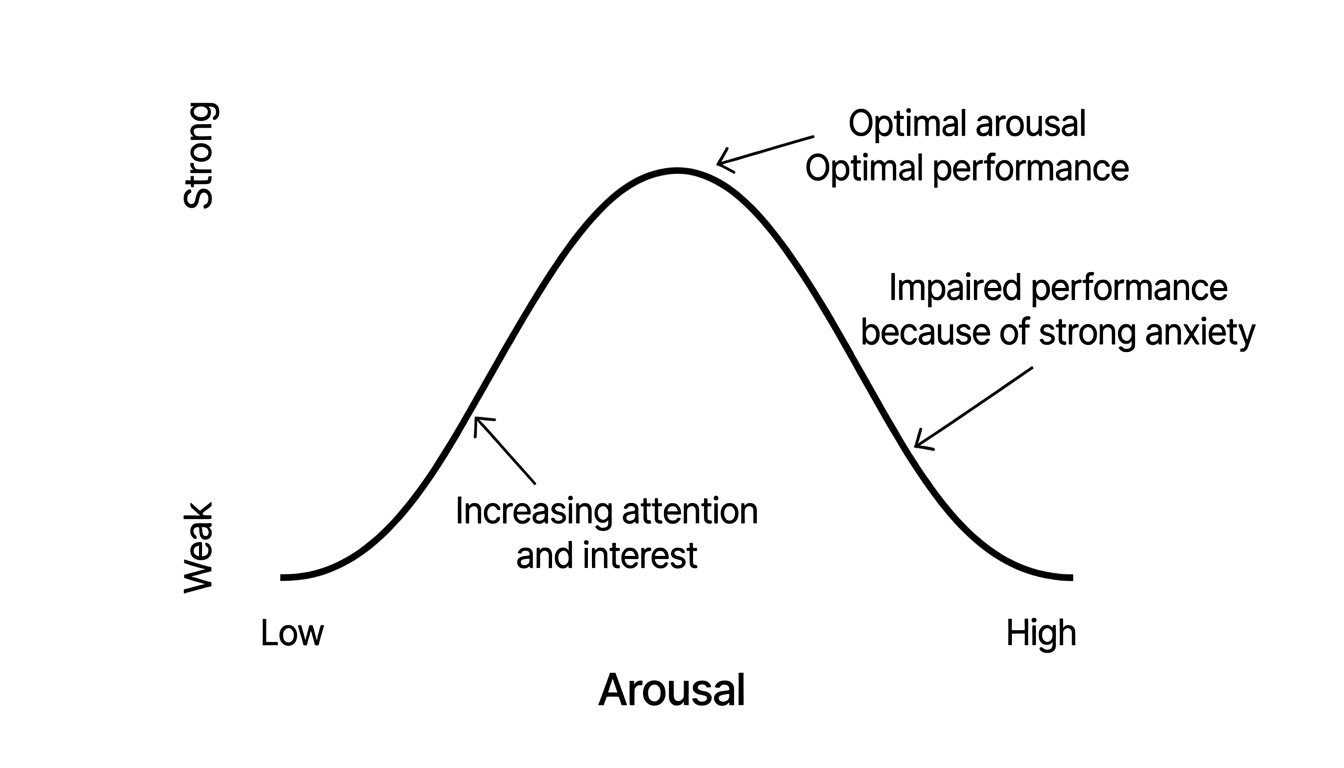
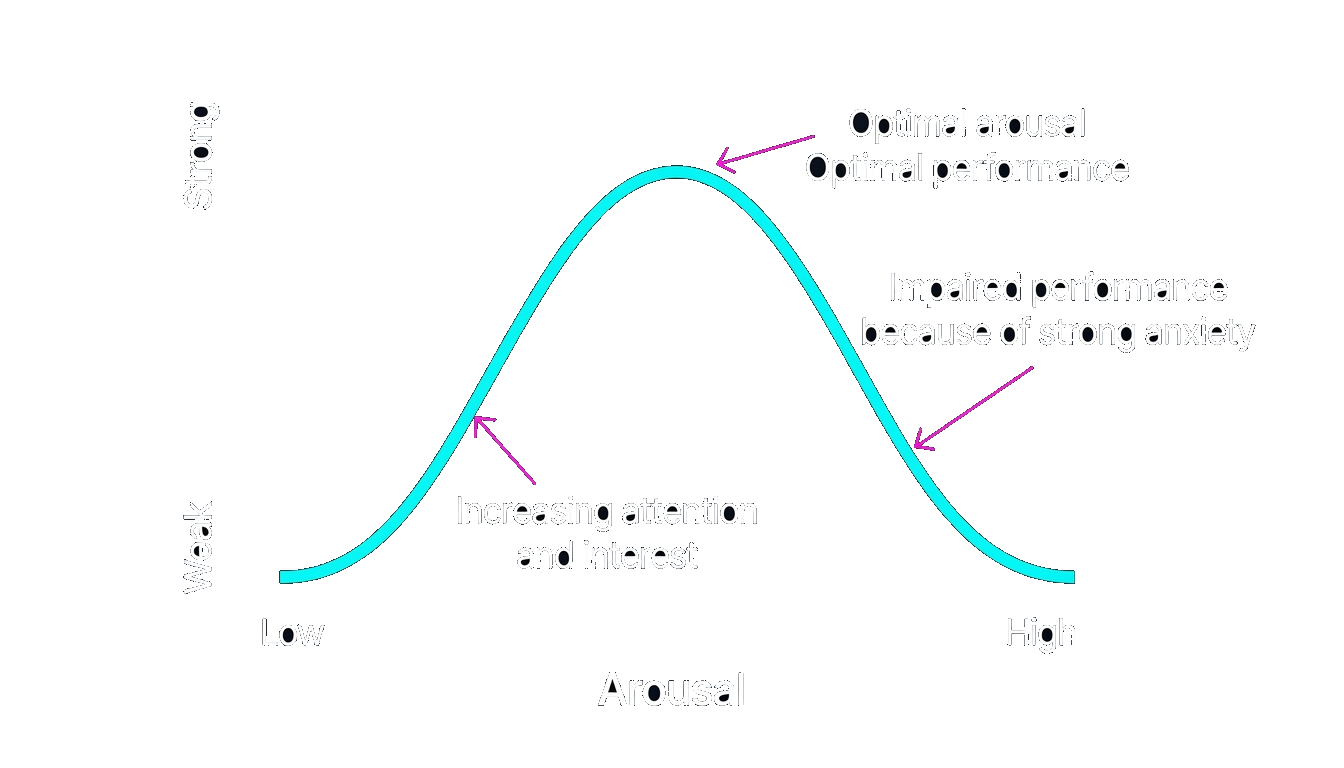
The Yerkes-Dodson inverted-U curve underlying the tolerable-stress framing: arousal raises performance up to an optimum, then degrades it under strong anxiety. The instructor keeps demand in the rising / peak band, not past the point where performance collapses.
10.1.3 Laws of Learning
Human behaviour in flight training names three laws and treats each in turn.
Law of Readiness
Students learn best when they are ready to learn. Knowledge and information are stored in the cognitive element any time the brain is stimulated. Knowledge does not become learning until behaviour is evident. The cognitive element may store knowledge upon knowledge; however, that knowledge cannot become behaviour without being filtered through the affective element. In the affective element, the law of readiness is activated. Provide a strong purpose, a clear objective, and a well-fixed reason for learning.
Law of Exercise
This law states that those things most often repeated are best remembered. It is the basis of practice and drill. The cognitive, affective, and behavioural elements are not infallible; they can rarely retain, evaluate, and apply new concepts or practices after a single practice. Feelings, attitudes, values, and emotions need frequent and repetitious exercise to become consistent. If not continuously monitored and strengthened, the student's affective element will revert to a previous structure.
Law of Effect
This law is based on the affective reactions of the student. Learning is strengthened when accompanied by a pleasant or satisfying affectation. When the cognitive process is being affected, the affective element labels knowledge and information as positive or negative. Cognition becomes behaviour (learning occurs) more easily if the affective element has a positive association with the process.
10.1.4 Human Needs
Abraham Maslow, of Brandeis University, organised human needs into a pyramid and divided them into five levels: physical needs, safety needs, social needs, ego needs, and self-fulfilment needs. The higher level needs (such as ego and self-actualisation) cannot be fulfilled until all those needs on the low strata are satisfied. One cannot be motivated to realise one's potential to be creative if hunger and safety are providing the motivation.
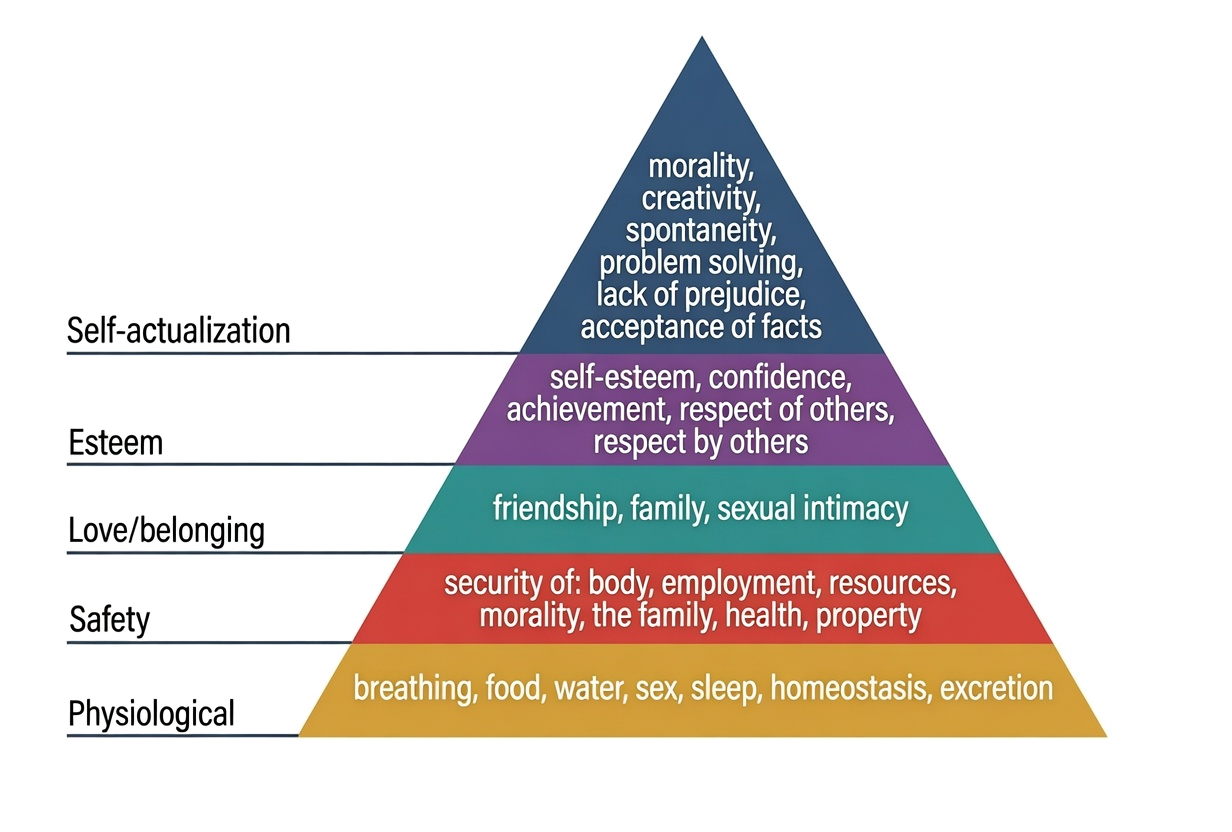
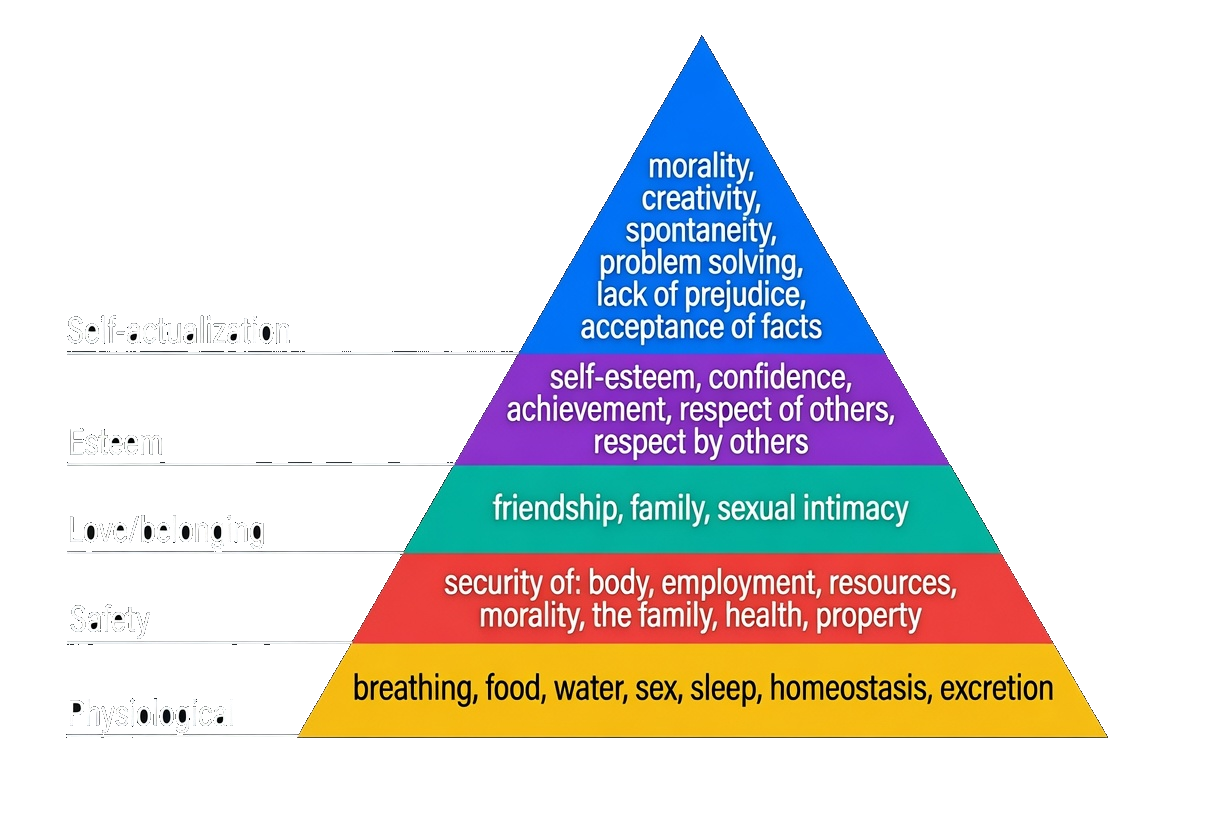
Maslow's hierarchy of needs as referenced in human behaviour material: physical, safety, social (belongingness), ego (esteem), and self-fulfilment (self-actualisation). Lower-tier deficits block higher-tier engagement.
The ego needs have a direct influence on the student / instructor relationship. Those needs are two-fold:
- Those that relate to one's self-esteem (needs for self-confidence, for achievement, for competence, for knowledge); and
- Those that relate to one's reputation (needs for status, for recognition, for appreciation, for the deserved respect of one's fellows).
The self-fulfilment needs are realising one's potential, continued development, being creative in the broadest sense of that term. The needs of a student should offer the greatest challenge to the instructor. Aiding another in realising self-fulfilment is perhaps the most worthwhile accomplishment an instructor can achieve.
The instructor can ensure a healthy environment for learning by striving to help the learner satisfy these needs. When the instructor works for good human relations, the learner experiences fewer frustrations and can therefore devote more attention to learning.
10.1.5 Perception and the influencing factors
Sight and sound are the two primary perceptual inputs to the cognitive element. Learning occurs most rapidly when information is received through more than one sense. Perceiving involves more than the reception of stimuli from the five senses: perceptions do not occur until the cognition element gives meaning to the sensations. Several factors affect the cognition element's ability to give meaning to sensations. One is physical, the remaining three are affective.
Physical organism
The physical organism is the means by which individuals bring sensations to the cognition element to become perceptions. Acute problems explained as aero medical factors and chronic problems associated with age and disease can change the perceptual apparatus for various periods of time. A head cold may distort hearing and balance. Age may permanently impair sight. Constantly be aware of perceptual distortion in the student.
Basic need (self-concept)
A person's basic needs are first to protect, and second to enhance, self. How one pictures oneself is the most powerful determinant in learning. Self-concept is an affective value and affects all perception. The affective element filters cognition before it becomes behaviour; likewise, the affective element filters perceptual input before it becomes cognition. Before information (by way of experience) becomes cognition, it must be filtered through the student's feelings, values, attitudes, and emotions.
If experiences and information tend to support a favourable self-image, the student tends to remain receptive to subsequent experiences. If a student has negative experiences that tend to contradict the self-concept, there is a tendency to reject additional training. Being required to fly in a less prestigious aircraft, or perform in a lesser position, can often cause a student to reject training or to take performance requirements lightly.
Negative self-concepts inhibit the perceptual processes by introducing psychological barriers (defence mechanisms). These barriers tend to keep the student from perceiving or properly implementing what is perceived. Helping people learn requires finding ways to aid them in developing better perceptions in spite of their defence mechanisms. The catalogue of defence mechanisms (rationalisation, escapism, aggressiveness, resignation) and the four ways to minimise trainee frustration is treated in detail in 10.2 The Trainee.
Goals and values
Every experience and sensation that is funnelled into the cognitive element is filtered by the individual's own beliefs and values. It is important to know the student's precise kinds of commitments and philosophical outlooks. This knowledge will assist in predicting how the student will interpret experiences and instructions.
Motivations
Motivations are a product of one's affective element. Those things that are more highly valued and cherished are pursued; those of less value and importance are not sought. Positive motivations are those that enhance one's self-image. Negative motivations debase or detract from an individual's view of themselves or their perception of how others view them.
Threats
Fear is another affectation that affects students' perceptions by narrowing their perceptual field. Confronted with threats, students tend to limit their attention to the threatening object or conditions. For example, when an individual is critiqued repeatedly on take-off procedure, their field of vision and cross check are reduced. Learning is a psychological problem, not a logical one. Cognition and behaviours are logical; affectations are psychological. Realising that input to and output from the cognitive element is filtered through the affective element, the good instructor will facilitate the learning process by keeping the affective element clear and open.
10.1.6 Flight behaviour
Flight behaviour is the ability to perform a flight task within designated parameters or the ability to group tasks together for performance. The instructor's responsibility is to assist each pilot in acquiring new flight behaviour or in changing faulty flight behaviour. The instructor must understand the dynamics and the process of flight behaviour. To achieve the goal of understanding flight behaviour, divide the pilot's personality into the knowledge (cognitive), skill (behavioural) and affective (attitude) elements. An understanding of the interrelationship between knowledge, attitude, and skill (the KSA triad) sets the stage for an understanding of how people learn and how to enhance that learning through instruction.
The Performance-Influences (Human Factors) model
The Performance-Influences model is the EBT-specific human-factors framework that complements the general human-behaviour treatment above. It is reproduced as a reminder of the model the instructor was trained on; the textual treatment lives in A4.B.1 EBT Introduction. The framing:
The model is a layered onion: at the centre, performance; around it, four faces of factors that influence performance.
Composite model
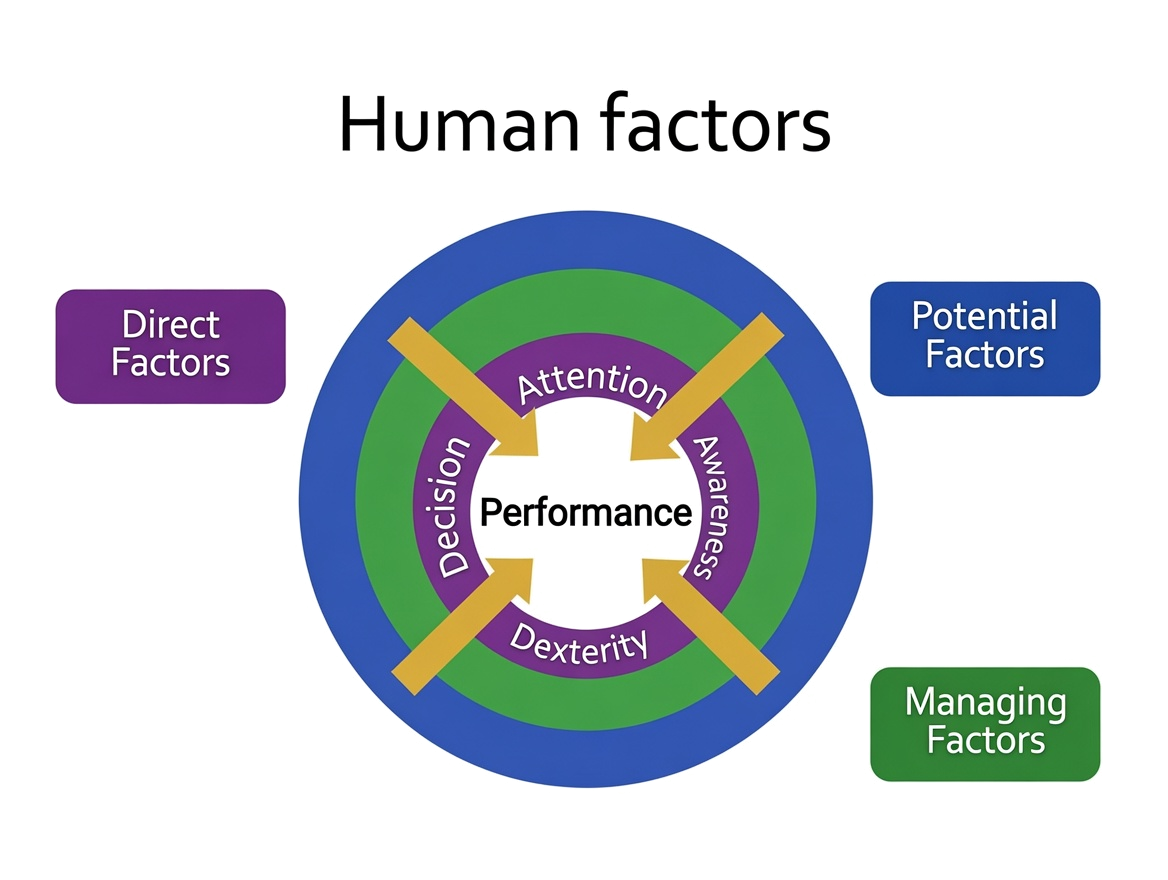
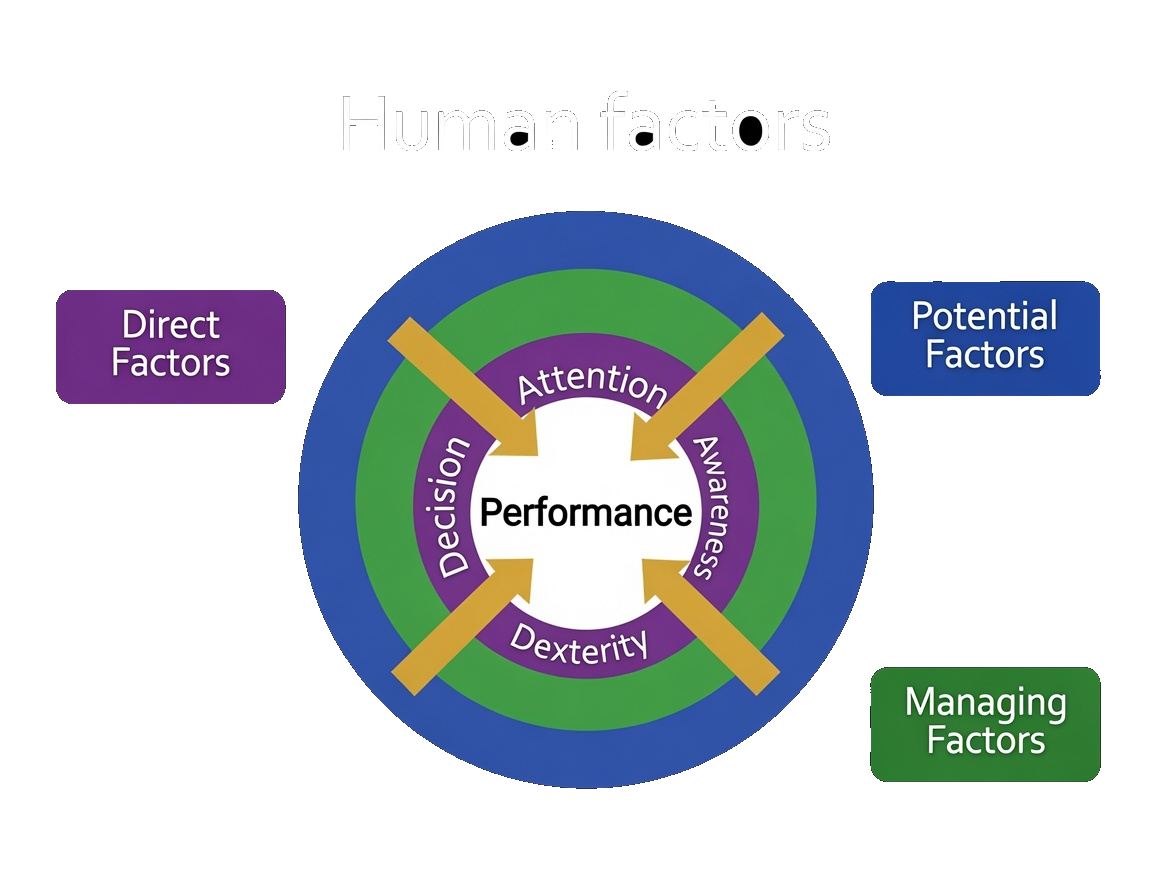
The composite shows the four faces wrapped around a central performance core: Direct factors (the acts or omissions that directly affect performance: decision, dexterity, attention, awareness), Potential factors (the latent conditions that load the trainee toward error), Managing factors at the organisation level, and Managing factors at the individual level. The four faces are not parallel: direct factors are the proximate causes of an observed performance; potential factors are the conditions that made those proximate causes more likely; managing factors are the levers (organisational and personal) that change the potential and direct factor profile over time. Root-cause analysis works inward from observation (what did the crew do?) to direct factor (which of decision / dexterity / attention / awareness was implicated?) to potential factor (which latent condition primed it?) to managing factor (which organisational or individual lever could change the next outcome?).
Direct factors
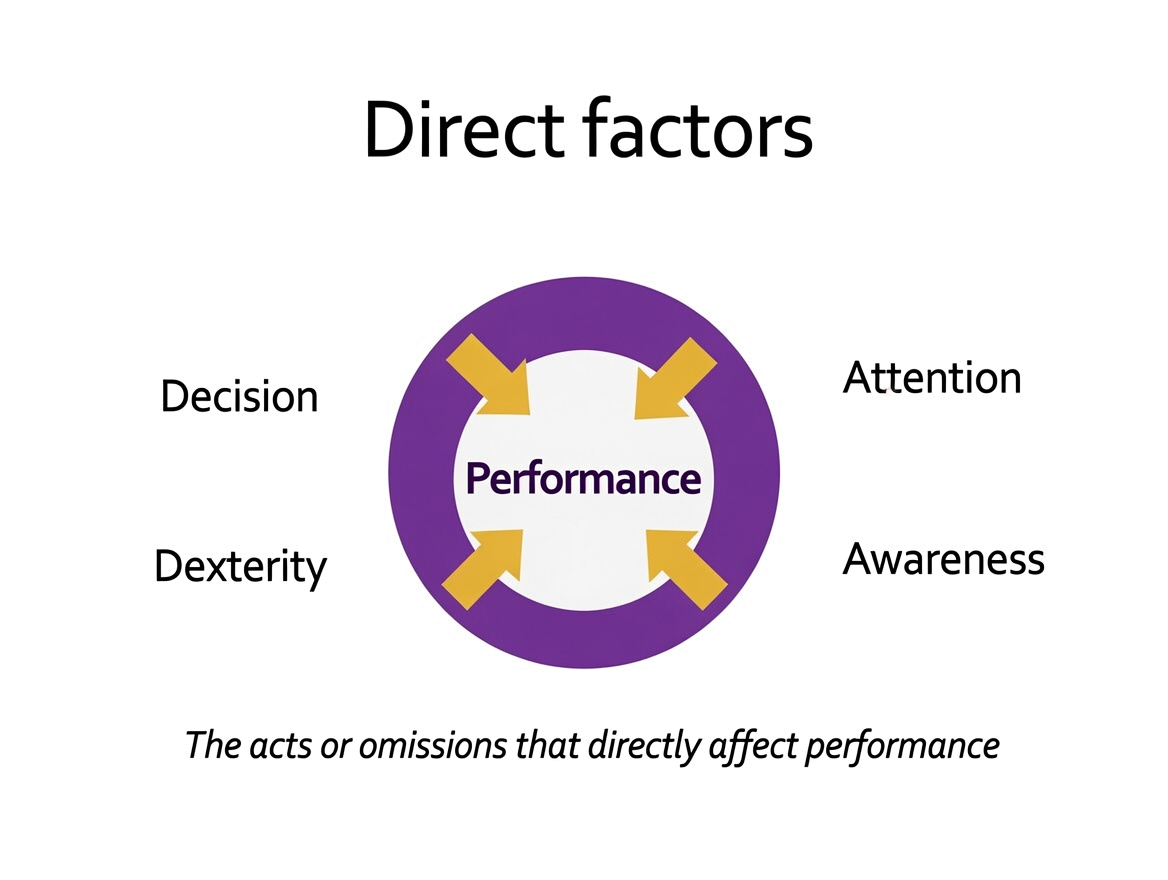
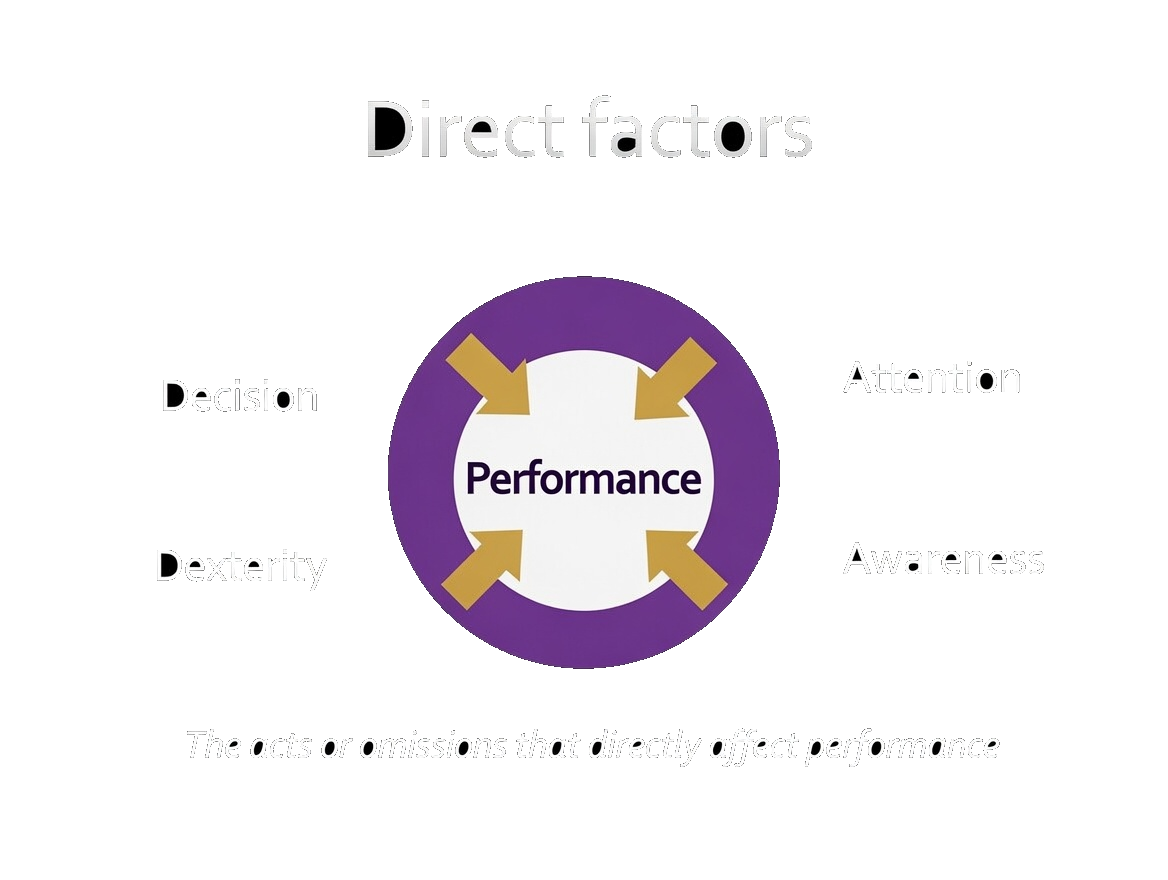
The four direct factors (decision, dexterity, attention, awareness) are the acts or omissions that directly affect performance. They are the layer the instructor observes most readily in the simulator: a decision was made or not made, a control input was correct or not, attention was directed to the right cue or not, situation awareness held or broke. The three laws of learning above and the KSA triad (knowledge / skills / attitudes) sit one layer behind: the direct factors are how the trainee's knowledge, skill, and attitude show up in the cockpit on this run.
Potential factors
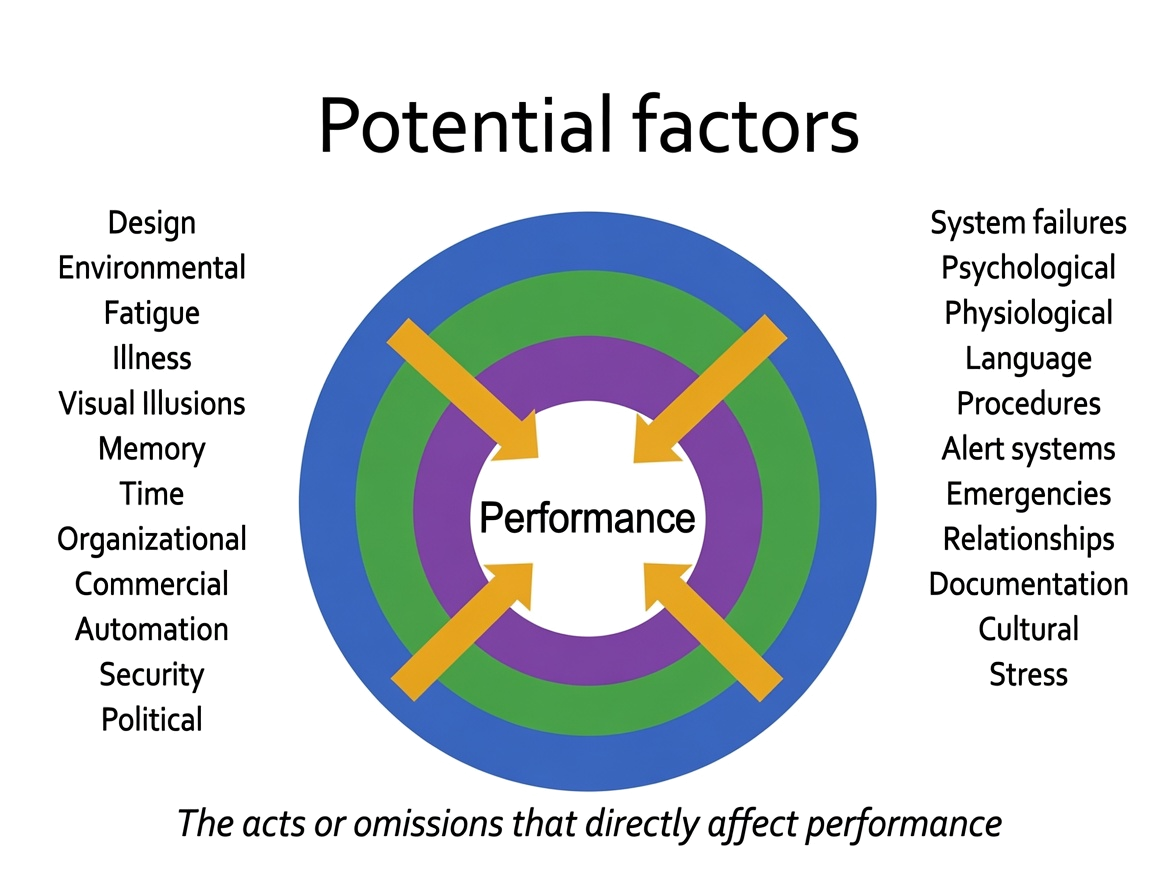
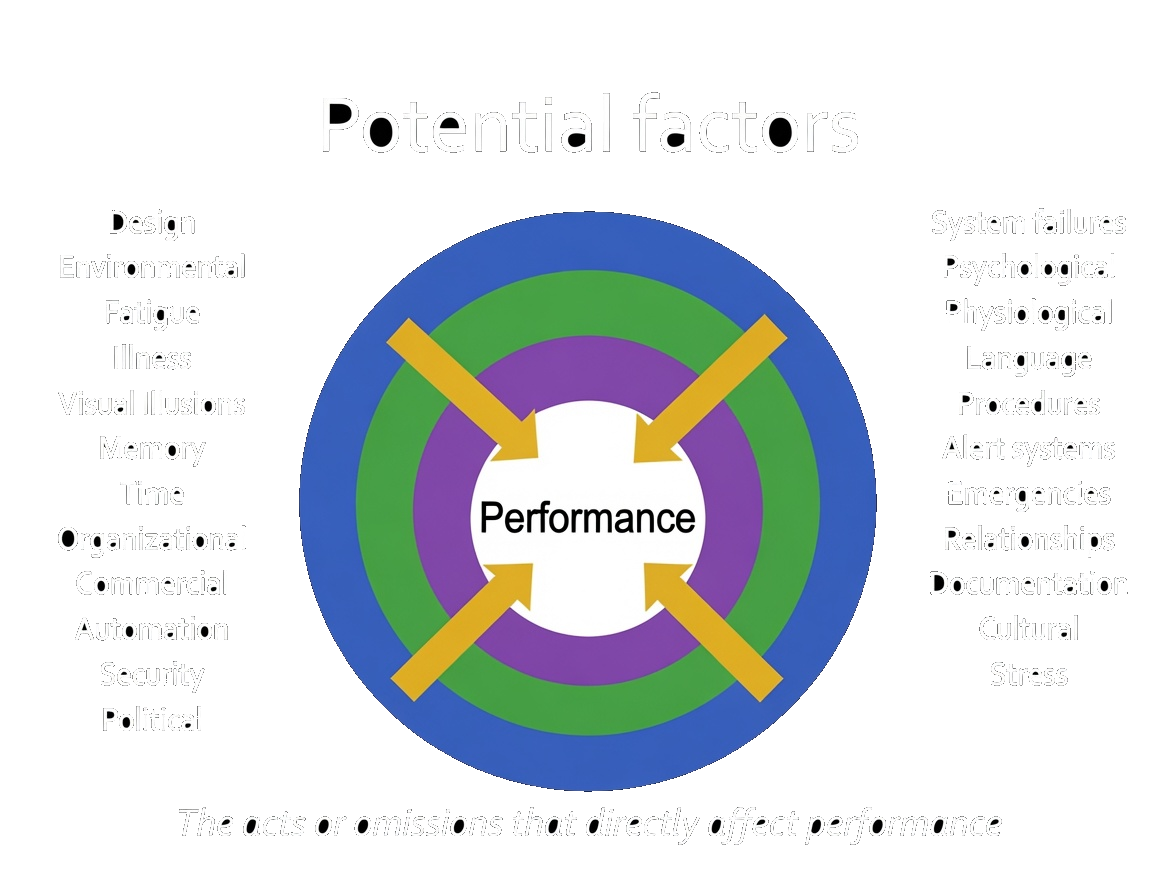
The potential factors are the latent conditions that load the trainee toward error or toward effective performance. A4.B.3 Human Factors Model lists them in two columns: design, environmental, fatigue, illness, visual illusions, memory, time, organisational, commercial, automation, security, political; and system failures, psychological, physiological, language, procedures, alert systems, emergencies, relationships, documentation, cultural, stress. The list is deliberately wide because it is the manifold of conditions that any given simulator session draws from. Most of these factors are not visible in the cockpit recording; they have to be drawn out in the debrief, often through facilitation.
Managing factors: organisation
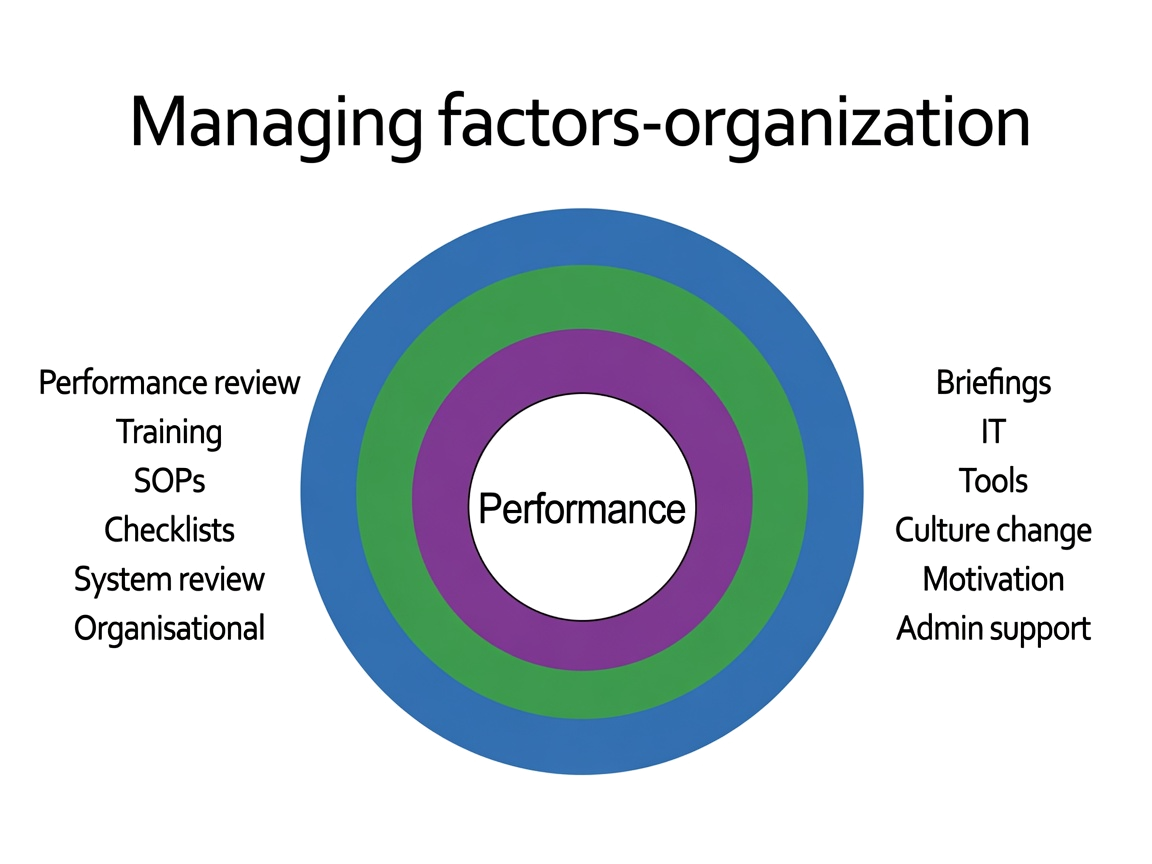
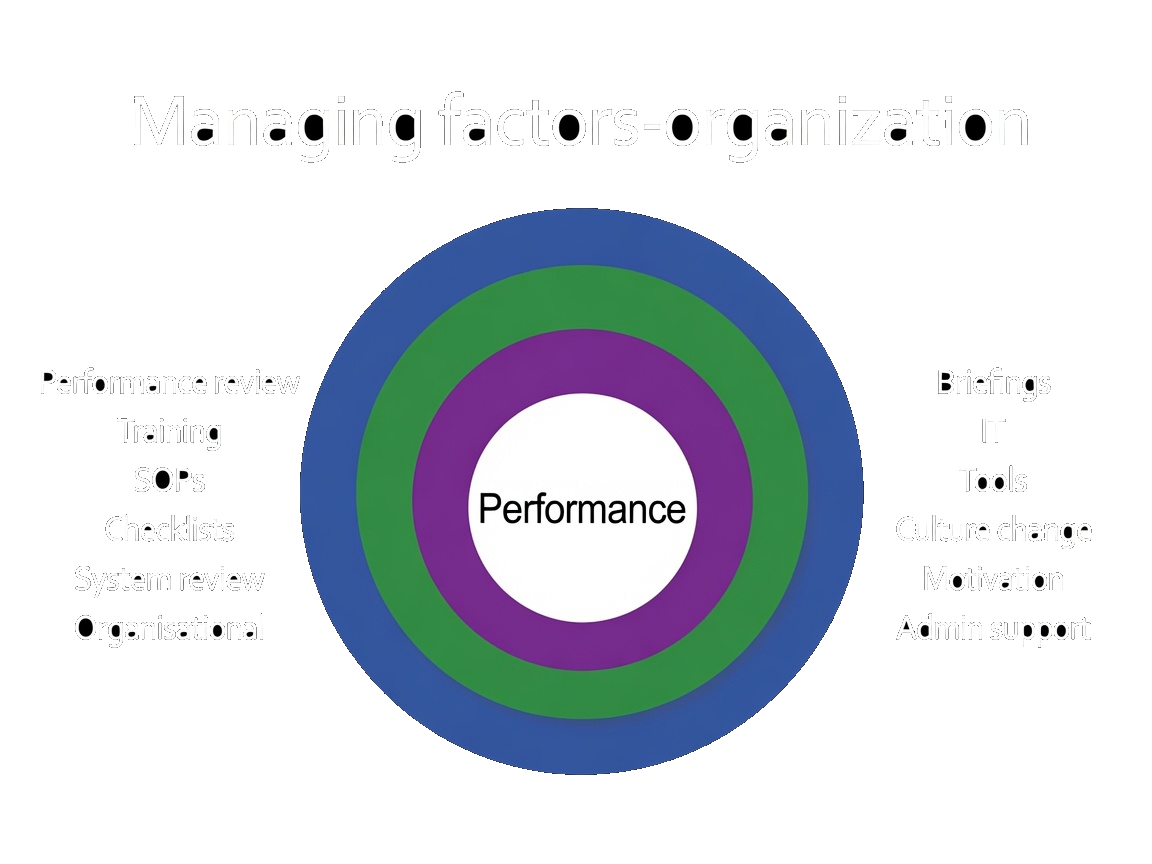
The organisation-level managing factors are the levers an operator owns: performance review, training, SOPs, checklists, system review, organisational, briefings, IT, tools, culture change, motivation, admin support. These are the factors a single instructor cannot change in the moment but can flag for the training department: a chronic deficiency observed across multiple crews points to one of these levers being mis-set.
Managing factors: individual
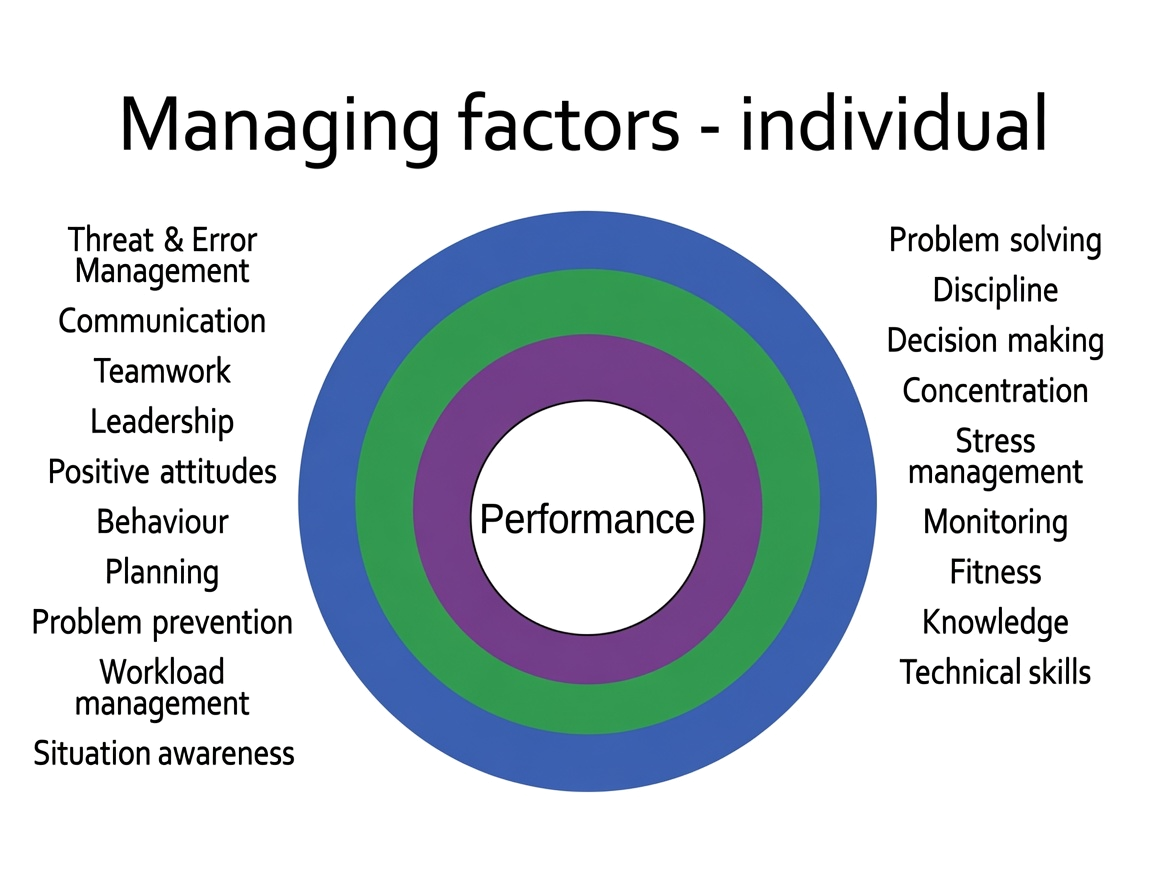
The individual-level managing factors are the levers the trainee owns: threat and error management, communication, teamwork, leadership, positive attitudes, behaviour, planning, problem prevention, workload management, situation awareness, problem solving, discipline, decision making, concentration, stress management, monitoring, fitness, knowledge, technical skills. The list overlaps substantially with the ICAO core competencies and with the KNO knowledge competency used in this framework: individual managing factors are, in effect, the trainee's competency profile expressed in human-factors language.
Connections
- 10.2 The Trainee. The trainee side of the relationship: defence mechanisms, the four-step protocol for minimising frustration, adult-learner characteristics, cultural differences.
- 10.3 Learning Styles. The Honey-Mumford four-type taxonomy (activists, reflectors, theorists, pragmatists) the instructor adapts to.
- 10.4 The Instructor. The instructor side: the Skills / Trainees / Instructor triangle, the good-instructor qualities, the bad-instructor patterns, the assertive-versus-aggressive-versus-submissive behaviour distinction from the EBT instructor handbook.
- A4.B.1 EBT Introduction. The textual treatment of the Performance-Influences model whose figures are embedded above.
- 2.3 Behaviour. Learning theory's treatment of behaviour as the observable end of the cognitive / affective / behavioural triad.
- 2.4 Motivation. Learning theory's treatment of motivation, which the Maslow material above reframes in terms of the needs hierarchy.
- 2.5 Needs. Learning theory's preview of the Maslow material developed above.
- 2.6 Perception and Understanding. Learning theory's treatment of perception that the influencing-factors catalogue above extends.
- ICAO Doc 9995 Conduct of EBT. The ICAO chapter on conduct of EBT whose root-cause requirement (7.7.1) the Performance-Influences model operationalises.
- KSA. Knowledge / skills / attitudes; the triad invoked in the flight-behaviour section as the unifier of the cognitive, behavioural, and affective elements.
- Core competencies. The ICAO competency framework whose elements overlap with the individual-level managing factors of the Performance-Influences model.