
2.4 Motivation
Motivation is a very strong force and may be positive or negative, tangible or intangible. It is described as the force that impels a person to a goal. Negative motivations are those that engender fear or threats and are not usually a factor in flying training. Positive motivation is more obvious and is the instructor's prime method to encourage the trainee to learn.
There has been a great deal of research conducted on the subject of motivation and how trainees learn. Principally, an individual will have various needs that are the basic forces motivating a person to do something. Maslow created a hierarchy list, where on attaining the first basic level the trainee would then move to the next level of need and ultimately be goal-oriented towards the upper levels.
Maslow's hierarchy of needs
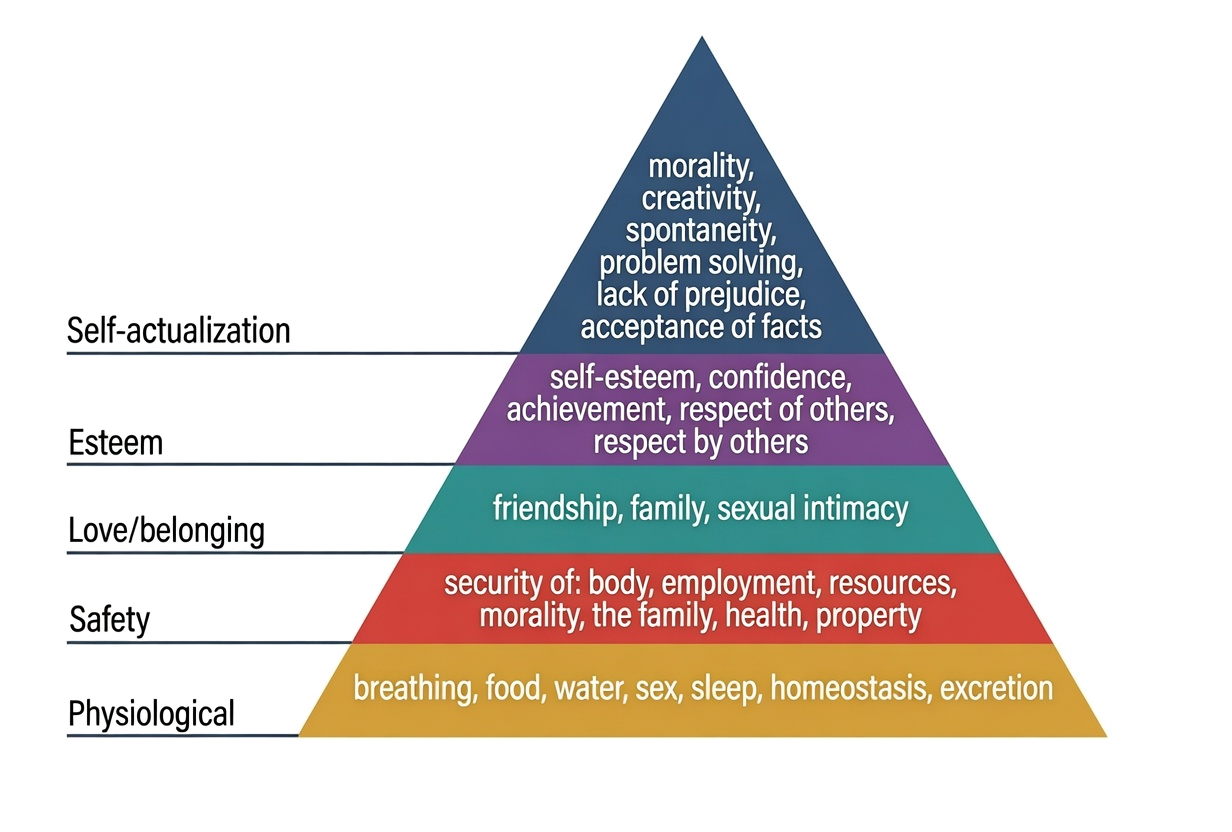
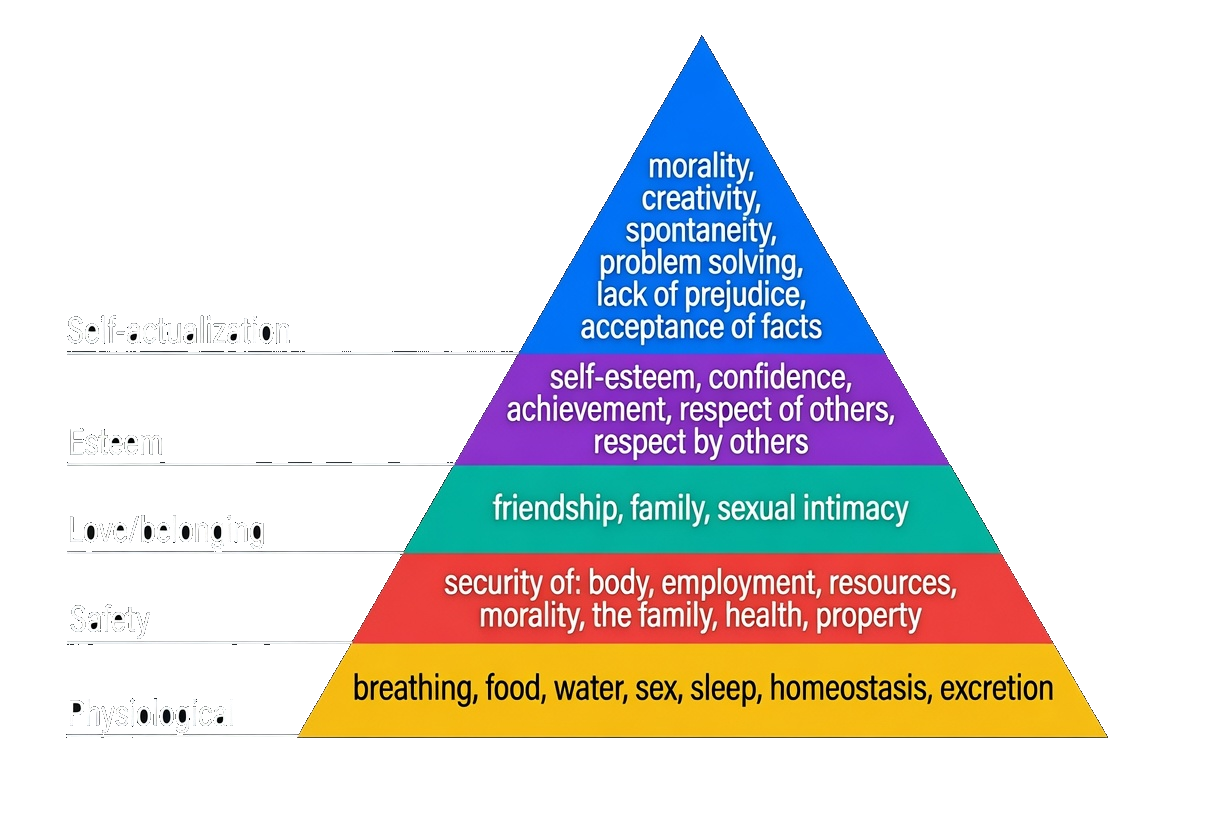
Maslow's five-level hierarchy of needs: physiological at the base, then safety, belongingness, esteem, and self-actualisation at the apex. Motivation material argues pilot training engagement lives in the top two tiers.
Motivation material lists Maslow's five levels in descending order from the apex of the pyramid:
| Level | Includes |
|---|---|
| Self-actualisation | Morality, creativity, problem solving, etc. |
| Esteem | Confidence, self-esteem, achievement, respect, etc. |
| Belongingness | Love, friendship, intimacy, family, etc. |
| Safety | Security of environment, employment, resources, health, property, etc. |
| Physiological | Air, food, water, sex, sleep, other factors towards homeostasis, etc. |
The lowest basic level on the hierarchy, physiological needs, includes necessities such as air, food, and water. These tend to be satisfied for most people but become predominant when unmet.
During emergencies, safety needs such as health and security rise to the forefront.
Once these two levels are met, belongingness needs, such as obtaining love and intimate relationships or close friendships, become important.
The next level, esteem needs, include the need for recognition from others, confidence, achievement, and self-esteem.
The highest level is self-actualisation, or self-fulfilment. Behaviour in this case is not driven or motivated by deficiencies but rather one's desire for personal growth and the need to become all the things that a person is capable of becoming. These are sometimes referred to as "growth needs."
The hierarchy is descriptive, not strictly sequential in real human life: people pursue esteem needs while their belongingness needs are imperfectly met, and trauma can flip an individual back down the hierarchy regardless of where they normally operate. The model's contribution to the instructor is the recognition that when a trainee shows up under-slept, distracted by a family crisis, or fresh from a layoff scare, the lower-tier needs are not yet satisfied and the higher-tier engagement the instructor is counting on will not be reliably available. The right response is not to ignore the situation; it is to recognise it and to adapt the session expectations to what the trainee can actually bring.
Reward-based motivation: Kenney's list
It is too simplistic to state that motivation is simply a force derived from satisfying various needs. Adult human behaviour demonstrates that individuals are also motivated by reward. Kenney quotes a useful list of factors based on rewards:
- Achievement motivation: for which the reward is success.
- Anxiety: for which the reward is avoidance of failure.
- Approval motivation: for which the reward is approval in its many forms, public recognition, and improvement of self-image.
- Curiosity: for which the reward is increased opportunity to explore the environment and be exposed to novel stimuli.
- Acquisitiveness: for which the reward is something tangible such as money or material benefit.
The five factors are not mutually exclusive. A given trainee in a given session is motivated by some mix of all five. The instructor who can identify which factor is dominant for which trainee can shape the session's incentives accordingly: the achievement-motivated trainee responds to clear standards and visible progress; the anxiety-motivated trainee responds to risk reduction and predictability; the approval-motivated trainee responds to feedback and recognition; the curiosity-motivated trainee responds to scenarios that genuinely surprise; the acquisitiveness-motivated trainee responds to the link between the training and concrete career or financial outcomes.
Operational implications for the instructor
The motivation discussion appears immediately before 2.5 Needs because the two are paired: motivation is the force, needs are what give the force its direction. The operational instructor checklist (the E-factor calculus and the factors-affecting-motivation list) lives in 2.5 Needs. What this section commits the instructor to is:
- Recognise that the trainee is bringing a mix of motivation drivers into the session, dominated (in a normal flight-training population) by esteem and self-actualisation needs.
- Recognise when the lower-tier needs are not satisfied and the higher-tier engagement is therefore unreliable; adjust expectations accordingly.
- Use positive motivation by default; treat negative motivation (fear, threat) as a fallback that is rarely useful in flight training and usually counter-productive.
- Identify the trainee's dominant reward factor and shape session incentives to it.
The next section (2.5 Needs) develops the calculus that ties needs, the effort-energy-excitement-expenditure (E) the trainee will invest, and the results that satisfy the need.
Connections
- 2.2 The Learning Process. Motivation is the all-important condition of learning identified there.
- 2.5 Needs. The next section, which develops Handy's E-factor model and the practical motivation checklist.
- 2.3 Behaviour. The output that motivation drives.
- 2.6 Perception and Understanding. The lens through which the trainee perceives the training as worth motivating themselves to engage with.