
10.4 The Instructor
10.4.1 Instructor / Student Relationship
In the learning setting, there are three main factors:
- Skills to be learned.
- Trainees to learn them.
- An instructor who possesses these skills, and whose job it is to teach these skills to the trainees.
This can be presented diagrammatically as follows:
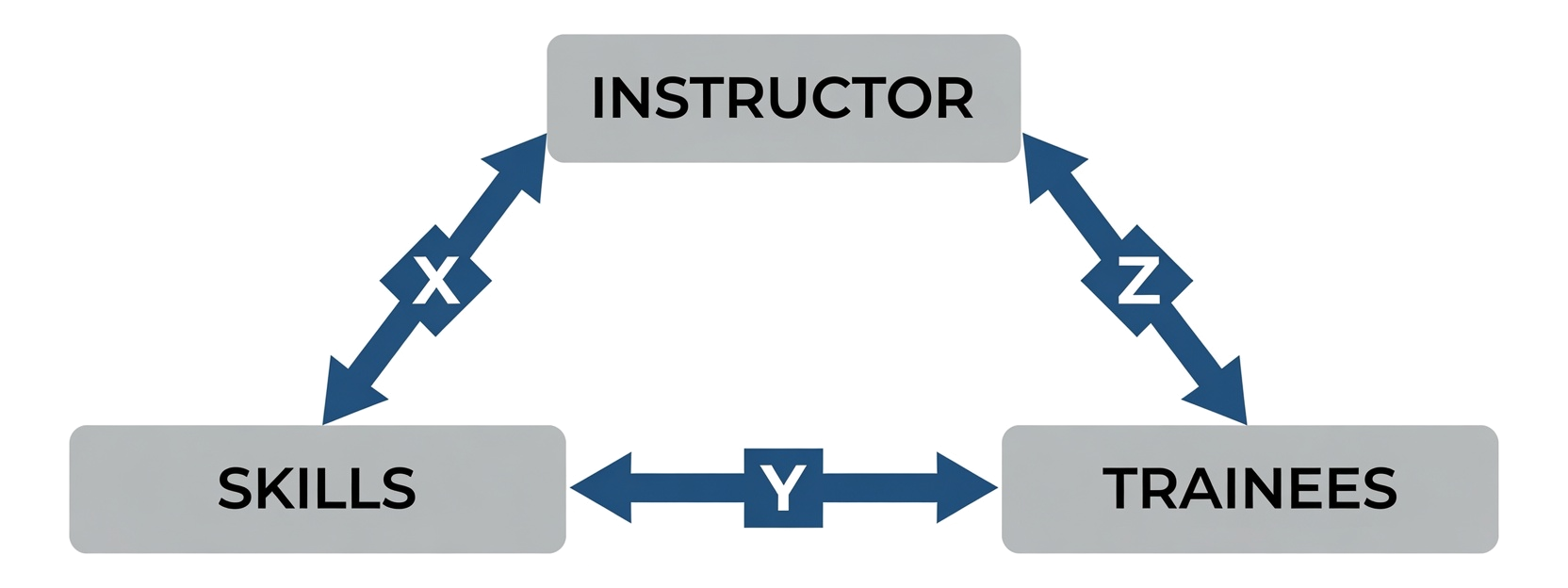
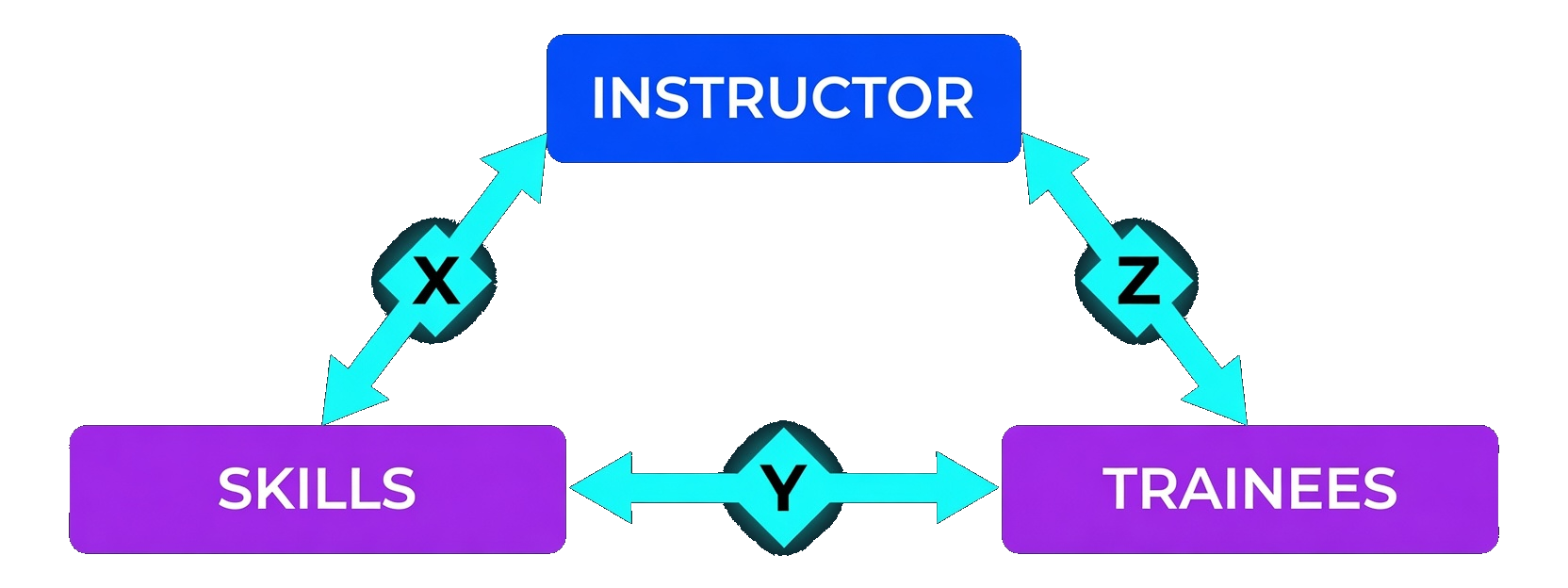
Where:
- X = Skills of trade.
- Y = Trainee attitudes / instructor's instructional skills.
- Z = Instructor / trainee relationships.
The presence of Factor X is taken for granted. Factor Y is dealt with in the trainee and adults-in-training material above (10.2 The Trainee and 10.3 Learning Styles) and in the instructional-skills material throughout the Train-the-Trainer Course Manual. The aim of this section is to examine Z, the instructor / trainee relationship, from the point of view of the personality and attitude of the instructor.
10.4.2 General Instructor Attributes
There are probably as many kinds of instructor personalities as there are instructors. There is no "ideal" instructor. Certainly there are "good" and "bad" instructors, as any trainee will tell you. But what is the difference?
10.4.3 The "good" instructor
The personality of the good instructor tends to be marked by one major factor:
To achieve these roles, and to continue to function as line pilot, the instructor needs a formidable list of personal qualities. The full list:
| Quality | Quality |
|---|---|
| Patience | Confidence |
| Understanding | Authority |
| Tact | Empathy |
| Humour | Self-discipline |
| Enthusiasm | Neatness |
| Cheerfulness | Approachability |
| Encouragement | Impartiality |
| Trustworthiness | Consistency |
| Responsibility | (and so the list could continue) |
This is a formidable list indeed. There are very few people who consistently exhibit all these qualities. The good instructor, however, is the one who tends to:
The framing carries the load: the good instructor is not the instructor who maximises any one quality but the instructor who reads the situation and delivers the right blend for it. Maximum patience with a trainee who is exploiting it is a vice; maximum authority with a trainee who is already over-stressed is a vice; the same quality is correct or incorrect depending on the moment.
10.4.4 The "bad" instructor
Obviously, the bad instructor will be the complete opposite of the good. They will be:
| Quality | Quality |
|---|---|
| Impatient | Arrogant |
| Sarcastic | Autocratic |
| Overbearing | Morose |
| Sloppy | (and so the list could continue) |
However, an instructor could also be regarded as bad because of an over-abundance of the good qualities. They could be over-confident, excessively full of humour, painstakingly tactful, or over-solicitous about the trainee's welfare. Again:
The symmetry here is deliberate. Bad instruction is not only the absence of the good qualities; it is also their excess. The reader who finishes the good-instructor list with the implicit assumption that "more patience is always better" is corrected by the bad-instructor list: more is not always better. Calibration is the operational skill.
The behavioural complement from the EBT instructor handbook
The EBT instructor and examiner training material includes a behavioural model that complements the personal-qualities list above with a read on the instructor's own conduct. The textual treatment lives in A4.B.1 EBT Introduction; the four behavioural patterns the model names are summarised below because they map directly onto the good / bad / over-abundance distinction set up above.
Direct aggression, indirect aggression, submissive, assertive
Four behavioural postures the instructor can adopt. The first three are non-productive; the fourth is the target.
| Posture | Markers |
|---|---|
| Direct aggression | Loud, forceful, anger, posture, invading space, shouting, abusive, violent, glaring, finger-pointing |
| Indirect aggression | Sarcasm, condescending, belittling, spreading rumour, gossip, hides behind humour, dishonest, confusing, manipulative, sulking |
| Submissive | Quiet, avoid eye contact, apologetic, nervous, timid, agrees with everything, does not express opinion, does not argue, never says no, does not make decisions, does not ask questions |
| Assertive | Friendly and relaxed, confident, open and honest, expresses feelings and opinions, has empathy, listens to understand questions, clear and concise, gives criticism and praise, manages and reads body language, comfortable eye contact, asks for what they want, says no, willing to compromise |
Three short statements frame the four:
- Behaviour breeds behaviour.
- Behaviour is a choice.
- Thought plus benefit will encourage a behaviour.
A contrast between short-term gains and long-term effects of each non-assertive posture, which is the diagnostic the instructor should run on themselves:
| Posture | Short-term gains | Long-term effects |
|---|---|---|
| Direct aggression | Get your way, keep control, get respect, save time, get results, stop protests, get your message across | Lack of respect, avoided, does not get information, personal stress, loses credibility, creates fear, no initiative from others, no support, disliked |
| Indirect aggression | Get your way, have fun, gain support of others, self-satisfaction | No trust, no respect, revenge, avoided, no progress, conflict |
| Submissive | Quiet life, to be liked, no pressure, avoid conflict, not blamed | Does not get anything, treated badly, depressed, ignored |
Your rights
The instructor's rights (and by symmetry the trainee's rights):
- I have the right to be treated with respect.
- I have the right to ask for what I want or need.
- I have the right to my own personal feelings, and to express them.
- I have the right to state my values, opinions and ideas.
- I have the right to make mistakes, be unaware or unskilled.
- I have the right to change my mind.
- I have the right to refuse a request and say "no", without feeling guilty.
- I have the right to ask for more information when I do not understand.
- I have the right to decline responsibility for other people's problems.
- I have the right to say and do the things that are more important to me.
- I have the right to decide not to assert myself.
The list is not soft: each right carries the responsibility for the consequences of exercising it. The instructor who exercises the right to refuse a request must accept the consequences of that refusal; the same logic applies to the trainee.
The LISTEN acronym
The active-listening discipline (treated more fully in 7.3 General Debrief Techniques and A1.4 Facilitation Techniques) is captured in a six-letter acronym:
- Look interested.
- Inquire with questions.
- Stay tuned.
- Test understanding.
- Evaluate the message.
- Neutralise your thoughts and feelings.
Remember: you can only concentrate on one thing at a time. Listening is a key observation skill: in addition to neutralising your thoughts, listening actively and watching will help you understand the way the crew are performing. You will hear key statements that verify levels of awareness, effectiveness of communication, and decision making.
The Johari window
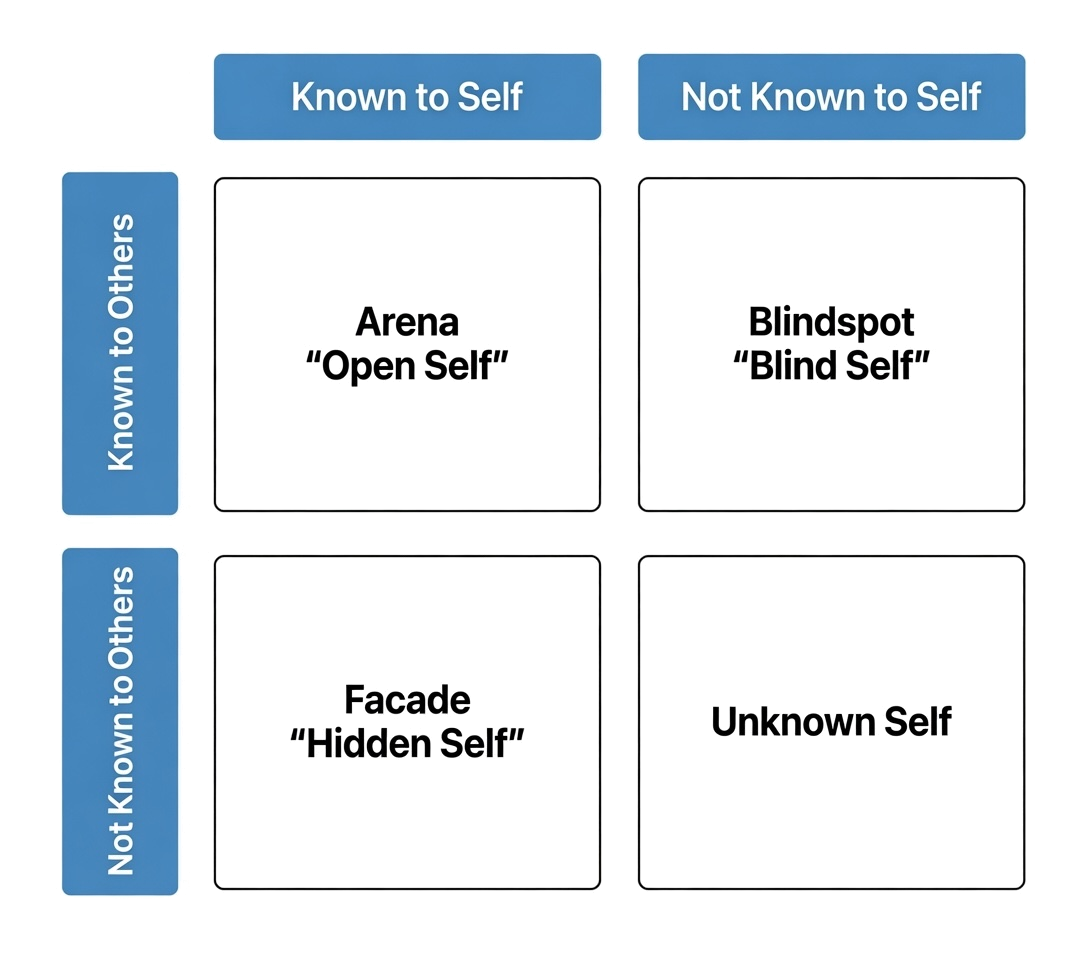
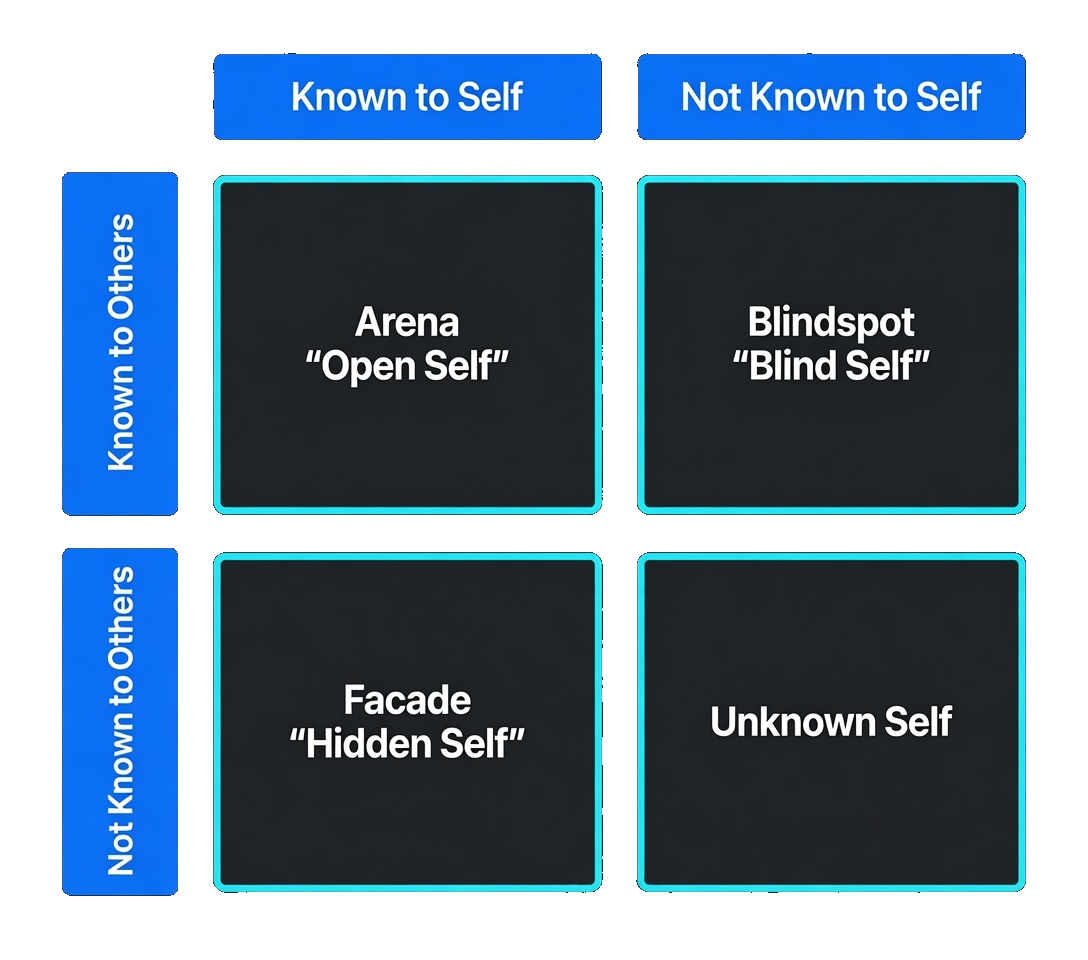
The Johari window: a 2 × 2 grid mapping self-awareness against external observation. The instructor's blind-spot quadrant is the one only trainees and peers can shrink, by criticism received as a gift.
The Johari window as a model for thinking about feedback and self-awareness:
| Things I know about myself | Things I do not know about myself | |
|---|---|---|
| Things others know about me | Public area | Blind spot (what they think about me; minimise it; ask for criticism; want all the information about me) |
| Things others do not know about me | Hidden area | Unknown / unfulfilled potential |
The framing is direct: "Criticism is a gift." The blind spot is the area an instructor cannot reduce alone; only by asking for criticism (from trainees, peers, training department) can the blind spot shrink.
Giving criticism: the five-stage protocol
A protocol for giving criticism, applicable to the instructor's debrief and to the instructor's own development conversations:
1. Preparation
- Who: the right person, and are they ready to receive the criticism.
- What: it should be about their behaviour and not the person, and only behaviour that can be changed. Be specific about what they are actually doing. Think of examples.
- Why: criticism is a gift, which must be for the benefit of the receiver and not a release for the giver. Be clear about what you really want; ask yourself if it is reasonable and achievable. Think about consequences if they say no.
- Where: choose an appropriate place. Set them up to receive it well.
- When: choose an appropriate time but as soon as possible after the event.
- How: this needs to be done assertively. Avoid making vague insinuations or direct personal attacks. Think positively, acknowledging that the other person has the right to be treated with respect as well as all their other rights, but you also have the right to express your opinion and to ask for a change.
2. Delivery
- Describe their behaviour. Avoid vague generalised statements ("That approach was a complete mess"); make clear specific statements instead ("When you don't respond to advice that I offer you...").
- Describe its effects. Express how you feel about their behaviour or how it affected you or others ("I feel concerned that you might not progress as quickly as possible").
- Check awareness. Open up the discussion and check the other person's understanding ("Had you realised?", either that they had not responded or the effects).
3. Discuss their views, look for solutions and any compromises
Normally their response is positive. If not, ask why they are behaving in that manner, why they prefer their way, and why it is important to them. Stay assertive: manage your tone and body language. If appropriate, ask what they might do differently to achieve the same result. Be clear what you want ("I'd like you to use the advice I give you, or ask if you don't understand"). Look for compromise and offer support, but reaffirm what you would like them to do.
4. Describe the consequences
If you have reached an agreement, state clearly what the outcome of their new behaviour will be; it will be positive ("I'm sure this will improve your performance and will make the training more enjoyable").
However, if there is no agreement, you will need to let them know the negative consequences ("If you do not respond to my advice, it will be difficult for me to continue with your training").
5. Summarise
The points that you have agreed: "Are you clear that is what will happen?"
Connections
- 10.1 Human Behaviour. Frames the human-behaviour material; the instructor / learner relationship there is the substrate the triangle above operationalises. The Performance-Influences model figures embedded there give the instructor the analytical frame the assertive-behaviour protocol delivers.
- 10.2 The Trainee. The defence-mechanism analysis; the over-abundance failure (excessive tact, excessive solicitousness) is what reinforces the trainee's defence mechanisms rather than dissolving them.
- 10.3 Learning Styles. The four-type taxonomy the instructor calibrates to; the assertive posture from the EBT instructor handbook is the instructor's own behavioural posture across all four trainee types.
- A4.B.1 EBT Introduction. The full textual treatment of the behavioural complement summarised here: human-factors model, behaviour, listening, Johari window, giving criticism.
- 7.2 Role of an Instructor. The companion section on the instructor's role in the debrief; the personal qualities catalogued above are the qualities that section assumes.
- 7.3 General Debrief Techniques. The active-listening, silence, and questioning toolkits operationalise the LISTEN acronym at the debrief table.
- 12.2 Instructor Competencies. The formal instructor-competency framework that the personal-qualities list informally maps onto.
- Facilitation. The primary instructional technique the assertive posture supports.