
2.7 Human Information Processing and Memory
Human information processing closes the learning-theory cluster with the cognitive-architecture model that applied instruction and debrief technique rest on. The Human Information Processing (HIP) model decomposes the process by which a stimulus from the outside world is detected, attended to, perceived, decided about, stored, retrieved, and acted upon. Every instructional technique from 3.1 Introduction onward (questioning, pacing, repetition, demonstration, briefing structure, debrief technique) is a way of accommodating one or more constraints of this architecture.
2.7.1 A functional model for information processing
Information processing is usually described in the form of a functional model or flow chart, which shows the relationship between the various elements involved in perceiving and acting upon an outside stimulus.
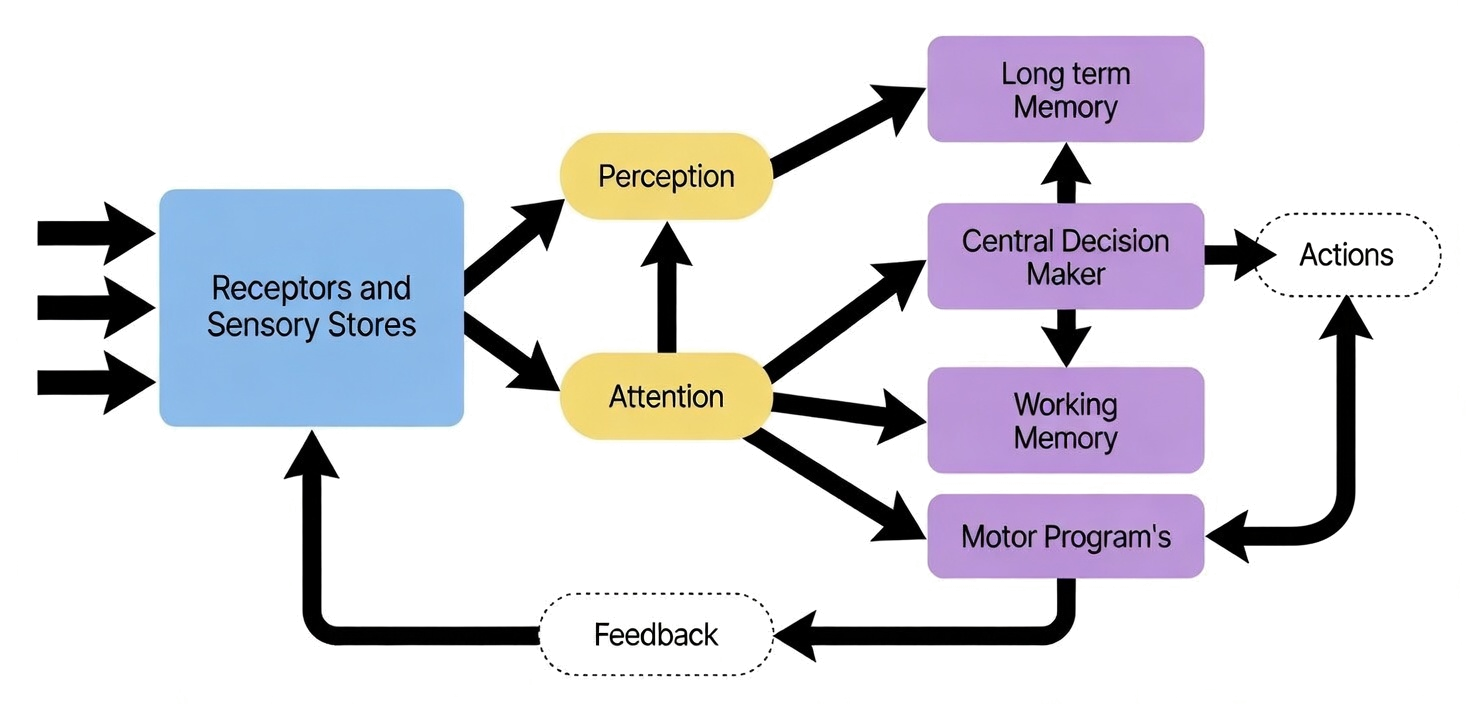
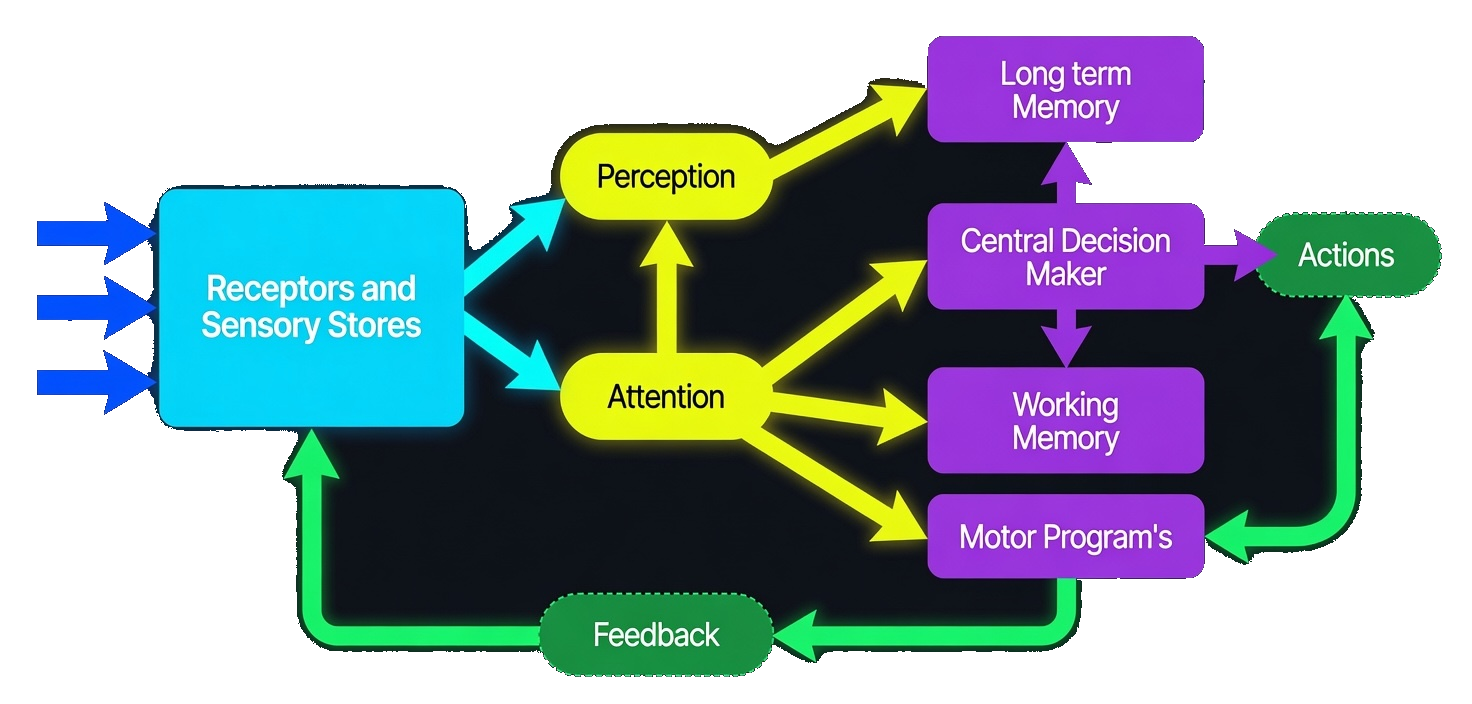
Figure 2: The Human Information Processing Model.
The model shows sensory inputs entering the receptors and sensory stores at the left, splitting into attention and perception, feeding into the central decision maker (which has two-way connections to long-term memory, working memory, and motor programmes), producing actions at the right, and looping back through feedback to the sensory inputs. The architecture is the working version of what cognitive psychology calls the multi-store memory model (Atkinson and Shiffrin 1968) extended with attention and motor-programme components from the Wickens-style HIP literature.
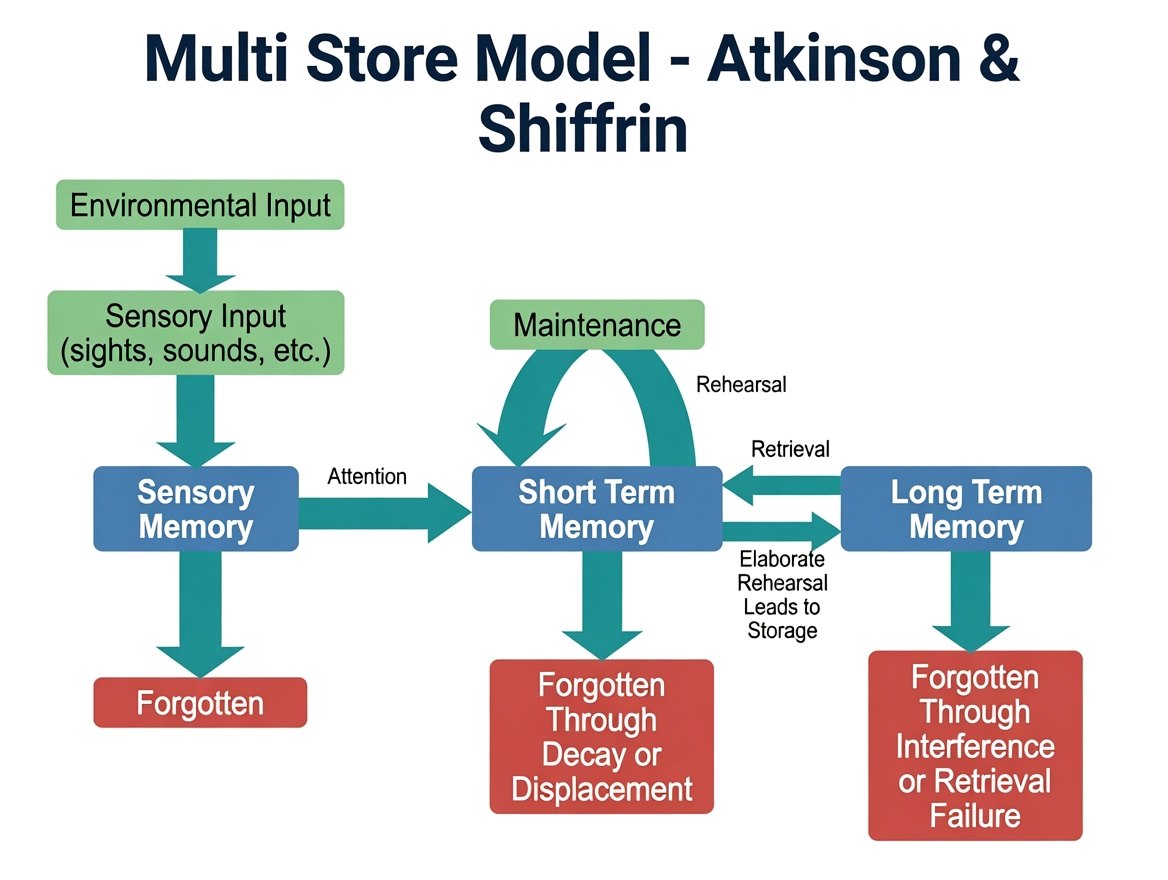
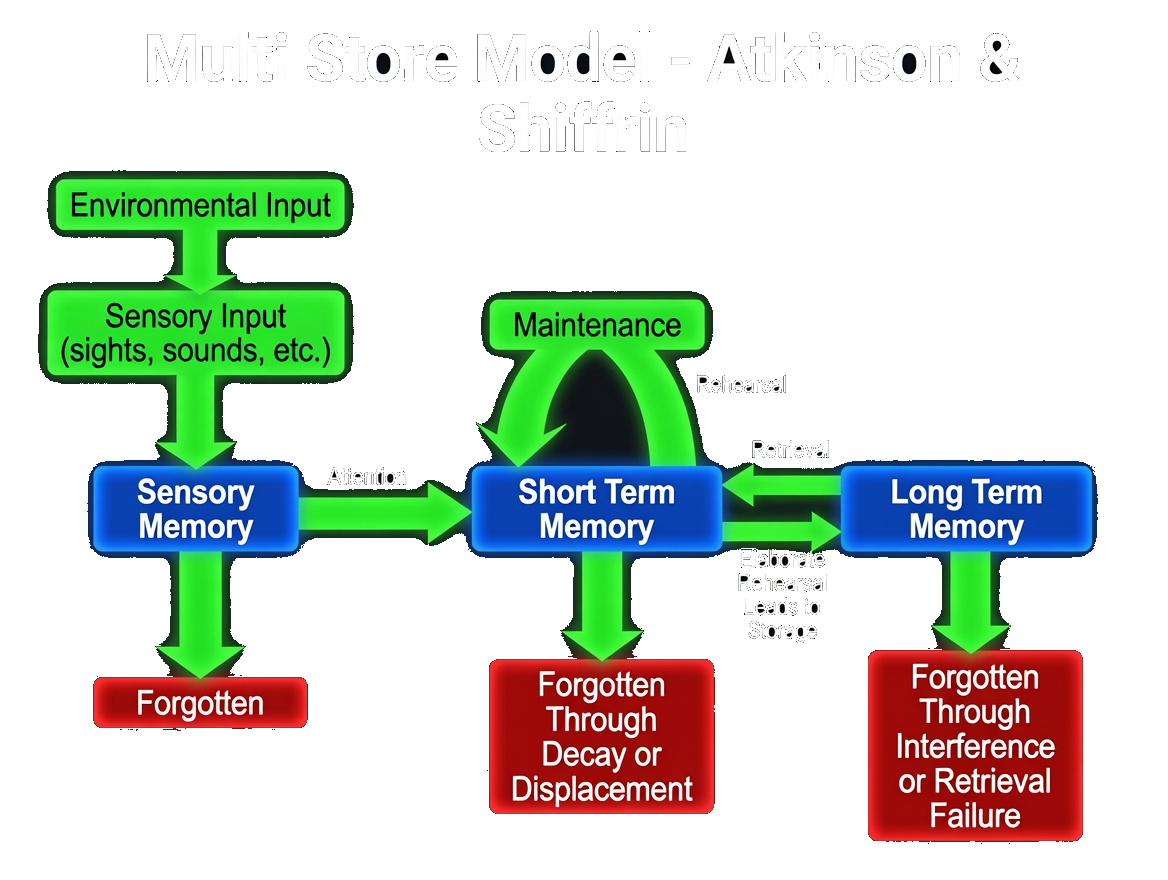
The Atkinson-Shiffrin multi-store memory model: sensory input enters the sensory register, attended content moves to short-term (working) memory, and rehearsed content transfers to long-term memory. The HIP figure above extends this classical model with attention, central decision making, and motor-programme components.
Sensory inputs
The sensory inputs to the system arrive in the form of visual images, sounds, touch, etc., and are received by sensory receptors (eyes, ears, etc.). Each receptor has a separate sensory store or memory in which the "image" is held for a very brief period until the process of attention comes into play.
| Sensory store | Approximate duration |
|---|---|
| Visual (Iconic) Sensory Memory | 0.5 to 1 second |
| Auditory (Echoic) Sensory Memory | 3 to 8 seconds |
The two stores have different durations because they serve different perceptual functions. Iconic memory holds a near-photographic snapshot of the visual scene for under a second so that the brain can integrate successive saccades into a continuous percept; the trade-off is that the snapshot fades fast. Echoic memory holds a longer trace of the auditory stream because speech and other auditory signals unfold over time and the brain needs to hold the early parts of an utterance until the late parts arrive.
Attention
Only a fraction of the sensory inputs to which we are constantly subjected proceed any further. In order for them to be processed, they have to trigger our attention. We can see this procedure in operation in the way we "filter out" RT messages: we generally tune ourselves to respond to our own flight number. Although all RT is heard, and will be stored briefly in the echoic memory, not all of the messages we hear will trigger the attention mechanism.
Occasionally, we may realise that a message is intended for us after some or all of it has passed. It is then possible to "replay" the part of the message that is still in the echoic memory.
2.7.2 Human information processing
Perception
Once the information has been detected and our attention has been triggered, the next link in the chain involves perception of the information. Perception can be described as the process by which the raw data is given meaning.
Mental models
The perceptual process depends heavily on our ability to create a mental model of the outside world, based on past experience. For example, RT exchanges are largely incomprehensible to the lay person; a pilot is able to perceive RT because he has a mental model built up from years of experience in dealing with distortion, foreign accents, etc. Above all, pilots have strong expectations concerning the potential content of an RT message.
There is, of course, an inherent risk of error when situations differ significantly from our mental model. To take one example, all of us have a mental model of the point commencing the landing flare. This depends in part on the image of the runway edge in peripheral vision. The runway perspective and peripheral cues that fit our standard mental model may not appear until a lower height, by which time we have already buried the wheels in the concrete.
Mental set
An inappropriate mental model is sometimes called mental set. This applies to situations where our expectations and preconceptions are so strong that we ignore or reject information that conflicts with our model.
Central decision making
Once the information has been perceived, it is passed to the central decision maker. The information may then be used to initiate an immediate response, or it may require further processing by the gathering of additional information into and out of memory. Decision making is discussed in greater detail elsewhere in the course; at this stage human information processing material examines in more detail the process by which information is stored and retrieved.
The central decision maker is the executive of the architecture: it allocates attention, retrieves from memory, evaluates options, and dispatches actions. Its capacity is limited (one demanding task at a time, broadly speaking). Most of pilot training, in cognitive terms, is the work of moving routines out of the central decision maker (where they are slow and capacity-consuming) into motor programmes (where they are fast and capacity-light) so that the central decision maker is freed up for the higher-order work of monitoring, anomaly recognition, and decision making.
2.7.3 Memory
Working memory
Working Memory (sometimes called Short Term Memory) is a temporary storage system for information of transitory nature. For example, a frequency heard on the RT and stored in the working memory is severely limited in capacity and time:
The limited capacity of working memory is easily demonstrated. Try memorising the following letters:
FMSCAAIBMBMWUSA
Unless you have spotted the groupings, you are unlikely to recall more than 7 individual letters. You can improve the situation by chunking the information:
FMS-CAA-IBM-BMW-USA
You have now reorganised the original list into 5 discrete "chunks" which now lie within the span of working memory.
Long-term memory
Long-term memory is where all our knowledge and experience of the world is retained. To use a computer analogy, long-term memory is the equivalent of the "hard disc" where programs and data are permanently stored. The information in long-term memory can be classified into two types: semantic memory and episodic memory.
Semantic memory
Semantic memory is our memory for meaning and meaningful relationships. It includes all knowledge for things we are able to do, e.g. understanding a word or knowing an item on a checklist. It is generally thought that once information has entered semantic memory, it is never lost. When we are unable to remember an item (e.g. a word) it is because we are unable to locate the word in the memory system, and not because the word has been permanently lost from the store.
Episodic memory
Episodic memory is our memory for specific events, e.g. a particular flight or an incident on the flight deck. One of the most important features of episodic memory is that the information does not remain static, but is heavily influenced by our memory of what should have happened. Recollections from episodic memory are thus influenced by mental models. This has obvious implications for debriefing in a training scenario, for accident investigation, and the like.
Episodic memory is also more prone to the common forms of amnesia. A shock or trauma may well prevent recall of events (episodic) but is unlikely to affect the store or basic knowledge of the world (semantic).
Motor programmes
The learning of skills involves practice and repetition leading to a reduction in the amount of central processing capacity required to monitor the task. Piloting skills depend heavily on the development of complex behavioural sub-routines or motor programmes, which may not require continuous conscious control, but do require conscious monitoring. This frees up spare capacity in the central decision maker for other tasks. For example, it is possible to fly (using motor programmes) whilst maintaining a conversation (using the central decision maker); however, if the flying becomes difficult, then the central decision maker has to be devoted to it, and conversation stops.
The ability to run motor programmes concurrently whilst the central decision maker attends to other tasks has obvious advantages. However, it can lead to particular types of error referred to as action slips. These tend to occur at the initial stage where an incorrect or inappropriate motor programme is triggered.
The 737 example is the textbook case: similar stimulus (intermittent tone) triggers the wrong but well-rehearsed motor programme (cancel the gear warning) instead of the correct but less-rehearsed response (recognise the cabin altitude warning and don the oxygen mask). Action slips are the dark side of motor-programme automation: the same automation that frees up the central decision maker also embeds responses that can be triggered by the wrong stimulus.
A practical worked example: Master Caution / Left Pack Temp
A Task 2.7 worked example traces a simple sequence of events involving a Master Caution / Left Pack Temp through the HIP model:
| Stage | What happens |
|---|---|
| Reception | Before responding, you must first detect a change in your environment. You will only see the Master Caution if it is in your field of view at the time (i.e. you are not looking around at the No. 1) but you hear the beeper. |
| Attention | Having detected a change, you must now give the light your attention. The positioning of the light and the emphasis placed during training on response to a Master Caution will ensure that the central decision maker will allocate a high enough priority to pay attention. A failure of attention, due for example to a heavy workload or distraction, will delay this process. |
| Perception | The process of perception gives meaning to what you observe. You see an amber light but perceive a Master Caution. We depend on mental models built up through training and past experience to attach meaning and significance to what we see. |
| Decision making | The perceived Master Caution is stored in working memory while the central decision maker processes the information. To do so, it has to gather all other relevant information and must access long-term memory. |
| Long-term memory | You search through long-term memory for information relevant to a Pack Temp e.g. "Do I turn the temperature up or down? Can't remember" = failure of long-term memory. However, years of training assert themselves; you resort to rule-based behaviour and call for the checklist. |
| Action | "QRH Checks please, Air Conditioning / Pack Temp." |
The worked example bridges the theoretical model into the cockpit. Each stage in the HIP model corresponds to a specific perceptual or cognitive event in a real flight-deck sequence. An instructor who can read a trainee's performance against the stages can locate where in the chain the failure (if any) occurred: a delayed reaction is an attention failure; a wrong-system identification is a perception failure; a wrong action chosen is a decision-making failure; an execution slip is a motor-programme failure.
How HIP lands in instruction and debrief
The HIP architecture, the working-memory limit, the motor-programme construct, and the episodic-memory finding all turn into specific instructional consequences:
| Constraint | Where it lands in the cluster |
|---|---|
| Sensory store decay (≤1s visual, ≤8s auditory) | Briefing pacing; checklist call-and-response timing |
| Selective attention | Briefing structure; the discipline of one topic at a time |
| Mental models and mental set | Training on anomaly recognition; the explicit "expect the unexpected" framing in non-normal training |
| Working memory ≤7 chunks, ≤10-20s | Procedure design (chunked); briefing length; the limit on how much new information one session can introduce |
| Long-term memory storage (semantic versus episodic) | Repetition and rehearsal as instructional technique; the role of practice in moving content from short-term to long-term store |
| Episodic memory's reconstructive nature | The use of video playback in the debrief; triangulation of trainee account with instructor observation |
| Motor programmes and action slips | The need for distinctive stimulus design; the diagnostic responsibility to classify errors as skill / rule / knowledge (see 2.3 Behaviour) |
The 7.3 General Debrief Techniques is the most direct downstream consumer: every facilitation technique in the debrief toolkit (questions, silence, active listening, video) is a workaround for a specific HIP constraint. Silence after a question gives the trainee's working memory time to retrieve from long-term memory; active listening builds the trust that lets the trainee surface uncomfortable episodic recollections without managing their image; video playback supplies the independent record that the trainee's reconstructive episodic memory cannot.
A4.B.3 Human Factors Model reinforces the same model with its "Human Factors Model" (the Direct factors, Potential factors, and Managing factors layered diagrams), which is the same architectural insight applied at the performance-influences level. Where the HIP model decomposes the cognitive plumbing, the Human Factors Model decomposes the situational factors that shape what the cognitive plumbing produces. The two models are complementary: the HIP model says "this is what the brain does"; the Human Factors Model says "these are the conditions under which the brain does it well or badly." Both are needed for the full diagnostic picture.
Connections
- 2.6 Perception and Understanding. The previous section, which covered perception at a higher level than the architectural decomposition here.
- 2.3 Behaviour. The skill / rule / knowledge taxonomy of the behaviour the HIP architecture produces.
- 2.2 The Learning Process. The repetition and rehearsal mechanisms that move information from working memory to long-term memory.
- 2.4 Motivation. The motivation force that determines whether the trainee allocates attention in the first place.
- 7.3 General Debrief Techniques. The downstream consumer of the HIP findings; the facilitation toolkit is built around HIP constraints.
- Threat and error management. The competency-management discipline that operates within the HIP architecture's limits.
- Core competencies. The framework that includes monitoring (an attention competency), workload management (a working-memory competency), and situational awareness (a perception-and-mental-model competency).